Content
09 September 2026
318
20 min
0.00
Magento vs Shopify: What to Choose for Your Store?

Alina Yarova
Content
Magento and Shopify address the ecommerce challenges in very different ways. One platform offers virtually unlimited customization and flexibility, while the other prioritizes ease of use, rapid deployment, and streamlined store management. In this article, we compare the two platforms, examine their core capabilities and technical differences, and help you determine which solution is the better fit for your business: Magento or Shopify.
Magento vs Shopify: Comparison Table
| Platform | Magento (Adobe Commerce / Magento Open Source) | Shopify |
| Platform Types | Open Source (self-hosted) or Adobe Commerce | SaaS (cloud-based) |
| Ease of Use | Requires technical knowledge or a development team | Intuitive interface, suitable for users without technical experience |
| Cost | Open Source is free, but you have to pay for hosting, development, support, and integrations. Adobe Commerce needs an enterprise license | Monthly subscription (from Basic to Plus); hosting is already included |
| Web Hosting | Selected and managed by the store owner | Included in the subscription price |
| Customization | Virtually unlimited thanks to its open-source nature | High, but limited by Shopify's architecture and API |
| Scalability | Suitable for large catalogs, international stores, and B2B projects | Scales well for most D2C and SMB businesses; Shopify Plus is for enterprise businesses |
| SEO | Full control over URLs, metadata, site structure, and technical SEO | Good basic SEO capabilities, but certain technical aspects have limitations |
| Performance | It depends on the server configuration and optimization | Optimized "out of the box" thanks to cloud infrastructure |
| Safety | Liability of the store owner or hosting provider | Shopify handles updates, PCI DSS compliance, and basic security on its own |
| Integrations | Any integrations via APIs and modules | A vast App Store with thousands of ready-to-use apps |
| Support | Community Forums (Open Source) or Adobe Commerce Support | Official 24/7 support for all paid plans |
| Store Launch Date | From a few weeks to a few months, depending on the complexity | From a few hours to a few days |
| Who is it for? | Large businesses, B2B companies, and companies with complex sales processes or specific requirements | Small and medium-sized businesses, D2C brands, and companies looking to enter the market quickly |
What is Magento (Adobe Commerce)?
Magento is one of the most powerful ecommerce platforms, making it a popular choice for mid-sized and enterprise businesses. It enables companies to build highly customizable online stores and manage operations through a single interface.
Launched in 2008 as an open-source solution, Magento gives merchants complete control over their store's functionality, design, and infrastructure. In 2018, Adobe acquired Magento and integrated it into its digital commerce ecosystem. Today, the platform is available in two main editions:
- Magento Open Source is the free, open-source edition. It allows businesses to deploy, customize, and maintain their stores independently, making it a cost-effective solution for companies that need flexibility without enterprise-level features.
- Adobe Commerce (formerly Magento Commerce) is the commercial edition designed for larger organizations. It includes advanced capabilities such as AI-powered merchandising, B2B functionality, personalization, analytics, cloud services, and dedicated support from Adobe.
Pros of Magento (Adobe Commerce)
- Magento Commerce includes built-in enterprise functionality, such as B2B tools, customer segmentation, advanced promotions, merchandising capabilities, and analytics, designed for large-scale ecommerce operations.
- Built on Magento Open Source, Adobe Commerce offers extensive customization options that enable companies to design complex workflows, create unique business models, and tailor their online store to their business vision.
- AI-powered and personalization features. Magento includes Adobe Sensei-powered capabilities, personalized shopping experiences, product recommendations, and advanced merchandising tools.
- Magento Commerce offers a strong ecosystem and integrations with other Adobe Experience Cloud products, as well as ERP, CRM, PIM, payment providers, and third-party business systems.
Cons of Magento (Adobe Commerce)
- Deploying a Magento store, configuring it correctly, maintaining its infrastructure, and managing ongoing updates typically requires a team of experienced specialists or a dedicated agency.
- In addition to the license, you need to factor in costs for hosting, development, technical support, and security. Below, we explore this issue in greater detail.
- Based on the points mentioned above, launching a store on Magento typically takes more time than setting up a store on a cloud-based platform like Shopify.
- For companies with simple product catalogs and standard ecommerce requirements, Magento Commerce may offer more functionality than they actually need.
What is Shopify?
Shopify is a cloud-based (SaaS) ecommerce platform that allows you to quickly set up an online store and easily administer it. Thanks to its “cloud-based” nature and subscription model, Shopify users immediately gain access to a server, hosting, updates, security, and basic tools for managing online sales.
Most Shopify-based store features can be customized without involving developers. In addition, you can easily connect thousands of apps from the Shopify App Store.
For large companies, Shopify also offers Shopify Plus, an enterprise solution that supports international commerce, process automation, and provides a higher level of customization.
Pros of Shopify
-
- Shopify lets you set up a simple online store in just one day of productive work. It is literally one of the best ecommerce platforms for small business.
- Shopify's user-friendly interface allows store owners or marketers to set up their store on their own and manage the necessary processes.
- A vast ecosystem of apps and integrations helps businesses quickly add new functionality, automate processes, and connect their stores with external services.
- Reliable performance thanks to the Shopify cloud infrastructure.
Cons of Shopify
- Compared to Magento, Shopify business owners are significantly limited in their capabilities, so it is impossible to integrate a complex business model or numerous communication workflows.
- Many of Shopify's features are implemented through integrated paid apps, which increases monthly costs.
- Less control over the technical aspects.
- In addition to the subscription fee, certain Shopify features may require additional paid apps or fees for using third-party payment gateways.
Magento vs Shopify: Ease of Use and Setup
Shopify operates on a Software as a Service (SaaS) model, so users just need to sign up for the platform, choose a template, add products, and set up shipping and payment methods. That's how your simple Shopify store is ready to go in just one day.
Magento (both versions) involves a much more complex implementation process. The store owner must handle key technical configurations and arrange for a development team or certified partner to be brought on board. Magento Open Source is more flexible in terms of customization, while Adobe Commerce has many complex, proprietary features.
At the same time, Magento's more complex configuration is offset by full control over the store's architecture and the ability to implement virtually any business logic.
Magento vs Shopify: Pricing and Total Cost of Ownership
The Total Cost of Ownership (TCO) of an ecommerce platform includes licensing or subscription fees, expenses related to hosting, infrastructure, development, design, themes, apps, integrations, maintenance, security, and ongoing technical support. Let’s take a closer look at each of these factors for both Magento and Shopify.
License and Pricing Plans
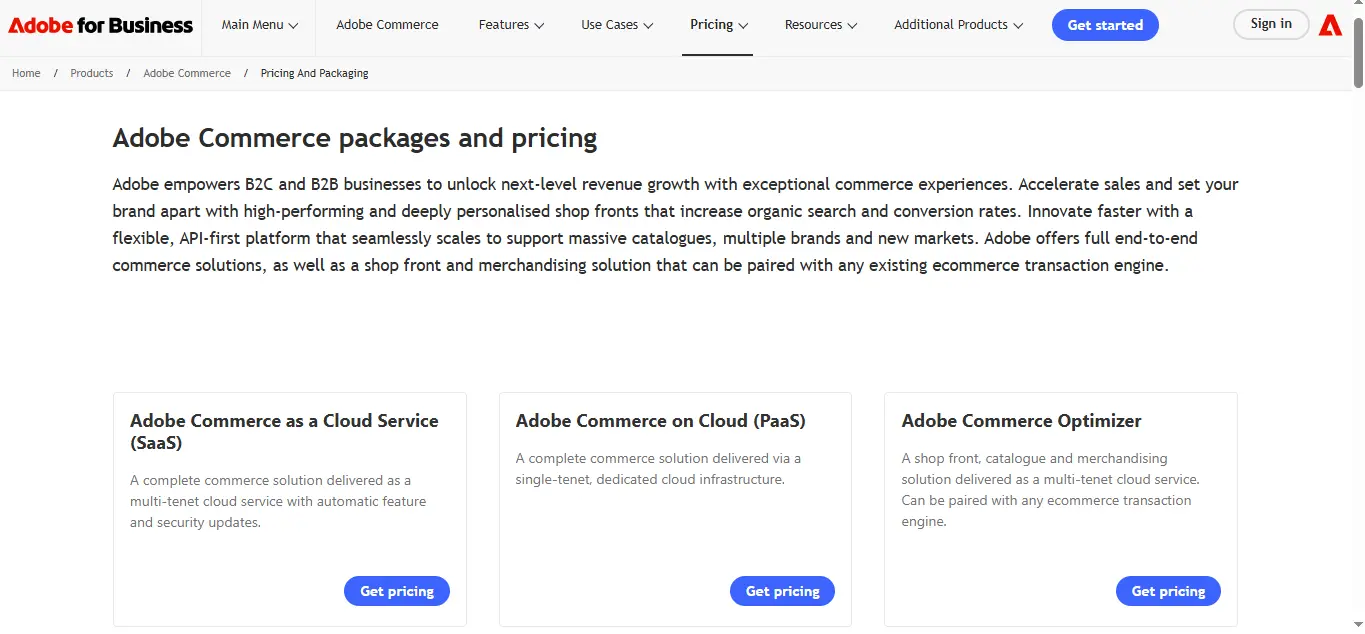
Magento Open Source is available for free, but users must pay for hosting, development, technical support, updates, and other related costs.
Adobe Commerce is the commercial version of Magento, which offers an enterprise license tailored to your specific needs.
Shopify operates on a subscription model. You get a three-day free trial; after that, you'll need to sign up for a subscription:
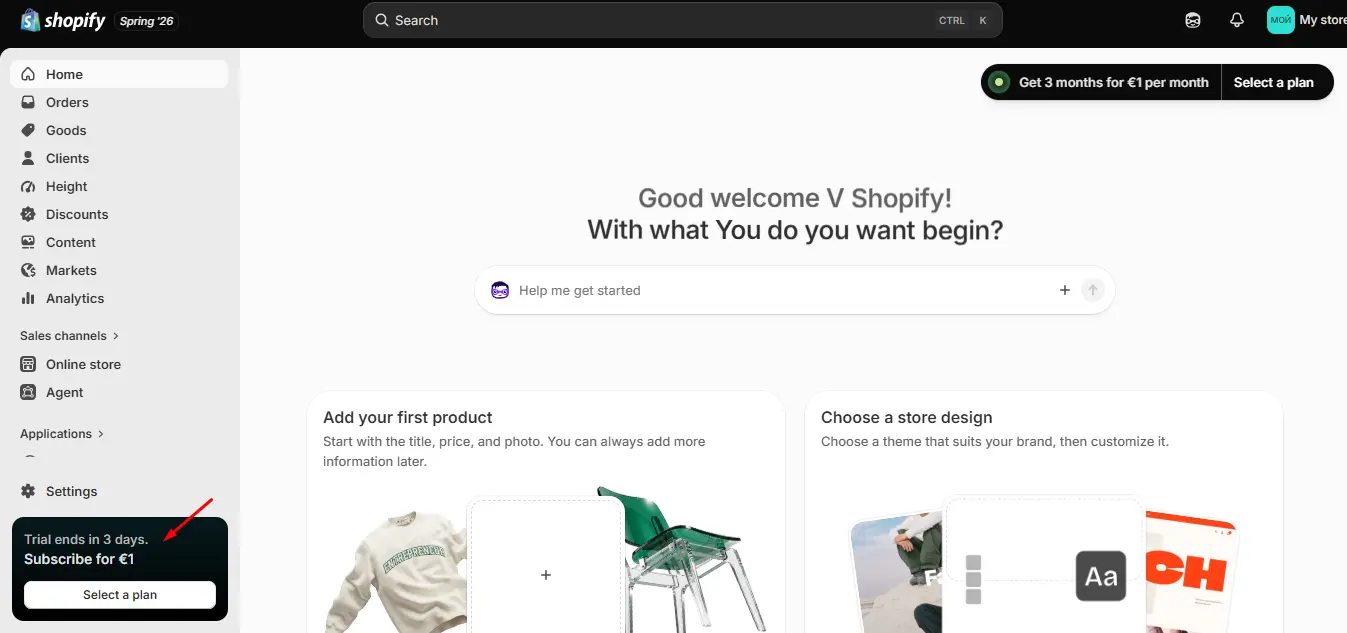
Users can choose from a range of pre-set pricing plans with a fixed monthly fee, and for large companies, the Shopify Plus pricing plan is available, which offers enterprise-level features.
Web Hosting
As mentioned above, Magento Open Source requires separate hosting, which the user selects and manages on their own. With Shopify, hosting is already included in the price of your plan.
Adobe Commerce Cloud provides hosting infrastructure, but businesses still need developers or agencies to manage customization, integrations, updates, and optimization.
Domain
| Shopify | Magento Open Source | Adobe Commerce | |
| Does it come with its own domain? | No (a permanent custom domain must be purchased separately) | No | No |
| Can I connect my own domain? | Yes | Yes | Yes |
| Does it provide a temporary domain? | Yes, the store will be your-store.myshopify.com | No (you need web hosting and a configured domain) | It depends on the environment |
| Who manages the DNS? | Typically, a store or domain registrar | Business/Technical Team | Business/Technical Team |
| Is the domain included in the plan? | No | No | No |
Development and Technical Support
Most Magento projects require a development team or an external integrator.
Shopify is much easier to maintain. Most day-to-day tasks can be done without developer help.
Magento vs Shopify: Design, Themes, and Customization
Design Themes
Shopify has its own Theme Store with themes that are easy to install and don't require complicated setup.
There are numerous paid and free design themes available for Magento Open Source — you can purchase them individually on marketplaces or ask for Magento custom development. Keep in mind that implementing them often requires additional customization or refinement for a specific project.
Since Adobe Commerce is built on Magento Open Source, there are also ready-made themes available for it. However, in practice, large companies often commission custom designs to create a unique style.
Customization
Magento Open Source offers customization flexibility thanks to its open-source code. This allows you to modify both the design and functionality of the platform, enabling even the most complex user interaction scenarios. However, the commercial version of Magento includes certain enterprise features that cannot be customized.
Shopify also supports design customization through its theme editor, the Liquid template language, and apps. However, it’s important to note that Shopify offers fairly standard solutions, so complex ideas will be much harder to implement.
Magento vs Shopify: Features and Sales Tools
Catalog Management and Inventory
Shopify offers an easy-to-use system for managing products, collections, variants, and inventory for stores with a small or medium-sized product selection.
Magento supports complex product structures, advanced attributes, flexible inventory management, and more. Both versions of Magento are good for complex ecommerce.
Checkout and Order Management
Shopify offers a streamlined checkout experience with a range of built-in customization options. While it covers the needs of most ecommerce businesses, its checkout and order workflows are more standardized than those of Magento.
Magento provides significantly greater flexibility, allowing businesses to customize the checkout process, implement complex business logic, and support advanced ecommerce scenarios.
Payments and Shipping
Shopify provides businesses with basic capabilities to offer their customers popular payment systems, basic shipping settings, etc.
Magento, among other things, offers comprehensive rules, support for multiple warehouses, and the ability to organize out-of-region shipping.
Multichannel Selling
Shopify has a built-in Shopify POS system, which helps sell through social media, marketplaces, and brick-and-mortar stores. This is one of Shopify's major advantages, as Magento lacks built-in POS functionality and typically requires integration with third-party POS solutions for in-store sales.
Magento vs Shopify: SEO and Marketing Capabilities
SEO Features and Optimization
Shopify provides basic SEO features, such as editing meta titles and descriptions, automatic sitemap generation, and image optimization. It also offers straightforward content management, making it a strong option among the best ecommerce CMS platforms.
Magento Open Source and Adobe Commerce offer a very high level of control over SEO. However, some of the advanced SEO capabilities are often implemented through extensions.
Marketing Tools and Promotions
Shopify has built-in tools for promo codes, discounts, email marketing, and integration with advertising platforms. Extra features can be added to the Shopify-based store through apps.
Magento supports complex marketing scenarios: customer segmentation, personalized offers, advanced discount rules, and integrations with enterprise systems.
Magento vs Shopify: Performance, Scalability, and Security
Performance and Site Speed
Since Shopify uses a cloud-based infrastructure, it delivers consistent store performance and automatically scales resources as your business grows. As a result, merchants don't have to worry about hosting, server management, or the technical maintenance of their Shopify store.
With Magento, performance largely depends on the quality of the hosting infrastructure, server configuration, and code optimization. If you plan to manage a large product catalog or expect high traffic volumes, it's essential to properly configure and optimize your Magento store.
Scalability and Growth Potential
Magento is a natural fit for companies aiming for large-scale operations, as it offers more opportunities for custom development. Shopify scales easily within its ecosystem, but it may not be able to handle high traffic or complex product systems, and it does not allow for the configuration of complex shipping options.
Security and Maintenance
Shopify handles updates, server security, and platform maintenance. In contrast, Magento requires more attention to security: regular updates, hosting configuration, and technical support.
Businesses using Magento Open Source or Adobe Commerce have greater control over system configuration and security than those using Shopify.
Magento vs Shopify: Apps, Extensions, and Integrations
Shopify and Magento both offer a wide range of third-party solutions, but they differ in their approach to expanding functionality.
Extensions and Apps
Shopify offers both built-in functionality and additional features through the Shopify App Store. Apps are available either free of charge or through paid subscription plans.
Magento also supports extensions, but the platform provides a more comprehensive set of built-in features out of the box. More functionality can be added using free or paid extensions, or developed by Magento specialists.
Business System Integrations
Shopify integrates easily with popular marketing, payments, shipping, and sales management services.
Magento is better suited for complex integrations with enterprise systems, such as ERP, CRM, and PIM, when a business requires a high level of control.
Which Platform Is Right for Your Store?
The choice between Magento and Shopify depends on the size of your business, startup capital, and tech and scaling needs. Shopify suits small businesses with a quick launch and easy management, while Magento suits complex projects with advanced features.
Small Business
Choose Shopify because of:
- quick store setup;
- easy management of products and orders;
- ready-to-use sales and marketing tools;
- low technical costs;
- minimal development requirements.
Growing Store
For rapidly growing stores, the choice between Magento and Shopify depends on the complexity of their business processes.
Choose Shopify if you need:
- a stable cloud-based platform;
- rapid expansion through apps;
- easy management.
Choose Magento if you need:
- a comprehensive product catalog;
- greater control over functionality;
- advanced integrations and customization;
- AI-powered and personalization features.
Enterprise
For enterprises with complex operational requirements, Shopify may not offer the same level of flexibility and customization as Magento or Adobe Commerce.
Choose Magento because of:
- support for large databases and high workloads;
- complex business processes;
- integration with ERP, CRM, and other systems.
How to Grow Sales on Magento or Shopify with Yespo
The Yespo platform is a real powerhouse for marketers and businesses of any size, bringing together everything you need to launch, analyze, and scale campaigns while effectively engaging diverse audiences across 9 channels.
For example, using Yespo CDP, brands can launch email, SMS, and web push notification campaigns, segment audiences, recover abandoned carts, and build automated customer journeys. Customer data enrichment helps businesses better understand their customers and use that information to create more relevant, personalized communications and better website recommendations.
For businesses exploring Klaviyo alternatives, Yespo offers a flexible solution for managing customer data, automating campaigns, and engaging audiences across multiple channels.
Shopify Integration with Yespo
Shopify integrates easily with Yespo through pre-built solutions, allowing for the quick transfer of data on customers, products, and orders. Stores can use this data for personalized recommendations, triggered messages, and marketing automation.
Magento Integration with Yespo
A ready-to-use Magento plugin is currently under development, but once released, it will simplify the setup process and help businesses work more effectively with customer data.
Final Thoughts
After reviewing all the features, pros, and cons of Shopify and Magento, we can confidently conclude that while Shopify helps you get up and running quickly, Magento is well-suited for handling complex processes. If you want simple product management, a straightforward store, and a ready-to-use ecosystem of tools, choose Shopify. Magento is the solution for companies that need maximum flexibility, scalability, and control over complex ecommerce processes.
Whichever ecommerce platform you choose, Yespo can help you turn customer data into personalized omnichannel campaigns. Book a consultation with our experts to explore the best setup for your business.