Content
12 May 2026
1052
21 min
0.00
10 Best eCommerce CMS to Maximize Conversions in 2026

Alina Yarova
Content
Modern ecommerce is no longer limited to a basic online store. It is a complex ecosystem centered on personalization and rapid management of customer data. It is precisely the speed with which a business responds to user actions that significantly impacts sales and, in turn, its ability to adapt and scale in the market.
Of course, at the heart of the management system is the ecommerce CMS, which is designed to help online store owners create a seamless path to purchase — quickly and without unnecessary hassle. Some systems offer everything right away but require time to adapt; others provide a quick start with the option to customize later. But what does your business actually need, and how can you define that early to avoid costly platform changes later?
In this article, we’ll take a look at the best ecommerce CMS platforms of 2026 — the ones that truly help boost conversion rates, streamline processes, and scale without constant quick fixes or compromises.
What is an eCommerce CMS and How Does It Work?
An ecommerce CMS (Content Management System) is a platform that lets you create and manage an online store without requiring custom development at every step. It brings together:
- product catalog;
- the website's visual design;
- admin panel;
- order processing system;
- integration with payment, shipping, and analytics.
At its core, it serves as the store's backbone, a bridge between the business and the customer. Ecommerce CMS shapes the user experience — from page load speed and navigation, to the simplicity of the ordering process. Also, it provides the business with tools for full control over managing content, pricing, analytics, and integrations.
That is why choosing an ecommerce CMS is not just a technical decision, but also a strategic move. It determines how easily customers can complete a purchase and how effectively a business can scale without unnecessary complications.
A well-structured and optimized online store has a significant impact on the repeat purchase rate.
Do You Need an ecommerce CMS in 2026?
The capabilities of an ecommerce CMS literally keep a business afloat. When a user visits the website, the platform displays product data in real time, in a structured format, and ensures a seamless shopping experience from browsing to checkout. This is where the visual layout the user sees is built, and where payment processing, order confirmation, and other operations occur.
Without an ecommerce CMS, the user experience would be fragmented, and it would literally prevent orders from being processed automatically on an ongoing basis. Among other things, you can quickly manage products and promotional offers, connect or disconnect payment systems, view sales and website activity analytics, and more through a traditional CMS. This is actually a very powerful automated feature, without which a business cannot function effectively.
10 Best CMS for ecommerce to Maximize Conversions in 2026
When choosing the best ecommerce CMS, it’s important to evaluate not only the user-friendliness of the interface but also how well the system supports sales, scalability, and marketing. A good platform should do more than just “display products”; it should support the entire lifecycle of an online store — from content management to order processing and analytics.
For your convenience, here is a quick ecommerce CMS comparison of the 10 most popular platforms in 2026:
| CMS | Type | Best for | Key Strengths | |
|
Specialized ecommerce CMSㅤㅤㅤㅤㅤ |
Shopify |
SaaS ecommerce |
Quick launch of an online store |
Simplicity, stability, robust infrastructure |
|
Adobe Commerce (Magento) |
Enterprise ecommerce |
Large, complex stores |
Maximum scalability and customization |
|
|
PrestaShop |
Open-source ecommerce |
Medium-sized online stores |
Free to get started, a wide range of modules, and full control over the code |
|
|
IdoSell |
SaaS ecommerce |
Specialty stores with logistics |
Extensive automation, warehouse/ERP/omnichannel capabilities "out of the box" |
|
|
Shoper |
SaaS ecommerce |
Small and medium-sized businesses (especially PL/EU) |
Easy setup + integrations with marketplaces such as Allegro and Amazon |
|
|
Hybrid CMS Platforms |
WordPress + WooCommerceㅤㅤㅤㅤㅤㅤ |
Traditional/Open-source |
Content websites, blogs, and simple online stores |
The largest ecosystem, flexibility, low startup costs |
|
Webflow (limited ecommerce)ㅤㅤㅤ |
Visual/SaaS CMS |
Design-focused websites |
Design review + clean layout without code |
|
|
Headless CMS* |
Contentful |
Headless CMS |
Omnichannel systems |
API-first, scalability |
|
Strapi |
Headless CMS (self-hosted)ㅤㅤㅤ |
Startups, custom projects |
Full control over the backend |
|
|
Sanity |
Headless CMS |
Content platforms, media |
Real-time editing |
*Content-driven platforms that support commerce through integrations.
Shopify
A highly competitive alternative to WordPress, yet a more independent cloud-based ecommerce CMS. One of the best CMS for ecommerce. The platform provides a ready-to-use system for creating and managing an online store in virtually any business niche. If you're choosing between Shopify and Magento, our Magento vs Shopify comparison can help you understand the key differences between the two platforms.
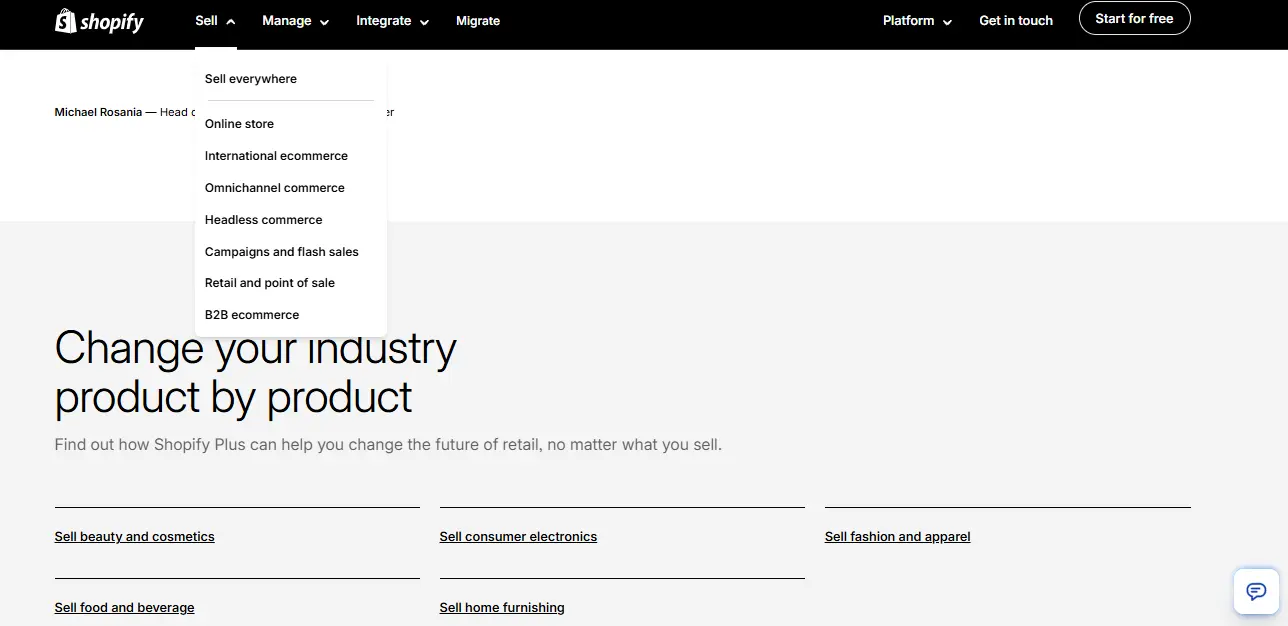
- The user works with ready-made interface elements rather than with code.
- Everything is managed from the admin panel.
- There is virtually no need for development or maintenance.
From a CMS perspective, Shopify’s key feature is its strictly standardized data structure. For example, a product always has fixed fields (price, variations, inventory, SEO description), and the catalog logic is built around collections and filters. This simplifies management but limits non-standard workflows.
The main advantage is operational efficiency, since most features are already integrated “out of the box,” including payments, inventory, and analytics. At the same time, this limits flexibility compared to open-source CMS platforms, as customization depends on the capabilities of the Shopify ecosystem.
Adobe Commerce (Magento)
Enterprise ecommerce CMS, which functions as a fully modular store management system. More powerful than any comparable solution, it allows you to build complex catalog structures, multi-level categories, and various pricing models. Custom development is available.
Key benefits:
- You can set up multiple stores and languages from a single admin panel;
- Robust features for managing products and prices;
- Unlimited possibilities for complex customer interaction workflows — personalization and segmentation tools, long-tail funnels;
- The system supports complex B2B and B2C workflows within a single installation.
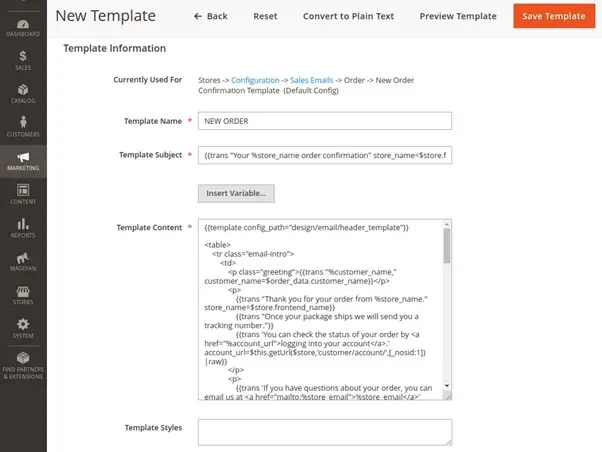
But despite its vast potential, there is a trade-off with such a product: it’s highly complex. To use an ecommerce CMS effectively, you need a dedicated support team and a sufficient budget. If you want to understand the setup process, costs, extensions, and growth options before choosing it, start with our Magento guide. For example, here’s what the email setup looks like:
PrestaShop
An open-source ecommerce CMS platform that is most commonly used by medium-sized businesses. It strikes a balance between control, flexibility, and cost of entry; it offers an optimal set of tools for marketing, SEO, category structure, filters, and extensions.
No technical team is required to use it, as its extensive library allows you to quickly add features without complex development.
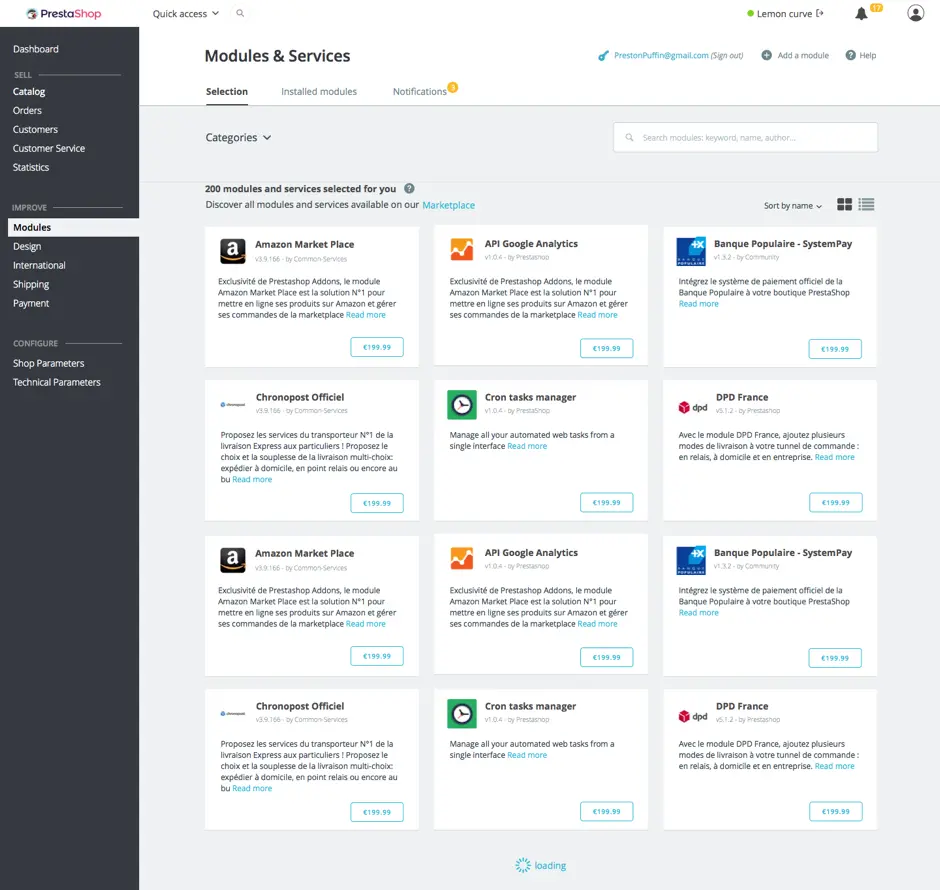
The main drawback of this platform is that the website cannot be paused. The platform’s unstable system requires constant monitoring of updates, modules, and overall system stability. Without this, the system begins to “break down.”
IdoSell
An ecommerce CMS platform designed to manage sales for businesses that are already up and running. It’s a highly marketing-oriented tool, but it makes sense for implementing a proven strategy rather than for testing a marketing program. The focus here isn’t on design or content, but on processes: order fulfillment, warehousing, shipping, and multichannel sales.
The perfect place to manage your entire sales funnel: from traffic acquisition to order completion. The platform integrates seamlessly with marketplaces, advertising, and sales channels, allowing you to scale up without the manual chaos and delays that come with a surge in orders. Another advantage is that the system is highly structured, so nothing gets lost even when traffic spikes.
Shoper
A Polish SaaS ecommerce CMS designed for small and medium-sized ecommerce businesses, particularly popular in Europe. Its main advantage is the ease of setup and extensive capabilities for testing niches and products.
The platform offers ready-made integrations with advertising, marketplaces, payment systems, and delivery services. In fact, you can quickly launch a template-based store and gain access to basic management tools.
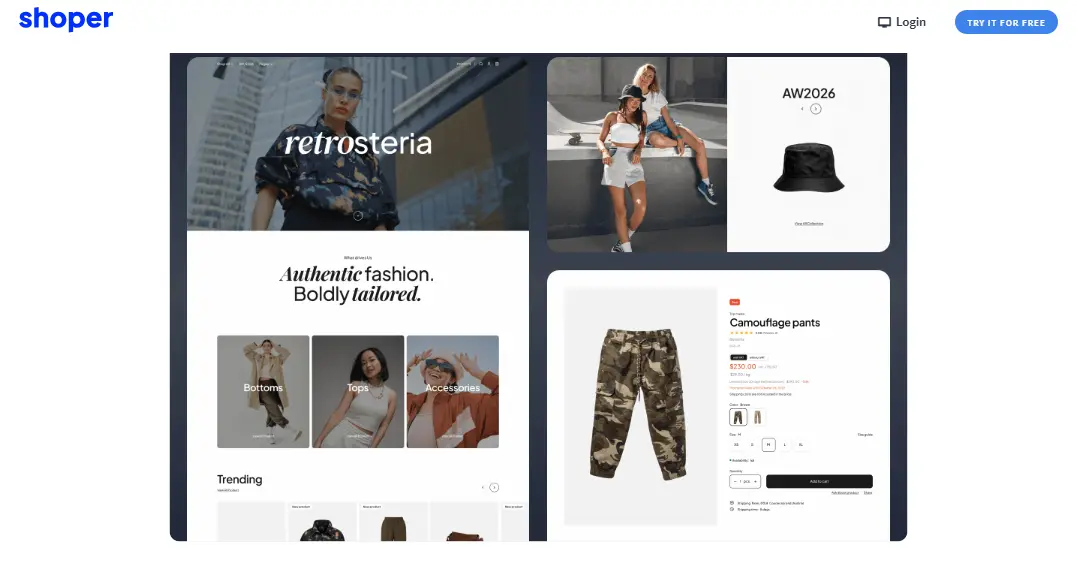
However, the platform isn't very flexible. As your business grows, you may find yourself constrained by the platform limitations. At that point, you might want to switch to something like IdoSell.
WordPress
The most popular CMS in the world, and the first one that comes to mind when you need to manage a website. The platform was originally created for blogs, but has since evolved into a versatile system for websites of any complexity.
WordPress, combined with WooCommerce, turns a content-focused CMS into a fully functional ecommerce platform.
The main advantage of WordPress is its user-friendly interface and versatile ecosystem. Here, you can add almost any functionality using plugins without having to build it from scratch.
CMS also offers many advantages for marketers and SEO specialists, as it makes it easy to build a website structure optimized for search traffic, launch landing pages, blogs, and content funnels, and test various hypotheses. Its out-of-the-box functionality is enough for many projects. Equally important is that users can choose exactly which features they want on the platform and pay only for what they need:
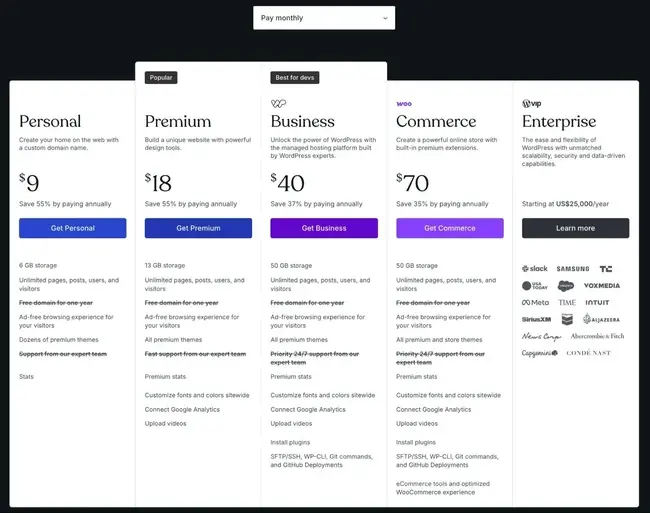
However, if you choose WordPress, you should be aware that you’ll have to manage such number of plugins. Оtherwise, your website can quickly become unstable, with slower load times and potential security issues.
Webflow
A limited ecommerce CMS, better suited for creating landing pages with a small product range, as well as promotional pages. On this platform, you’ll have more control over design, content, basic SEO, and page structure than over payment processes, customer data collection, and so on. Building custom pricing logic is out of the question, but it`s pretty good for creating gamification mechanics.
If you scale up and drive more traffic, this CMS won’t be able to handle it — and you won’t be able to set up complex product filters either. On top of that, the integrations are weaker than Shopify’s.
In short, it's a good marketing tool, but it's not suitable for large businesses. An ecommerce in Webflow is merely an add-on module.
Want to learn how to automate marketing and increase sales in your ecommerce CMS?
Contentful
Not all systems used in ecommerce are designed specifically for sales. Some focus on content management and enable the store to operate through integrations.
Headless CMS platforms function as content management systems that integrate with ecommerce platforms (such as Shopify) or custom solutions. In other words, these platforms simply store and deliver content via an API, while the website itself is built separately.
>> Discover the best ecommerce platforms for small business in our expert article.
One such system is Contentful — a headless CMS that delivers content to websites, mobile apps, and ecommerce platforms. For marketing, it is a powerful omnichannel tool, as it offers centralized content management and scalability across various platforms.
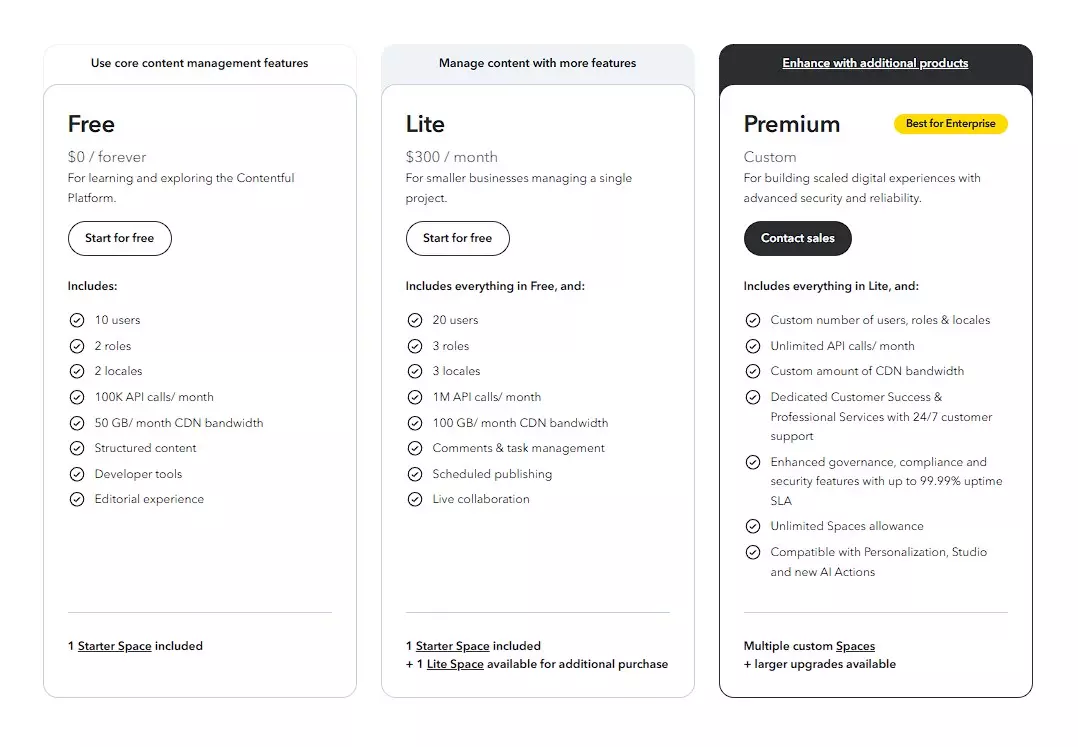
On the downside, the product is more difficult to implement and requires further development.
Strapi
Strapi is an open-source headless CMS that lets you manage content such as pages, blog posts, and SEO metadata. It is most commonly used by startups and custom digital product teams in conjunction with Shopify, Magento, or tailored ecommerce platforms for sales.
On the plus side:
- You can build any content structures, funnels, and integrations;
- It can be installed on your own server.
On the downside: this CMS doesn't work without developers, since it's not a ready-made SaaS solution.
Sanity
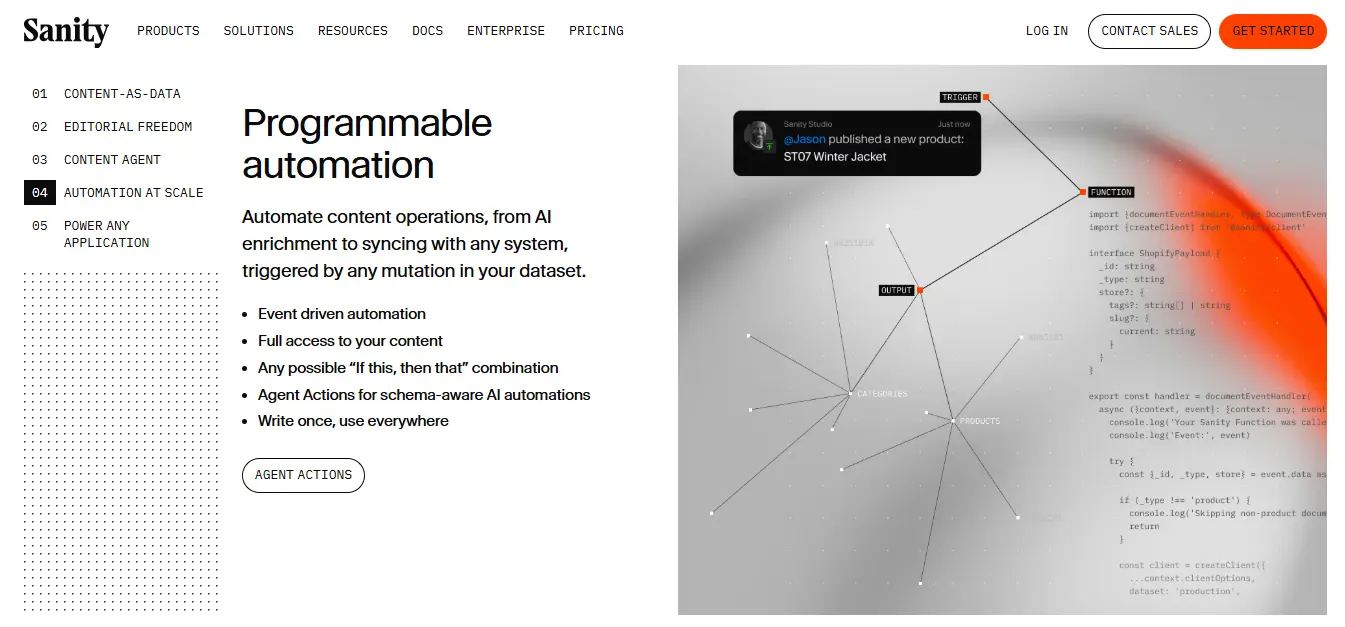
The main advantage of this headless CMS is that it allows teams to work on content simultaneously in real time, set up automated workflows, and much more. For large-scale media projects and content campaigns, this is a huge plus.
This platform is well worth considering for companies that focus specifically on content management. It’s a good fit for businesses where content is constantly updated, and team efficiency is key.
Key Features of an eСommerce CMS to Look For
1. Basic SEO
SEO is a crucial part of a website’s performance, and today ecommerce relies heavily on organic search traffic and SEO. An eСommerce CMS should provide at least basic control over SEO structure — such as URLs, meta tags, headings, redirects, sitemaps, and so on.
2. Flexible and Easy Products and the Catalog Management
If a website sells a significant number of products, managing them should be easy, as this is the foundation of the business. Without the ability to easily create and edit products, variations (size, color), categories, and attributes, managing the store will be extremely difficult. If you have a large store, also consider flexibility when building your product catalog.
3. Checkout and Payments
Another key point: if a customer gets confused during checkout, the purchase won’t go through. Therefore, the payment process must be simple and optimized for conversion. An ecommerce CMS should support multiple payment integrations, including local payment methods, and provide a streamlined checkout process with minimal steps.
4. Easy Integrations
EСommerce CMS must integrate easily with:
- payment systems;
- delivery services;
- CRM and ERP software;
- advertising platforms (Google, Meta);
- marketplaces.
In open-source solutions, this flexibility is often extended through modules and extensions — for example, an OpenCart plugin can be used to connect additional services and customize store functionality.
5. Analytics and Data
If your eСommerce CMS lets you manage products and SEO but doesn’t show you the results, the product isn’t just underwhelming — it’s limiting. That’s why a platform should allow you to track sales, user behavior, conversions, and the effectiveness of marketing channels. The more in-depth the analytics, the easier it is to make business decisions.
6. Wide Marketing Possibilities
Key built-in or integrated features for:
- discounts and promo codes;
- promotions and bundles;
- email marketing;
- personalization of offers.
7. Good Scalability
It doesn't matter if you have a small blog, for example, with just a few products. But if you plan to grow and scale up, you should check whether your eСommerce CMS can handle more products, traffic, and orders without sacrificing speed and stability.
8. The Ability to Control Content
An ecommerce CMS should allow you to manage not only products but also content pages — blogs, landing pages, banners, and SEO pages — to implement your ecommerce business ideas in the best way.
Common Problems an eСommerce CMS Can Solve in Your Store
1. Disorganization in Inventory Management
Without an ecommerce CMS, product management quickly becomes chaotic: inconsistent description formats, duplicate entries, and difficulties updating prices and inventory levels. A CMS centralizes all product data and allows you to quickly edit products and scale your catalog.
2. A Complicated and Slow Sales Process
If the checkout or ordering process is cumbersome, the business loses sales. A good ecommerce CMS helps streamline the customer journey from product selection to purchase, reducing the number of steps and technical errors.
3. Built-In SEO Tools and Organic Traffic Issues
Without a structured CMS, it’s difficult to manage SEO: pages are duplicated, URLs are disorganized, and metadata isn’t optimized. A right ecommerce CMS gives you control over the technical foundation of SEO and the structure of your content.
5. Limited Marketing Opportunities
Without an ecommerce CMS, launching promotions, discounts, and campaigns is time-consuming and often requires custom development. A right platform allows you to quickly create promo activities, test offers, and manage pricing. Properly configured marketing tools enable personalized customer communication, which is essential to success in today's ecommerce landscape.
6. Lack of a Unified Analytics System
Without a centralized system, user data is scattered across various tools. An ecommerce CMS collects so much valuable information on sales, user behavior, and channel performance in one place.
7. The Challenges of Scaling a Business
As the number of products, orders, and sales channels grows, manual management becomes impossible. A CMS allows you to scale your business without a proportional increase in operational workload.
Integrating ecommerce CMS Platforms with Yespo
Modern ecommerce CMS platforms rarely operate as standalone systems. To build personalized customer journeys and automate communication across channels, businesses usually connect them with marketing automation, analytics, CRM, and customer data platforms.
Yespo integrates with popular ecommerce CMS platforms through ready-made plugins, apps, and custom API integrations. This allows businesses to connect their existing store infrastructure with omnichannel marketing automation, customer data management, personalization, and retention workflows without rebuilding the entire system.
As a result, brands can launch campaigns faster, automate lifecycle communication, centralize customer data, and scale marketing more efficiently while continuing to use the ecommerce CMS that best fits their operational needs.
To Sum Up: How to Choose the Right ecommerce CMS for Your Needs
The choice of the best CMS for ecommerce depends not on trends, but on the business's actual needs. You need to consider its stage of development, the complexity of its product catalog, and its plans for scaling. For some, speed of launch is key, for others, flexibility and ease of use, and for others still, stable performance under heavy load.
There is no single “best” platform, but the only one that fits your sales model and marketing strategy. Remember, ecommerce CMS are most effective when combined with enterprise marketing automation and CRM systems that manage customer data and lifecycle communication.
If you want to do more than just choose between ecommerce CMS platforms and try them one by one, if you want to build an effective sales and marketing system around it, the Yespo CDP team is always ready to help you find the right solution for your business and configure it so that it actually drives revenue growth.