Conversion Rate Calculator
Other Calculators
Site conversion is the ratio of the number of users who performed a specific target action to the total number of its visitors. It is customary to measure such an indicator as a percentage; therefore, the resulting division result is additionally multiplied by 100%. Conversion calculations can be performed using a special formula or our convenient online calculator. Do not forget that eSputnik also has its own CPL calculator, CPO calculator, LTV calculator, ROMI calculator, and ROI calculator, online calculations on which are available for free.
Let's review at what types of website conversions exist, how to calculate the conversion from lead to sale and from transition to application, why such calculations are needed, and how to evaluate them.
Conversion calculator: online calculation in seconds
For those who do not know how to calculate conversion as a percentage, an online calculator from eSputnik will be very useful. In just a couple of seconds, you will receive a finished result and you can immediately go to analytics. To calculate your online conversion rate, you need two values:
- The number of users who have visited your site.
- The number of targeted actions from these users.
The calculator will automatically calculate everything and show the result as a percentage. Please note that it can be used to calculate the conversion for any targeted actions of site visitors:
- registration of the application;
- order a call back from the sales department;
- registration on the website;
- filling out lead forms indicating contacts;
- demo request;
- product purchase.
Thus, on our calculator, you can calculate the conversion of the sales funnel at all its stages. This will allow you to assess the quality of the site as a whole and the success of each stage of the funnel, which is important for effective marketing.
How to calculate website conversion manually
If you are not using the Sales & Bid Conversion Calculator, you can manually calculate this conversion rate. To do this, you need the following conversion calculation formula:
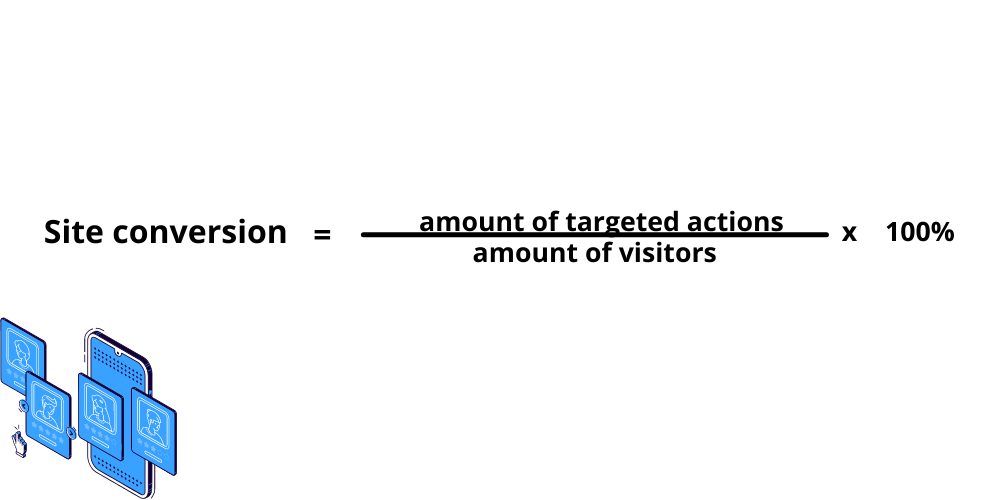
Here's a concrete example of how to calculate website conversion.
- Let's say 25,000 users visited your site in a month, of which:
- 2000 left a request (ordered a call back, filled out a pre-order lead form, requested a consultation or a demo, etc.);
- 5000 just registered on the site and left;
- 1000 paid for the order.
Knowing these indicators, we can calculate:
- conversion to the application - it is equal to 8% (2000/25 000 * 100%);
- conversion to registration - it is equal to 20% (5000 / 25,000 * 100%);
- conversion to sale - it is equal to 4% (1000 / 25,000 * 100%).
Similarly, calculate the conversion to other targeted actions, for example, filling out forms for downloading checklists, taking surveys, writing reviews, clicks on banners with advertisements, etc. For more in-depth analytics, we recommend segmenting the total traffic to the site by channel. Then track which of them resulted in the higher conversion to bid, sale, and other targeted actions that are important for the business. This will help you understand which channel is generating the most targeted leads, and where you should focus your efforts.
What is the calculation of website conversion for?
You need to count the conversion in order to:
- evaluate running advertising campaigns for an increase in targeted traffic and the quality of attracted leads;
- analyze the effectiveness of landing pages and website pages after their SEO optimization, design changes, navigation improvements, adding call-to-action buttons, pop-ups, sidebars, etc .;
- track the dynamics of conversion after changing the offer, introducing a bonus program, discounts and promotional offers, as well as launching new products.
Where to get data for calculating conversion
You can find out the volume of traffic to the site and the number of targeted actions for which you would like to calculate the conversion in Yandex.Metrica and Google Analytics services. To do this, you must first install the counters on the site by writing them in the code. They will calculate the indicators you need, and then automatically transfer them to the specified analytics systems. For convenience and to save time, we recommend setting up special reports in these programs, with the help of which you will quickly get access to the data already collected.
How to evaluate the result of the conversion calculation
It is necessary to evaluate the indicator of this metric taking into account the factors that affect it. Some of them are predetermined from the outset, that is, it is virtually impossible to change them. These include:
- niche - if you sell products that can be purchased in one click, then your conversion to sale will be higher than in areas with a long decision-making cycle;
- regional demand - if you offer products that are popular in a specific region, this will also have a positive effect on the conversion of your site;
- price segment of the offered products - conversions of sites offering expensive goods or services are usually lower than those of those who sell something inexpensive, however, the profits of such companies are usually higher than in the cheap segment;
- competition and its activity - the more worthy competitors you have that are active in the market, the more difficult it will be to achieve high conversions.
vc.ru researched the experience of their colleagues from large companies and shared the average conversion rates for various niches:
- Wholesale - 10-25%.
- Retail - 3-8%.
- B2B Services (for business) - up to 3-7%.
- B2C services (for end customers) - 5-8%.
- Subscription page (infobusiness) - 10-15%.
There are also factors that a business can influence, for example:
- Website optimization. For resources with high-quality content and design, a high level of usability and easy navigation, conversion rates are usually higher than those of simple websites.
- CTA. A lot depends on the call to action. If you know how to hook your audience and actively use it to attract leads, then the conversion to applications should be impressive (taking into account your niche).
- The quality and quantity of traffic. If the marketing budget allows you to attract a large number of users to the site, and its quality is high enough, then you can count on good conversions.
- Product line and its uniqueness. The more products you offer and the more effective your USP, the more likely you are to have good conversions.
- Price. Set an adequate price and offer the best offer, then your conversions will be higher than those of competitors' sites.
- Company image. If you are firmly entrenched in the market and the target audience recognizes your brand, then your website conversions will be higher than those of unknown competitors, and more than they were before you started positioning.
So what is the normal conversion rate? One that suits your business and helps you achieve your sales target. To develop a company, you need to constantly work on increasing conversions. If your site is converting orders and applications today better than it was a month / six months / a year ago, then you are on the right track.
Any Questions?

