Content
12 November 2026
6
22 min
0.00

What Is Agentic Commerce? A Full Guide with Cases

Ivan Diulai
Content
Imagine this scenario: a buyer types "find me running shoes under $120 that work for my flat feet" into their AI assistant of choice. Forty seconds later, he’s presented with three options with prices, delivery dates, and return terms. One tap to confirm the order, paid with a saved card. And this person didn’t browse the store’s website at all.
This is how agentic commerce works, and parts of it are already live. Google, OpenAI, Amazon, Visa, and Mastercard have all built pieces of it over the past year, along with open protocols that let AI agents communicate with stores and payment systems.
This guide covers how agentic commerce works and the protocols that support it. It covers what's live today and what online stores should change as more of the agents browsing their catalogs are AI-powered.
TL;DR
- Agentic commerce is shopping where AI agents act on a person's behalf. They find and compare products and, in some cases, buy them within limits the person sets.
- Today, most of it is agent-assisted. Agents research and build carts while people still confirm the payment. Fully delegated buying exists for narrow cases such as price-drop purchases and restocking.
- It runs on a stack of protocols: MCP and A2A connect agents, ACP and UCP handle commerce flows, and AP2 and card network programs provide payment authority.
- For merchants, the task is practical: accurate machine-readable product data, agent-compatible checkout, and measurement that captures orders placed outside the website.
What Is Agentic Commerce?
Agentic commerce is a model of online buying in which AI agents interpret a shopper's goal, search and assess options across stores, and take actions such as building a cart, placing an order, or tracking a return. The shopper sets the goal and the constraints, such as budget, brand, or delivery date. The agent handles the steps in between.
The difference from a recommendation widget or a support chatbot is initiative. A recommendation bot just suggests, while an agent executes. It plans a sequence of actions, calls external tools, and keeps going until the task is done or it needs a decision from the person. The underlying technology is agentic AI used in buying and selling.
Autonomy comes in degrees. A useful way to interpret these systems is to place them on this ladder:
- Recommendation. The agent researches and suggests. The shopper buys on the merchant's site.
- Cart building. The agent assembles a cart, often across several merchants.
- Approved checkout. The agent completes checkout after the shopper confirms.
- Standing delegation. The shopper pre-approves rules (like, "buy when the price drops below $80"), and the agent purchases without asking again.
- Agent-to-agent transactions. A buyer's agent negotiates directly with a seller's agent.
Most actual products are something from steps 1-3. Step 4 exists in limited form, and fully autonomous agents handling open-ended shopping remain rare. Step 5 is mostly in pilots and specifications.
How Does Agentic Commerce Work?
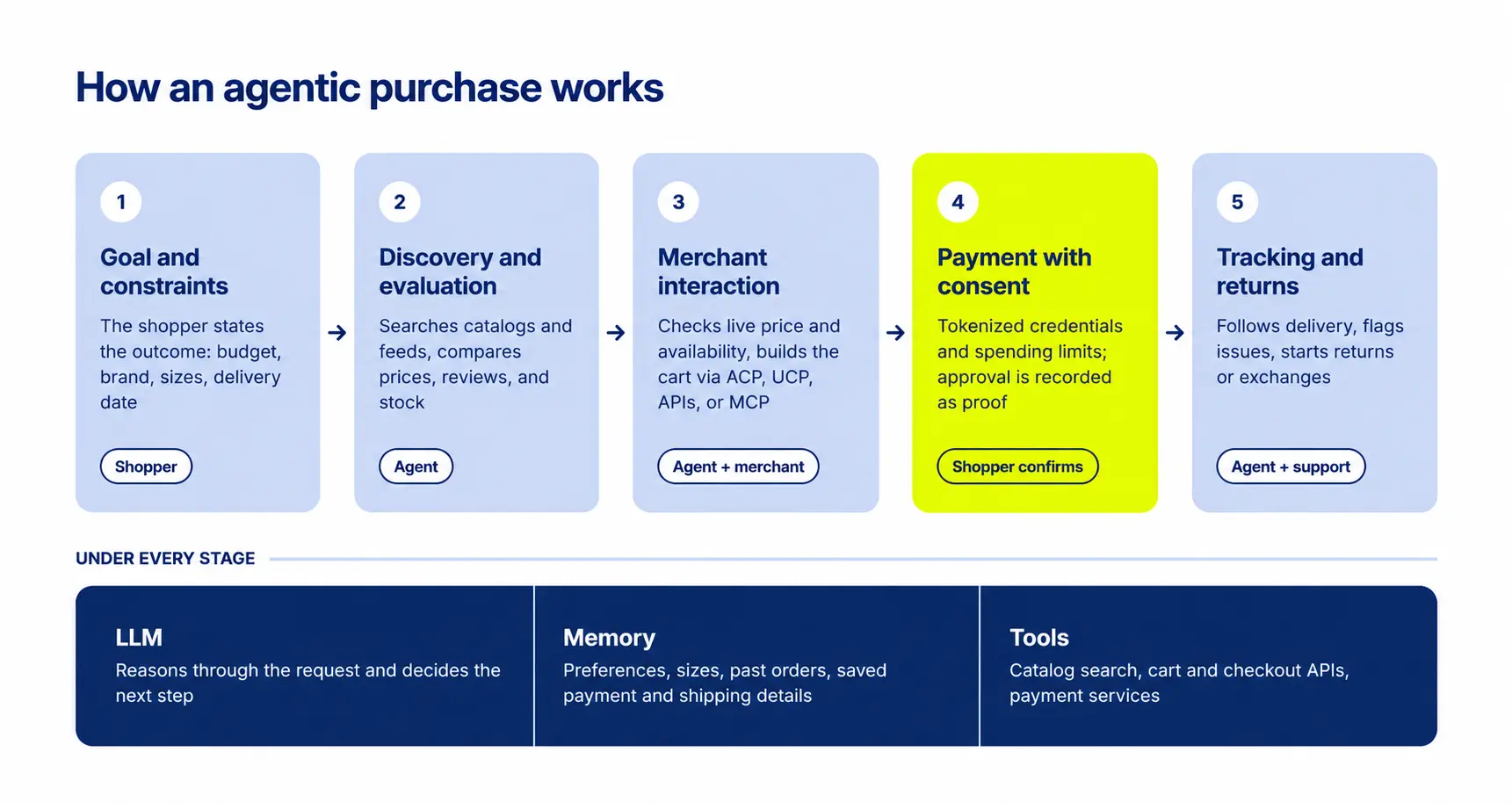
Every shopping agent combines three components. A large language model (LLM) handles reasoning: it breaks a request into steps and decides what to do next. Memory stores preferences, sizes, past orders, and saved payment and shipping details. Tools are the connections that let the agent act: catalog search, price lookups, cart and checkout APIs, payment services. Each purchase moves through five stages.
1. The user sets a goal and constraints
The shopper describes an outcome in natural language: "a gift for my sister under $50, she likes ceramics." Constraints can be explicit (budget, delivery date) or inferred from memory (preferred brands, sizes, past returns).
2. Discovery and evaluation
The agent searches for options across catalogs, product feeds, and the open web, then filters them against the constraints. Price comparison, review analysis, and stock checks happen here. Stores with incomplete or out-of-date product data drop out at this stage, often without notifying the merchant.
3. The agent interacts with the merchant
To act, the agent needs a structured way in. That can be a commerce protocol endpoint (ACP or UCP), an API, an MCP server, or, as a fallback, the website itself. Through these interfaces, the agent checks real-time price and availability, applies discounts, and builds the cart.
4. Agent-initiated payment with consent and limits
This is where agent-initiated payments differ from autofill. The agent never receives the raw card number. It uses tokenized payment credentials or a single-use virtual card scoped to one merchant, amount, or time window. The shopper's approval is recorded as proof of what the agent was allowed to buy. Spending caps and confirmation rules act as guardrails, and high-value purchases often include a human-in-the-loop step.
5. Post-purchase: tracking and returns
After the order, the agent can track delivery, surface issues, and start returns or exchanges. This part is the least standardized. Protocols cover order status, but substitutions, partial refunds, and disputes still often end with a human support agent.
Benefits of Agentic Commerce
Agentic commerce benefits both the people buying and the stores selling.
Less work for shoppers
Comparing ten tabs of specs and return policies is the part of online shopping most people would gladly delegate. Agents compress hours of research into one request. In a May 2026 survey by Global Payments, 63% of respondents said they use AI shopping tools to save time, and 69% to find better deals.
Fewer abandoned carts
Many cart abandonment issues are caused by friction: account creation, long forms, payment errors. Checkout automation can reduce friction by eliminating repetitive form-filling and simplifying payment.
Personalization based on stated intent
An agent works from what the shopper explicitly asked for plus what it remembers about them, and its product recommendations follow that stated intent rather than guesses. Stores that already run personalized recommendations on their own channels have the product attributes and affinity data that agents need.
Show me how personalized recommendations work on my site
New demand surfaces for merchants
Every major assistant, from ChatGPT to Gemini to Claude, is becoming a place where purchases start. For merchants, that's a new acquisition channel with high purchase intent. Shoppers referred by AI services to US retail sites converted at a 60% higher rate than other traffic in July 2026, according to Adobe.
Agentic Commerce vs. Traditional and Conversational Commerce
Conversational commerce puts a chat window, or an AI shopping assistant, on top of the store. It answers questions and recommends products, but it waits for the user and doesn’t complete a transaction on its own. An agentic system takes a goal and pursues it across steps and sometimes across stores.
| Traditional ecommerce | Conversational commerce | Agentic commerce | |
| Who drives | The shopper | The shopper, with chatbot help | An AI agent, within the shopper's limits |
| Interface | Website or app | Chat on a website, messenger, or app | AI assistant or the agent's own interface |
| Behavior | Static pages | Reactive: answers when asked | Proactive: plans and acts |
| Checkout | Manual forms | Usually hands off to the site | Agent-initiated, with consent |
| Scope | One store | One store | Many stores and services |
| What it needs from merchants | Good UX and SEO | Scripts, FAQs, catalog access | Machine-readable data, APIs, agent-ready checkout |
Why Agentic Commerce Matters Now
Between 2025 and 2026, agentic commerce moved from demos to live products, mainly due to three developments.
First, shoppers already use AI to buy. An IBM and NRF study of more than 18,000 consumers in 23 countries found that 45% turn to AI for help during their buying journeys, mostly to research products (41%), interpret reviews (33%), and find deals (31%). Generative AI is now a common step in product discovery.
Second, trust is growing, though slowly. In the Global Payments survey (8,027 consumers in seven markets, May 2026), respondents expected AI agents to make 15% of their purchases within five years, up from 9% a year earlier. Handing over the final decision is a different matter: in a Gartner survey of US consumers, willingness to let AI make the purchase decision topped out at 11%, even for low-stakes categories.
Third, the infrastructure now exists. Payment networks and AI platforms shipped working protocols for delegated payments. Agents can now pay without seeing card numbers, and merchants can tell a verified buying agent from a scraper.
The long-term stakes are large. McKinsey estimates that agents could orchestrate $3 trillion to $5 trillion of global consumer commerce by 2030, including up to $1 trillion in US B2C retail. The figure describes revenue that passes through agents, not necessarily new spending, and McKinsey itself notes that the pace of adoption is still unclear.
Key Technologies and Protocols Behind Agentic Commerce
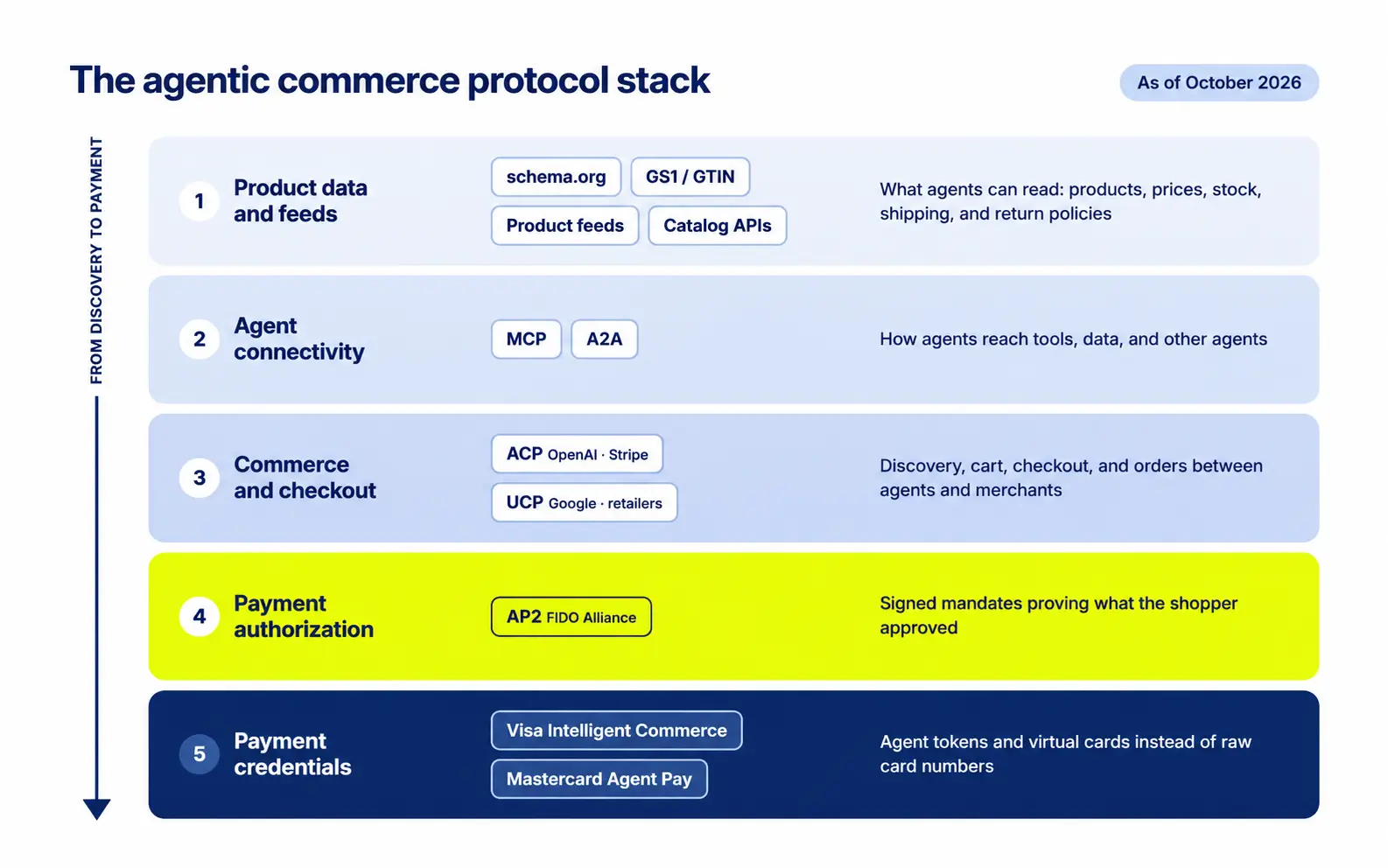
There’s no single standard to run agentic commerce. Each protocol covers one piece of the puzzle, and most are designed to work together.
Model Context Protocol (MCP)
Model Context Protocol (MCP) is an open standard for connecting AI models to external tools and data. Anthropic introduced it in November 2024 and, in December 2025, donated it to the Agentic AI Foundation under the Linux Foundation, co-founded with Block and OpenAI. In commerce, MCP lets an agent query a catalog or call a store's API. It isn't a payment or checkout protocol.
Agent2Agent (A2A)
A2A, launched by Google in April 2025 and moved to the Linux Foundation that June, standardizes how agents built by different vendors discover each other and exchange tasks. It's the groundwork for agent-to-agent negotiation between buyers and sellers.
Agentic Commerce Protocol (ACP)
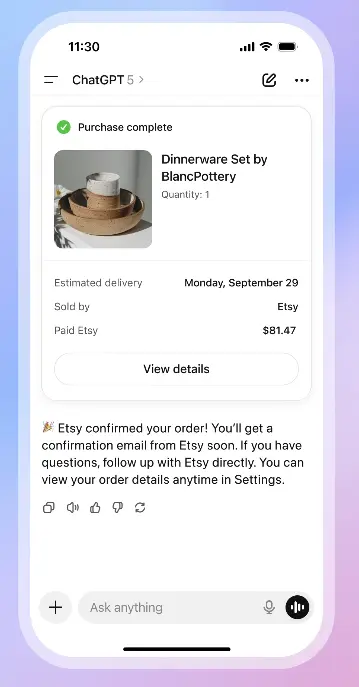
Agentic Commerce Protocol (ACP) is an open standard co-developed by OpenAI and Stripe. It launched in September 2025 to power ChatGPT Instant Checkout, with Etsy and Shopify merchants first in line. In March 2026, OpenAI changed course: Instant Checkout moved into merchants' own ChatGPT apps, merchants can now use their own checkout, and ACP became mainly the product discovery layer. Target, Sephora, Nordstrom, Lowe's, Best Buy, The Home Depot, and Wayfair have integrated ACP for discovery.
Universal Commerce Protocol (UCP)
Google announced UCP in January 2026 at NRF, co-developed with Shopify, Etsy, Wayfair, Target, and Walmart and endorsed by Visa, Mastercard, Stripe, Adyen, and others. It covers the full journey from discovery to cart, checkout, and orders, and works alongside A2A, AP2, and MCP. UCP powers checkout in Google's AI Mode and the Gemini app. In October 2026, Google opened a UCP hub in Merchant Center that offers cart transfer, native checkout, and account linking, with US merchants first and onboarding by approval.
Agent Payments Protocol (AP2)
Agent Payments Protocol (AP2) answers a narrow question: how does a merchant or bank know what the shopper actually authorized? It uses cryptographically signed mandates that record the shopper's intent and the approved cart. Google introduced it in September 2025 and in April 2026 handed it to the FIDO Alliance, releasing version 0.2 with support for "human not present" purchases based on instructions approved in advance.
Card network programs
Visa Intelligent Commerce and Mastercard Agent Pay issue agent-specific tokens, so an agent can pay within limits without holding card details. Visa's Trusted Agent Protocol lets merchants verify that traffic comes from a registered buying agent, which helps with fraud detection and bot management.
Agentic Commerce Use Cases and Live Examples
The most common agentic commerce use cases today are routine and easy to reverse: restocking household staples, buying when a price drops, booking tickets, and handling subscription management. B2B procurement is a natural next step. Repeat orders made within approved supplier lists, budgets, and contracts suit agents well. For B2B sellers, part of the effort that now goes into trying to generate sales leads will shift toward being findable by a buyer's procurement agent.
Published performance results for individual merchants are still rare. The examples below are live products. Each is marked with its rung on the autonomy ladder.
Walmart inside ChatGPT (approved checkout)
In March 2026, Walmart launched an app inside ChatGPT. Shoppers can link their Walmart account, use loyalty benefits, and pay with Walmart payment methods. It's the clearest example of the post-Instant Checkout model, where the merchant runs checkout inside the assistant.
Google AI Mode, Gemini, and Universal Cart (cart building and approved checkout)
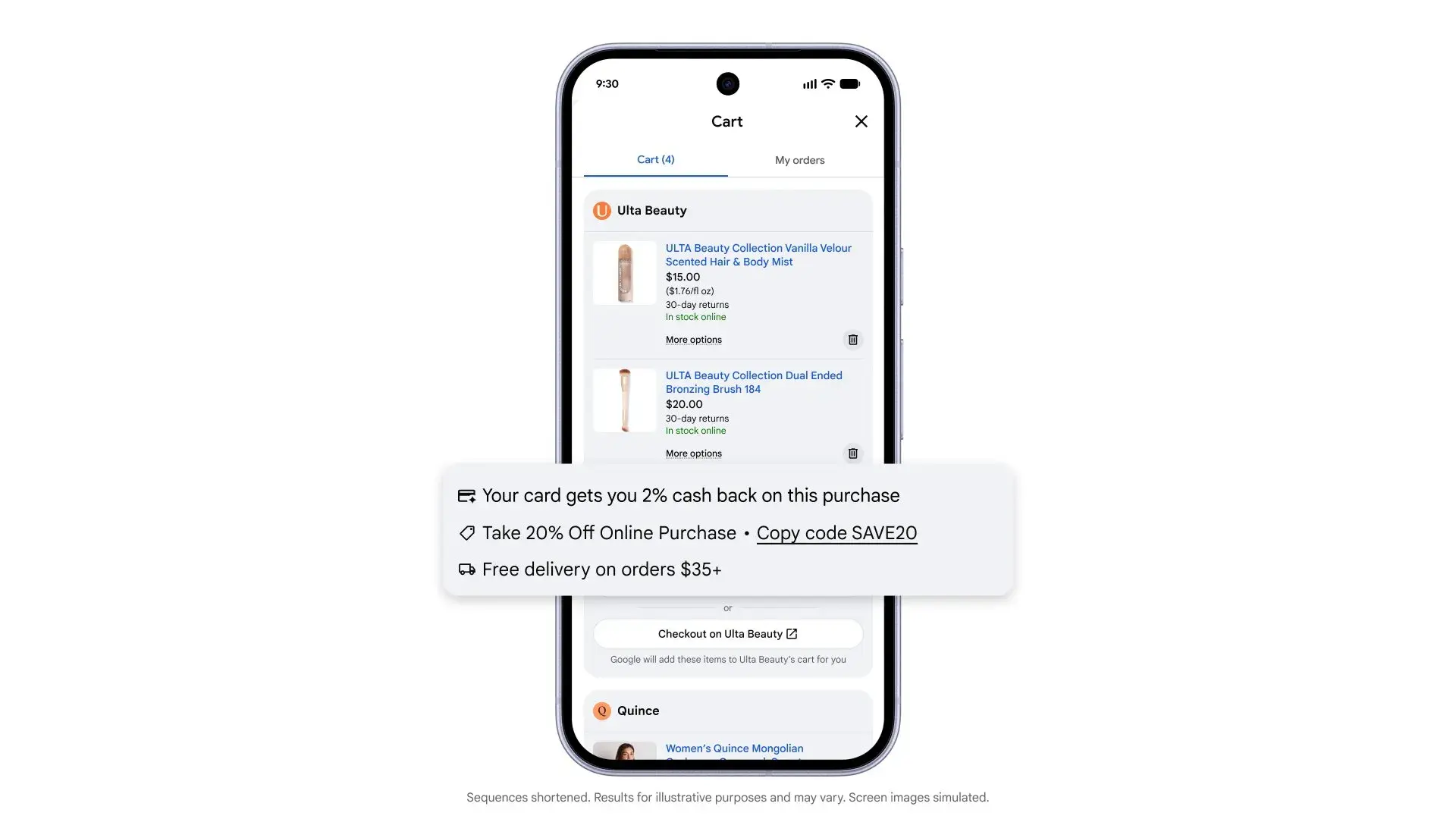
Google's Universal Cart, announced at I/O in May 2026, keeps one cart across Search and the Gemini app, tracks price drops and restocks, and checks product compatibility. Checkout runs through UCP with Google Pay, or the cart transfers to the merchant's site. Launch merchants included Nike, Sephora, Target, Ulta Beauty, Walmart, and Wayfair. US only for now.
Amazon Alexa for Shopping (standing delegation)
In May 2026, Amazon folded its Rufus assistant into Alexa for Shopping, available to US shoppers. It can restock items on a schedule, buy automatically when a product hits a target price, and use "Buy for Me" to complete purchases on other retailers' sites with the shopper's saved details.
Visa agent purchases in Europe (autonomous, within limits)
In July 2026, Visa reported AI agents completing live purchases with merchants including lastminute.com and Frasers, with more than 30 European issuers taking part. Agents bought within limits the consumer had set, and every transaction was authenticated with passkeys.
I want to turn AI-referred shoppers into repeat customers
What the early numbers show
Platform-level data is more available than merchant cases. Shopify reported that orders from AI-powered searches grew nearly 13 times in Q1 2026. Adobe reported that AI-referred visits to US retail sites were associated with 53% higher revenue per visit. Both figures measure AI-assisted shopping. Neither separates out fully autonomous orders, which platforms don't yet report on their own.
How to Prepare Your Business for Agentic Commerce
Shoppers will choose their own agents. A merchant's job is to make the store easy for any of them to read, buy from, and measure. Agentic commerce readiness comes down to five areas.
Make product data machine-readable
Agents choose from what they can parse. Publish complete machine-readable product data: titles, attributes, variants, sizes, materials, compatibility, shipping times, and return terms. Mark up pages with structured data (schema.org), use GS1 standards for product identifiers such as GTINs, and keep your product feed in sync with real stock and prices. An agent that finds a price mismatch at checkout will often drop the store and pick the next option.
Open your store to agents through APIs
API-driven commerce and headless commerce architectures have an advantage here: catalog, cart, and checkout already exist as callable services. Check whether your platform supports ACP or UCP, or plans to. Many merchants will get there through their platform provider rather than building integrations themselves. If you run on Shopify, your existing Shopify marketing automation and catalog setup are a good place to start the audit.
Set the rules for agent checkout
Decide which agents you accept, how you verify them, and what limits apply. Work with your payment provider on token support and trust and safety controls. Separate verified buying agents from scrapers so bot protection doesn't block real customers.
I want every order linked to one customer profile, across all devices and channels
Own the customer relationship after the agent leaves
An order placed through an assistant still involves a real customer. Capture first-party data where the protocol allows it, record consent management choices, and connect the order to a unified customer profile. A customer data platform (CDP) and a strong first-party data strategy let you continue the relationship after the first order: onboarding, replenishment reminders, loyalty, customer journey orchestration across omnichannel touchpoints, and predictive segmentation for win-back. Agent-led customer retention starts with knowing who bought.
Rework attribution
Agent purchases often skip the pageview, the session, and the pixel. Add server-side tracking, tag orders by source agent or protocol, and watch how often assistants mention your products. Track conversion rate and repeat rate for agent-originated customers separately. Without that split, standard analytics will undercount agentic commerce revenue.
The Future of Agentic Commerce
Five shifts are likely to shape agentic commerce over the next two to three years.
Protocols consolidate
Governance is moving to neutral bodies: MCP and A2A under the Linux Foundation, AP2 under the FIDO Alliance. Expect fewer competing specs and more interoperability between ACP and UCP flows.
Agents negotiate with agents
McKinsey describes agent-to-agent commerce, in which a personal-shopping agent negotiates with a retailer's sales agent, as one of three emerging interaction models. Merchant-side agents for pricing, offers, and service will need their own guardrails.
More purchases run through agents
Shoppers expect the share of AI-made purchases to grow, but trust is the limiting factor. Adoption will lead in low-cost, reversible categories and move slowly into high-value ones.
Discovery and attribution change
Assistants already sell sponsored placements. Brands will compete for a place on an agent's shortlist, and AI marketing will need new metrics for visibility inside AI answers. Teams already using agentic AI for marketers in their own work, such as AI agents for ecommerce marketing that analyze campaigns and edit templates, will find it easier to plan for shoppers who delegate too.
SEO expands into GEO and AEO
Generative engine optimization (GEO) and answer engine optimization (AEO) focus on being cited and recommended by AI systems rather than ranked on a results page. Clean data, clear policies, and consistent third-party reviews matter more than keyword density. Large action models, trained to operate interfaces directly, could extend autonomous checkout to sites without dedicated agent APIs, though reliability on unfamiliar sites is still unproven.
FAQ: Agentic Commerce
Is agentic commerce safe?
It can be, when built on the current standards. Agents pay with tokens or virtual cards, so they never see card numbers. Mandates record what the shopper approved, and spending limits cap the damage of a wrong purchase. The main risks are errors, such as the wrong size or a stale price, and unverified bots posing as agents.
Is agentic commerce the same as agentic AI?
No. Agentic AI is the general technology: AI systems that plan and take multi-step actions toward a goal. Agentic commerce is one application, focused on buying and selling. The same agentic AI techniques also power agents for marketing, customer service, and software development.
Where can I use agentic commerce today?
In the US, shoppers can buy through Google AI Mode and Gemini with eligible merchants, through merchant apps in ChatGPT such as Walmart's, and through Amazon's Alexa for Shopping. In Europe, Visa and Mastercard have enabled agent payments with participating banks and merchants. Availability varies by country and changes often.
Do shoppers have to approve every purchase?
In most cases, yes. Most current products ask for confirmation before payment, and many shoppers want it: a third of respondents in the 2026 Global Payments survey want to approve every transaction. Standing rules, such as buying at a target price, are the main exception.
How can a store become visible to AI shopping agents?
Start with product data. Keep feeds complete and in sync with real stock and pricing, add schema.org markup, and use standard identifiers. Then check whether your ecommerce platform supports ACP or UCP, and make sure bot protection lets verified agents through.
What's the difference between ACP and UCP?
Both standardize how agents work with merchants. ACP, from OpenAI and Stripe, now mainly powers product discovery in ChatGPT. UCP, from Google and retail partners, covers discovery through checkout and orders in Google's AI Mode and Gemini. Several large retailers, including Target and Wayfair, work with both.
Agentic commerce will reach most stores in stages: first as AI-referred traffic, then as orders placed inside assistants, and later as purchases made without a click-through. The groundwork stays the same at every stage. Agents need clean product data to choose you, and you need clean customer data to keep the people they send.
That's where we can help. Fill in the form below, and we’ll show you how a customer data platform can connect orders originating from AI assistants to unified customer profiles and support ongoing customer engagement where permitted.