Content
18 June 2026
1156
17 min
5.00

Still Cautious About Using AI for Marketing? Here’s What Data Actually Shows

Ivan Diulai
Content
AI adoption in marketing in 2026 is in a strange spot. Most organizations are using it. Most aren't using it well. And the gap between those two groups is widening fast.
If you've been hesitating, you probably have reasons. They're rarely irrational. Sometimes they're shaped by a bad experience with an earlier tool. Sometimes by a vendor who oversold. Sometimes by a quiet concern that the whole category is more hype than substance. These objections show up in real conversations with marketing leaders all the time, and most of them sound responsible — the kind of caution a thoughtful operator would have.
But the underlying landscape has changed enough that several of these objections now target a version of AI that no longer exists. This article works through nine of them. For each one, we'll look at what's legitimate, what the current data actually shows, and what that means for the decision in front of you.
Does it actually work?
"It's still unproven"
Healthy skepticism is good. Permanent skepticism is a competitive disadvantage. There's a window when a technology is genuinely experimental, and waiting makes sense, and a later window when "still unproven" becomes a way of avoiding a decision the market has already made.
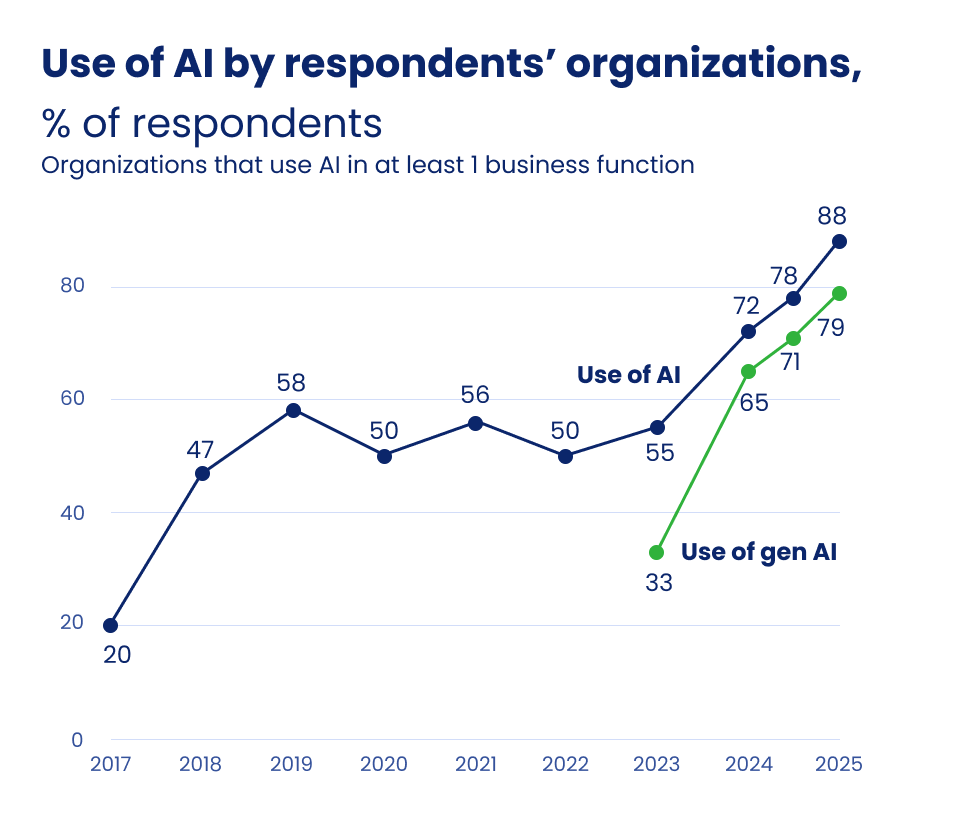
AI in marketing crossed from the first window into the second some time ago. McKinsey's 2025 State of AI survey found that 88% of organizations now use AI regularly in at least one business function, up from 78% the year before. Marketing and sales have consistently been among the top-adopted functions in the survey. The serious question now isn't whether AI in marketing works — it's how to use it well.
"We can't justify the ROI"
You've watched vendors claim transformational returns, only to see the actual numbers come in flat. That experience is real, and it's shaped how many marketers approach AI now. But it's worth separating two things: AI implementations that fail because the underlying technology doesn't work, and AI implementations that fail because they were poorly scoped, poorly integrated, or sold on hype. The flat results are almost always the second category — and the loud anecdotes about them have done more to shape industry sentiment than the quiet successes have.
The actual numbers tell a different story. Deloitte's Q4 2024 survey of 2,773 senior decision-makers found that 74% of organizations say their most advanced GenAI initiative is meeting or exceeding ROI expectations. McKinsey's 2025 data goes further and points to why some implementations work and others don't: among high performers — organizations that attribute 5% or more of EBIT to AI — they're roughly 3x more likely to have fundamentally redesigned how work flows and to be scaling AI agents across the business, and they're more likely to pursue growth and innovation as core AI objectives rather than just efficiency.
The implementations that deliver ROI are those aimed at moving the business forward, not just trimming costs at the edges.
Now, the counter-evidence. S&P Global Market Intelligence found that 42% of organizations abandoned most of their AI proof-of-concept projects before reaching production, up from 17% the year before. That's a real number that deserves attention. What it tells us isn't that AI doesn't work — Deloitte's 74% figure applies to organizations' most advanced initiatives, while the abandonment number captures everything, including hastily-launched pilots, mis-scoped experiments, and projects that should never have been started. The two stats describe the same world. AI works — it’s the bad implementations that don't.
"We tried AI before and it didn't deliver"
This is the most personal objection on the list, and the hardest to argue with directly. If a previous tool burned you or your team, that experience is real, and the reluctance to repeat it is reasonable. But it's worth checking what the previous tool actually was.
If your team's "we tried AI" memory is anchored in 2023, you're remembering a product category that no longer exists in the same form. Wharton's Human-AI Research group conducted the same year-over-year tracking study over three years and found that the share of decision-makers using GenAI regularly rose from under 40% in 2023 to more than 80% in 2025, with 46% reporting daily use. That kind of jump in usage tracks a real change in what the tools can do.
The capability data confirms it. Stanford's AI Index 2025 report found that on SWE-bench, a coding and logic benchmark, AI systems solved 4.4% of problems in 2023 and 71.7% in 2024. The smallest model capable of clearing 60% on a major reasoning benchmark shrank from 540 billion parameters in 2022 to 3.8 billion in 2024 — a 142-fold reduction in the model size needed to do the same work. None of this means AI is now flawless; reliability still varies, and bad implementations still happen. It means that a disappointing 2023 experience is a poor predictor of a 2026 one, because the underlying tools have moved through more than one generation since then.
Can you actually pull it off?
"It'll cost too much, take too long, or need skills we don't have"
If your picture of an AI project is a six-figure contract, a multi-month integration, and a data scientist on retainer, that picture is two or three years out of date. The cost structure of the underlying technology hasn't just declined. It has collapsed.
Stanford's AI Index 2025 report tracked the cost of querying an AI model at GPT-3.5-equivalent quality. In November 2022, that cost was $20.00 per million tokens. By October 2024, it was $0.07 per million tokens — a 280-fold reduction in roughly 2 years. The 2025 edition of the same report confirmed that the trend hasn't stalled: AI hardware costs are declining by roughly 30% annually, and energy efficiency is improving by about 40% per year. The economics of doing AI work in 2026 have almost nothing in common with the economics of 2022.
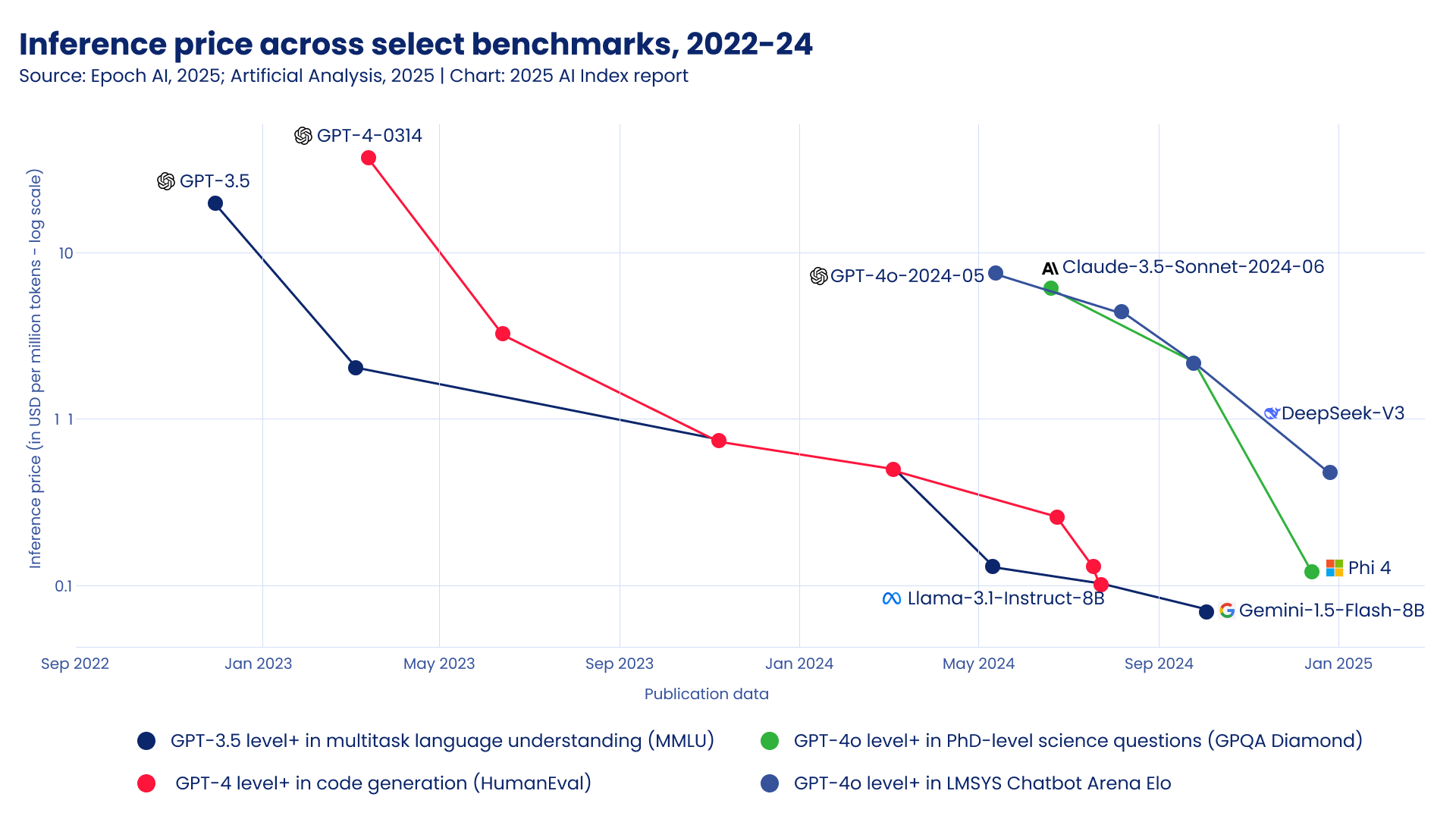
That kind of cost curve directly affects what vendors can offer and who can use it. Things that would have been enterprise-tier projects three years ago are now subscription products. The skills barrier dropped alongside the price. Deloitte's 2026 State of AI in the Enterprise report — based on 3,235 leaders across 24 countries — found that worker access to AI rose by roughly 50% in a single year, from under 40% to around 60% of workers equipped with sanctioned AI tools. Most of those workers aren't AI specialists. They're marketers, analysts, ops people — configuring AI the way they configure email campaigns, not the way they configure databases.
How this works in Yespo
Our AI features — predictive segments, product recommendations, content generation — are parts of the same platform where campaigns are already built. AI is not a separate product but rather an addition to already existing processes.
If you haven't evaluated AI tooling in the last 12 months, you're not looking at the same product category you remember. The cost, deployment time, and required skills are on a different curve than they were when many marketing leaders formed their mental model of what "doing AI" means.
"Our data isn't clean enough for AI"
This one is very rational. It signals discipline, awareness of the failure mode, and an unwillingness to set yourself up for a bad result. The problem is that it assumes there's a clean-data threshold you'd cross if you waited, and that the companies already running AI have crossed it.
That’s not the case. Cisco's 2026 Data and Privacy Benchmark Study, based on a survey of 5,200 IT and security professionals across 12 markets, found that 65% of organizations struggle to access high-quality data efficiently. That's the universal baseline. Meanwhile, 88% of organizations use AI in at least one business function, according to McKinsey. Those two numbers can't both describe a world where data readiness is a prerequisite for AI. What's actually happening is that organizations are deploying AI and improving their data governance in parallel, not sequentially.
How this works in Yespo
A CDP is designed for the "in parallel" flow — unifying web, app, email, and order data into one customer profile makes AI features usable. You don't clean the data first and connect it later. It’s all a continuous process.
The "we're not ready" stance assumes there's a finish line you can cross before starting. There isn't. Data quality is a continuous discipline, not a milestone. The orgs ahead of you are ahead because they accepted that earlier.
"We don't have the AI expertise in-house"
If this is the objection that's been holding you back, you're in a huge company — and the company is more senior than you might think. Deloitte's 2026 report named the AI skills gap as the single biggest barrier to integration, with only 20% of leaders saying they feel highly prepared in talent. The dominant response among the rest isn't to wait. Most companies — 54%, per the same report — are simply educating existing employees to raise their AI fluency.
The math here is unforgiving. PwC's analysis of nearly a billion job ads found that skill requirements for AI-exposed jobs are changing 66% faster than for other jobs. Waiting until you hunt the talent is waiting for a target that's moving faster than the hiring market can keep up with. The way through for everyone is the same: start with the people you have, pick a use case, and learn as you go.
Should you actually do it?
"We'll lose control over decisions we're accountable for"
The black-box concern is usually very reasonable: a previous tool that made decisions you couldn't see, couldn't override, and couldn't explain to others. But the AI conversation has moved past the question of whether humans stay in the loop. The current question is how that loop is designed.
BCG and MIT Sloan Management Review's ninth annual joint study, Leading in the Age of AI Agents — based on 2,102 respondents across 21 industries and 116 countries — found that 76% of executives now describe agentic AI as more like a coworker than a tool. Coworkers have responsibilities you assign to them. They have judgment within scope, not over it. They report back. The shift in framing reflects how products work now.
The modern generation of AI marketing tools is built around explicit human control — brand boosts, category exclusions, price-range rules, recall parameters, override toggles. The marketer sets the constraints. The AI fills the blanks within them. As MIT Sloan and BCG argued in May 2026, the work isn't to delegate oversight to a checkbox at the end of a workflow — it's to design oversight into the workflow itself. You're not handing over the keys. You're delegating the parts of the job you'd hate doing manually anyway.
How this works in Yespo
You choose the algorithm and block type (like Similar products, Also bought, Bestsellers, Personal recommendations) and where it runs: homepage, category page, product card, cart, 404. Filters then restrict what the model is allowed to display: a single brand, a price range, discounted items only, or category pairs that must never appear together (kids' products alongside adult ones, budget items for a VIP segment).
You can even set fallback options when there's no recommendation data for a contact.
"Our data isn't safe with AI vendors"
This is the one objection on the list that doesn't expire. Customer behavioral data is sensitive, regulators are paying attention, and no honest vendor will tell you the risk is zero. We can't talk you out of that concern, and frankly, we wouldn't try.
What we can point out is that the concern is now answerable through specific, verifiable questions rather than gut judgment. The International Association of Privacy Professionals — the global body for privacy practitioners — found in its 2025 AI Governance Profession Report that 77% of organizations are now building AI governance programs, and that the ones whose privacy function leads AI governance are significantly more likely to feel confident in their EU AI Act compliance (67% vs. lower rates elsewhere). Cisco's 2026 benchmark adds that 90% of organizations have expanded their privacy programs specifically because of AI, and 99% report measurable benefits from privacy investment.
That shift matters because it means the security teams ahead of you have already built standardized vetting frameworks, and you can lean on their work instead of reinventing it. The right questions to ask any AI vendor in 2026 are concrete:
- Are you GDPR- and CCPA-compliant?
- Are you ISO/IEC 27001-certified for information security?
- Are you ISO/IEC 42001-certified for AI management systems?
- Do you align with the NIST AI Risk Management Framework?
- Do you support the right to be forgotten?
- Where is the data physically stored, and what jurisdictions does it cross?
- Who are your sub-processors?
If a vendor answers those cleanly, the risk is bounded and known. If they don't, you have your answer. The decision doesn’t have to be about trust alone. Now it’s more about due diligence you can actually run.
"AI will make our marketing sound generic"
This concern has become more urgent as more AI-generated content has entered the world, and it's worth taking seriously. Anyone who's read a paragraph of obvious LLM output knows the texture: technically correct, faintly hollow, four em-dashes deep into a list of "not just X but Y" constructions. If that's how AI is present in your marketing, your brand voice is in trouble.
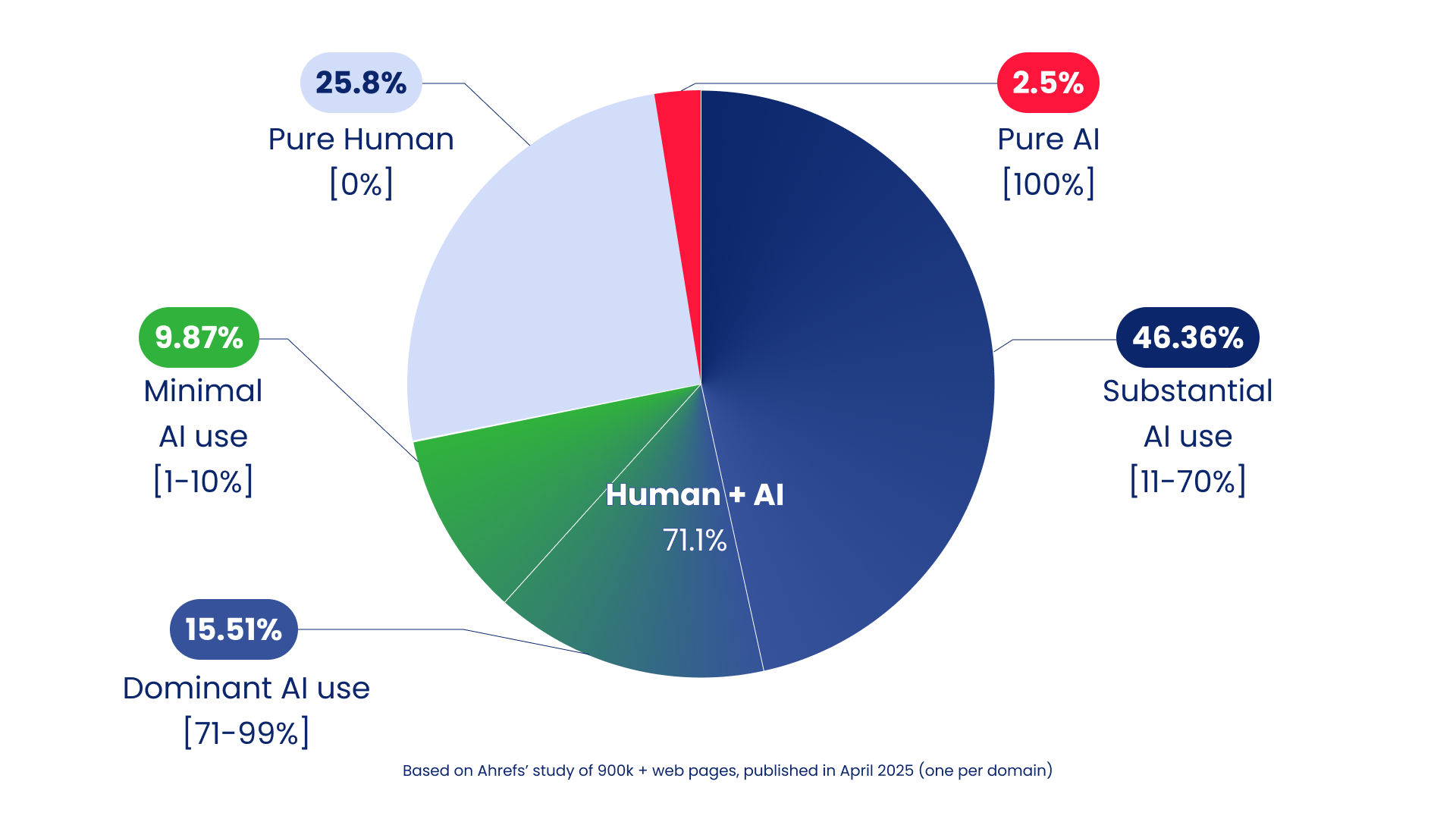
But that's not how most marketers actually use it. Ahrefs' 2025 State of AI in Content Marketing analyzed how marketers actually use AI. Their analysis of nearly 900,000 webpages found only 4% qualified as pure AI-generated content, even as 87% of marketers said they use AI to assist with content creation. The dominant pattern, by a wide margin, is AI as a draft layer that humans then edit, shape, and rewrite. The risk of generic-sounding marketing isn't due to using AI. It happens when businesses publish AI output without doing the second pass.
The consumer-side evidence backs this up. NIQ's 2024 neuroscience-based research — using EEG, eye tracking, and implicit response measurement — found that AI-generated ads, even ones perceived as high-quality, elicited weaker memory activation and lower engagement than traditional human-produced ads, and risked creating a negative brand halo effect.
The market is already telling you which mode works. Used as raw material for a marketer to shape, AI extends what a small team can produce. Used as an autonomous content engine, it produces exactly the generic output the objection warns about. The tool isn't the problem — it’s all in how it’s used.
If you've read this far, you've probably noticed something. None of these objections is wrong, exactly. Each one points at something real — a vendor who oversold, a tool that disappointed, a team that isn't trained, a regulator who's paying attention. These concerns aren’t imaginary. But they describe risks you can now answer with specific questions, framed against a benchmark that's already moved.
There's no version of this where you wait until you "know enough" and then start. IBM's 2025 CMO study found that 65% of marketing leaders agree that AI-literate talent is critical to achieving their priority objectives, while only 21% believe they have the talent to deliver over the next two years. Two-thirds of marketing leaders know AI capability is now an absolutely vital requirement. One in five feels equipped for it. The rest — the overwhelming majority — are working through the same uncertainty you are.
The way through is the same for everyone: pick one concrete use case, understand it well enough to evaluate whether it fits your business, and decide. That's it. The companies that are pulling ahead aren't pulling ahead because they had better answers at the start. They're pulling ahead because they started.
If you want to talk through which use case makes sense for your business, we'd be glad to help. Fill in the form below and let’s talk!