Content
15 March 2026
3522
14 min
0.00

What is Enterprise Marketing Automation? A Comprehensive Guide

Yana Bozhko
Content
As ecommerce businesses scale, marketing quickly becomes more complex. The time-proven strategies stop working because suddenly there are more channels, more data, more clients – and also far more pressure to drive meaningful customer engagement while maintaining a clear ROI. Teams that used to work with spreadsheets, manual campaigns, or basic marketing automation platforms (MAPs) soon realize that’s not enough when a company reaches enterprise level. Their efficiency fluctuates, their communication becomes fragmented, and their revenue becomes inconsistent rather than growing steadily.
All of this can be avoided or fixed with the help of enterprise marketing automation (EMA) software. It helps large organizations improve and optimize their marketing efforts without slowing teams down. Its efficiency can be proven by the numbers: the global EMA generated revenue of $1,382.5 million in 2024 and continues to grow. This article will explain the essentials about enterprise marketing automation features and definition, the benefits that matter most, when it makes sense to implement it, and which platforms are commonly used in ecommerce today.
What is Enterprise Marketing Automation?
Enterprise marketing automation is software that helps large organizations coordinate, automate, and optimize marketing activities across multiple channels.
Such systems operate with large numbers of user records, integrate with CRMs, customer data platforms, data warehouses, and business intelligence (BI) tools. Marketing and sales teams can use them to launch tailored messaging and personalized promotional campaigns for bigger audiences while staying aligned with their business goals. The results? Increase in productivity and efficiency, supported by numbers – 36.6% of organizations report that automation reduced their costs by at least 25%.
Key Features of Enterprise Marketing Automation
Enterprise marketing automation platforms are built for scale. That’s why their capabilities go far beyond basic automation and are meant to give large teams the tools they need to make data-driven decisions, coordinate across channels, and support scalability and performance in high-traffic environments.
Key components of enterprise marketing automation services are the following:
Lead management
Enterprise marketing automation platforms can speed up and optimize lead management processes: their capture, scoring, and nurturing using behavioral triggers and AI-based intent signals. This largely affects long-term growth in customer lifetime value (CLV/LTV). Businesses using AI-driven lead generation often report a 50% increase in sales-ready leads.
Email marketing automation
Companies can use enterprise-grade email tools to make their triggered campaigns more personalized and scale their efforts. Such solutions can also be used for A/B testing and for analyzing customer engagement (e.g., opens, clicks, or conversions). Combining those tools with dynamic segments helps teams improve delivery timing, relevance, and engagement. As a result, they get a consistent email marketing customer journey.
Multi-channel orchestration
If you want to create a consistent omnichannel journey, EMA can help you with that. Such systems can coordinate communication across email, social media, SMS, paid ads, web experiences, push notifications, and in-app messages. They also support real-time event-based automation to keep customer interactions connected.
Reporting and analytics
Enterprise marketing automation creates real-time dashboards to help you get clearer insights about campaign performance. Such dashboards can cover such things as multi-touch attribution, marketing ROI, and churn prediction. You can also integrate EMA platforms with analytics tools to improve campaign optimization and make decisions with more confidence.
Integrations and CRM sync
Enterprise marketing automation solutions can integrate with CRMs, CDPs, ad platforms, and analytics tools. This, in turn, allows you to get a 360-degree view of users and achieve accurate customer journey mapping.
Benefits of Enterprise Marketing Automation
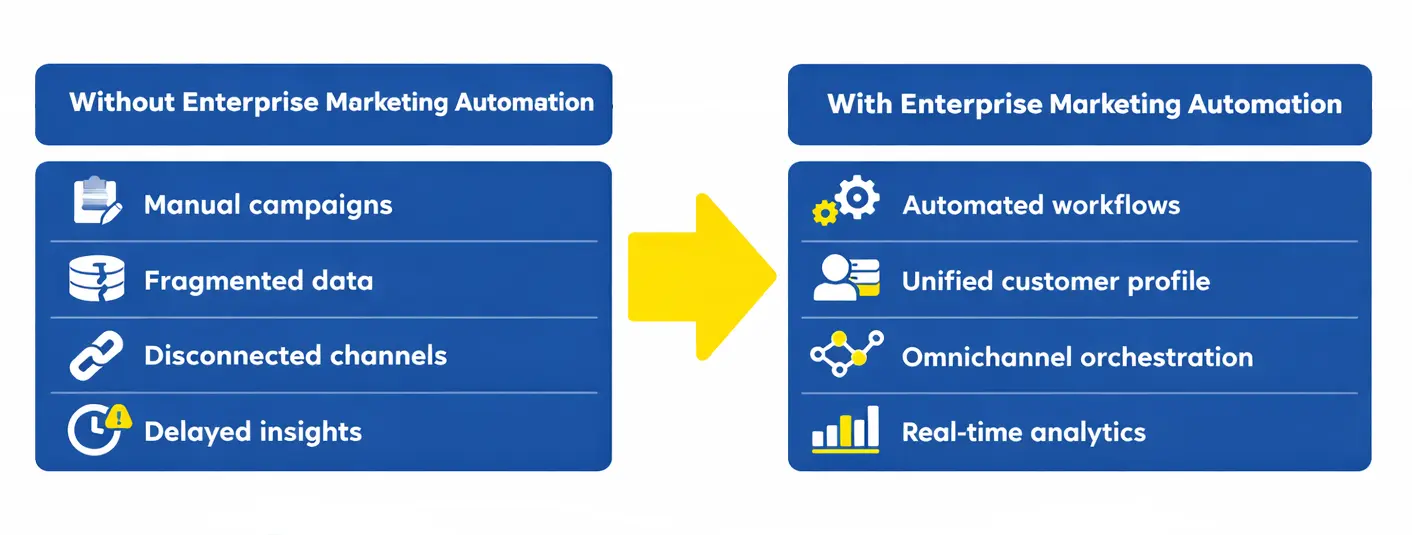
While it’s important to understand the definition and key features of enterprise marketing automation, it’s no less significant for businesses to realize how exactly using such platforms benefits them.
Here are some of the biggest advantages of enterprise marketing automation.
Increased efficiency
Processes like lead nurturing, segmentation, and campaign execution can be time-consuming and require significant manual effort. Enterprise marketing automation helps take care of them, speeding up the workflow and allowing the teams to orchestrate thousands of customer interactions daily with fewer errors.
Higher ROI and revenue impact
Teams can use EMA’s advanced analytics and attribution models features to quickly figure out what actually drives conversions. This knowledge can help improve lead scoring and campaign performance, boosting conversion rates and driving revenue.
Security and compliance
The estimated cost of cybercrime worldwide increases each year and is expected to reach a new peak of $15.63 trillion in 2029. This is one of the main reasons to focus on cybersecurity and compliance, especially for those companies that process and store lots of sensitive customer behavioral data. Enterprise marketing automation platforms offer a helping hand in that, providing GDPR and CCPA support, helping manage consent, data governance, and access control.
Scalability for growth
As large businesses scale, they need their tools to be able to handle it. That’s why it's important to opt for solutions like enterprise marketing automation if your company plans to grow quickly. EMA can process large data volumes, supports multiple markets, and distributed teams. With its help, enterprises can scale easily without slowing down performance or breaking workflows.
Stronger team alignment
The more data marketing and sales teams work with, the more challenging it is for them to be on the same page about it. Enterprise marketing automation platforms can fix that by granting those teams shared access and insights about customer journeys and pipeline activity. The teams, in turn, can use this data to align their workflows and improve collaboration.
When and How to Implement Enterprise Marketing Automation
Despite its benefits, enterprise marketing automation isn’t something that should be rushed just because it looks promising or your company is large.
It makes sense in situations when:
- Your marketing has outgrown manual processes, and coordinating messages manually becomes less efficient and error-prone.
- The customer lifecycle data keeps piling up, but isn’t used well (or on time) – for instance, when it’s stored across CRM, analytics, product platforms, CDPs, and your team is too busy to go through it manually.
- Personalization is no longer viewed as optional. You need to target by customer behavior, segment, region, or account in order to grow.
- Your sales and marketing team could collaborate better. In this case, automation can reduce friction between teams.
- The leadership expects clear ROI. In this case, enterprise marketing automation can help by offering attribution, forecasting, and performance analysis that connect campaigns to business outcomes.
If one or more of these cases sound like your situation, you are ready to implement enterprise marketing automation solutions. Here’s how to do this efficiently.
1. Set clear and measurable goals
To understand which platform you need, you need to come up with specific goals (be it increasing engagement by 20% or shortening the sales cycle). Doing so will not only help you figure out the necessary configuration of the EMA tool, but can also contribute to stakeholder commitment – if these goals are achieved quickly, they will be more likely to support further platform usage.
2. Choose the right platform
The best solution for you might not be the most marketed one, which is actually a good thing. You don’t need to pay for the higher-priced platform if you can find another one that truly fits your needs. To do this, think about EMA’s essential features (scalability, native integrations, AI support, and compliance requirements), then try matching all of them with your goals. Also, keep in mind that the total cost of a chosen platform will include not only licensing but also onboarding, training, and long-term support.
3. Clean, unify, and map your data
Before you even start building a successful enterprise marketing automation setup, you’ll need to build a reliable data foundation. To do this, remove duplicate records, standardize key fields, check where customer data lives and who manages it.
4. Build workflows and test before scaling
Starting small is a smart option that allows you to explore the features of a chosen EMA before actually committing to it and expanding it across the organization. Define triggers, logic, and A/B tests, then monitor performance closely. Use these early wins to refine processes and train your teams.
5 Enterprise Marketing Automation Platforms for Ecommerce
The best enterprise marketing automation platforms on the market can handle high data volumes, omnichannel orchestration, and deep real-time personalization without breaking under complexity.
Here are some of the most popular solutions commonly used in ecommerce, and what they’re best suited for.
1. Yespo
Yespo is an omnichannel CDP designed for ecommerce companies. You can use it to build efficient and personalized communication with your customers, using automated marketing messages, omnichannel campaigns, actionable dashboards, and triggers such as cart abandonment or browser-based follow-ups.
The platform integrates with popular ecommerce CMS solutions, including Shopify and WooCommerce, supports 9+ communication channels, and offers predictive analytics. Flexible pricing and solid multilingual support make it an optimal fit for both growing and international stores.
2. Klaviyo
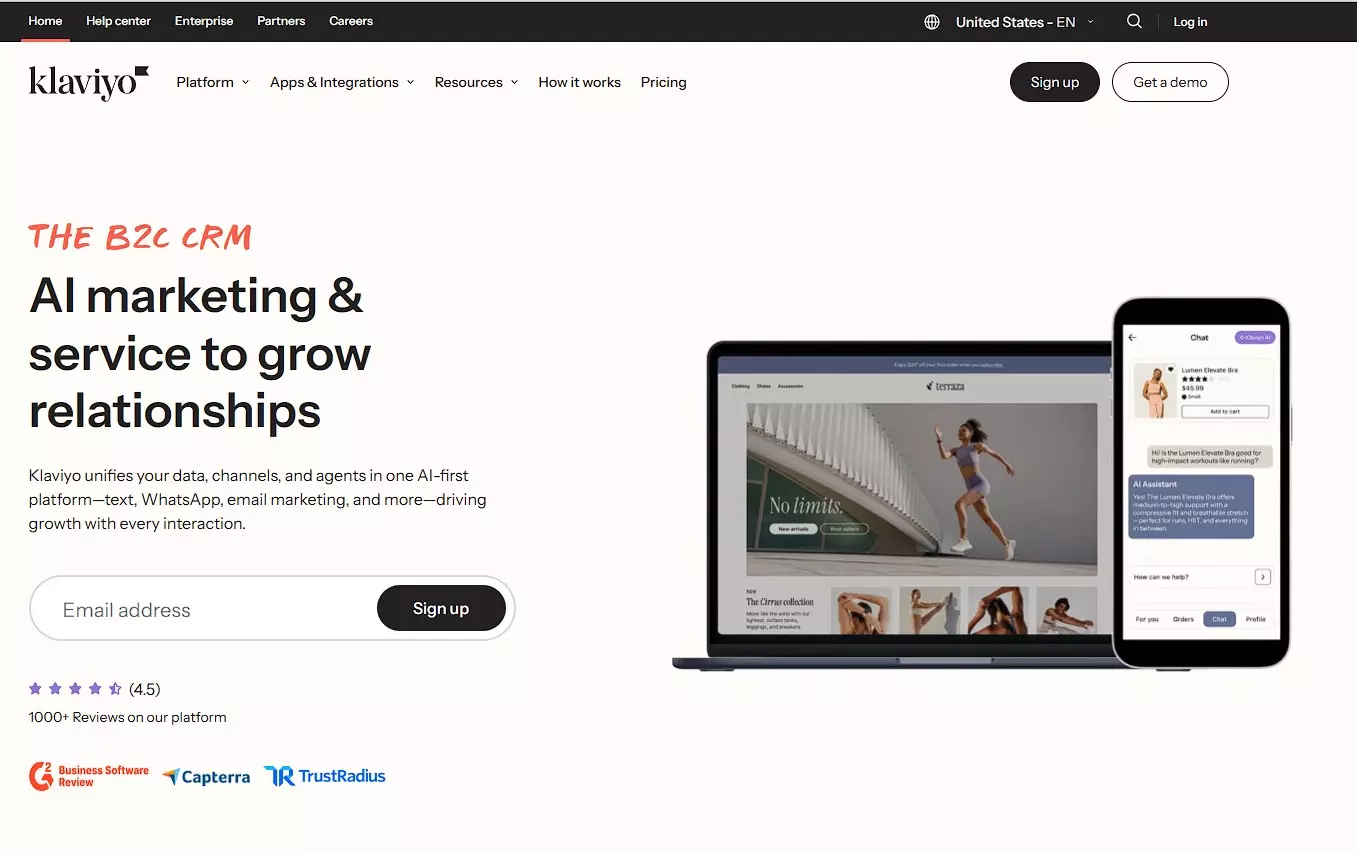
Klaviyo positions itself as an all-in-one platform for today’s enterprise marketing. It is AI-powered and offers predictive analytics and dynamic automation flows for post-purchase, win-back, and lifecycle campaigns.
The platform’s deep segmentation is based on rich behavioral and purchase data, which helps deliver highly personalized email, SMS, and WhatsApp communication as brands scale. For brands evaluating other options with similar segmentation and automation capabilities, this guide to Klaviyo alternatives offers a useful starting point.
3. HubSpot Marketing Hub
HubSpot helps enterprises automate using strong lifecycle marketing tools, omnichannel messaging, and built-in CRM integration. Ecommerce teams use it for advanced segmentation of their audiences, to improve retention, and manage customer journeys while keeping marketing and sales aligned in one platform.
HubSpot is a practical and scalable choice for companies growing from SMB to enterprise, especially when clear CRM visibility is important.
4. Salesforce Marketing Cloud
This platform is created for large ecommerce businesses with complex setups. It helps them personalize customer communication, build multi-step customer journeys, and connect marketing data with Salesforce CRM.
The Salesforce Marketing Cloud platform is best suited for companies with complex B2C or hybrid B2B–B2C models that require strong data control, customization options, and reliable performance.
5. Adobe Marketo Engage
Adobe Marketo Engage offers advanced lead management and multi-channel campaigns to ecommerce teams. It can also integrate with Salesforce and Microsoft.
This platform can be particularly effective for organizations that focus on complex buyer journeys, account-based strategies, and high-volume campaigns with detailed attribution and workflow automation.
How Yespo Powers Enterprise Marketing Automation
As an omnichannel ecommerce-focused CDP, Yespo focuses on customer data centralization to support AI-driven personalization and automation at scale. Today, Yespo is trusted by 3,500+ brands, including 300 enterprise customers.
The platform allows you to:
- combine campaign management and real-time AI-supported analytics to create omnichannel triggers or targeted campaigns;
- boost performance by gaining unique insight into customer behavior and using it for more accurate segmentation and relevant messages;
- collect customer data from websites, mobile apps, CRMs, offline systems, and communication channels to merge it into a single, unified customer profile, create dynamic content, and deliver the right messages to the right people;
- add product recommendations supported by machine learning algorithms into the website, email campaigns, or other communication channels to grow the average purchase value.
Yespo focuses on real challenges that ecommerce companies face and helps them overcome routine and inefficient processes to become industry leaders.
Want to know how Yespo can help your ecommerce brand grow?
Conclusion
EMA is about doing your marketing smarter, even when your company changes and scales. It can become a strong foundation for growing ecommerce companies, using their data, channels, teams, and strategy to combine them into a single, efficient system.
Enterprise marketing automation can make your marketing processes more effective, personalized, and aligned, leading to a stable, predictable growth. You, in turn, have to approach its implementation wisely and with clear goals in mind.


