Content
13 February 2026
2702
14 min
5.00
Gamification in Ecommerce: Mechanics, Examples, and Implementation Tools

Valeriia Shudryk

Yulia Sadovska
Content
In our previous article, we defined ecommerce gamification and explored how it addresses challenges throughout the customer journey – from customer acquisition to repeat purchases.
Now, let’s get practical. We’ve curated a list of game mechanics, formats, and workflows that brands leverage for lead generation, driving sales, and customer retention.
Examples of Gamification and Game Mechanics in Ecommerce
In ecommerce, gamification works across different channels and touchpoints – depending on the goal and context of the interaction:
- In popups: To engage and retain visitors who are about to leave the site.
- In email campaigns: Using AMP technology to enable gameplay directly within the inbox, eliminating the need to click through to the website.
- On separate landing pages, where the user arrives via a link from SMS, messenger, or Push notifications.
Let's dive into the most effective ecommerce mechanics.
Chance-based Games
A popular category for quickly collecting leads and fighting banner blindness. It is based on a dopamine hit triggered by an unpredictable win. They are perfect for holiday sales, as they invite customers to spin for a discount.
Marketing objectives: Database collection and increased sales.
How it works: The user spins a wheel, removes a protective layer, or chooses from several gift boxes. Receiving a reward with minimal effort brings satisfaction and encourages them to leave an email or complete an action.
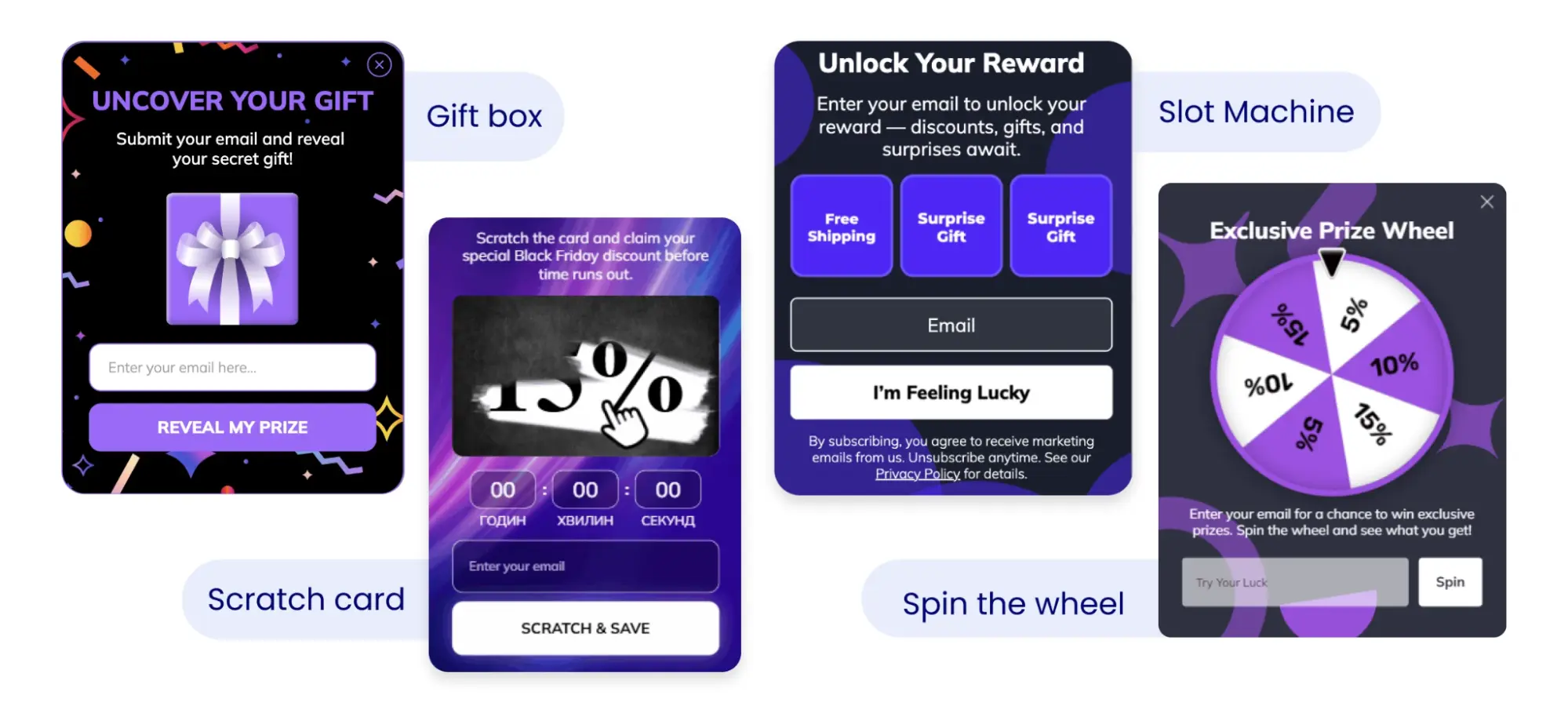
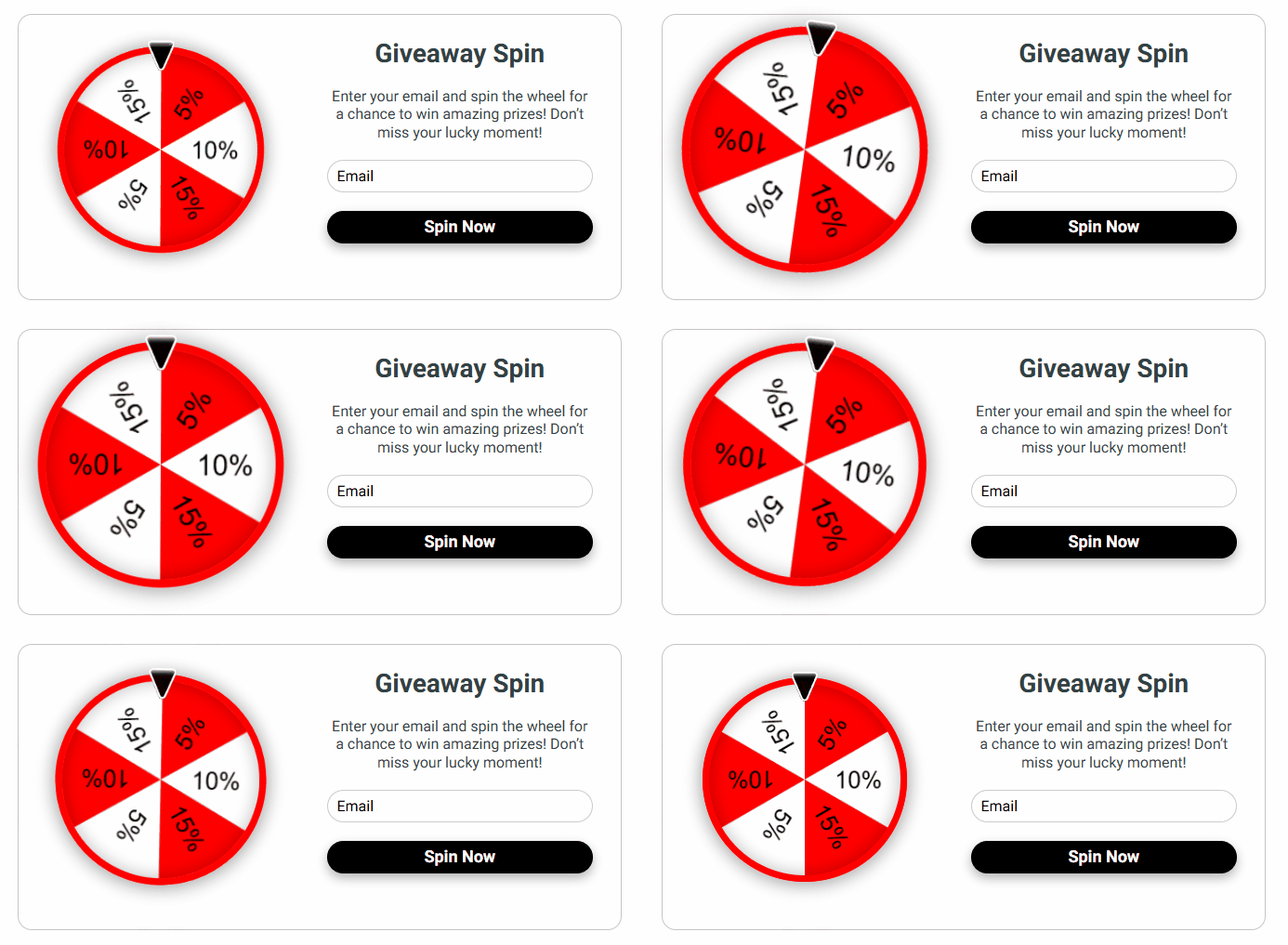
Spin the Wheel
The user spins the wheel and receives a random prize.
Case Study Example
Kärcher invited subscribers to spin a wheel directly within the email to win seasonal prizes and discounts.
Goal: To encourage customers to use discounts before a certain date.
Result: OR increased from 27% to 38%, and CTR, from 2.9% to 6.6%.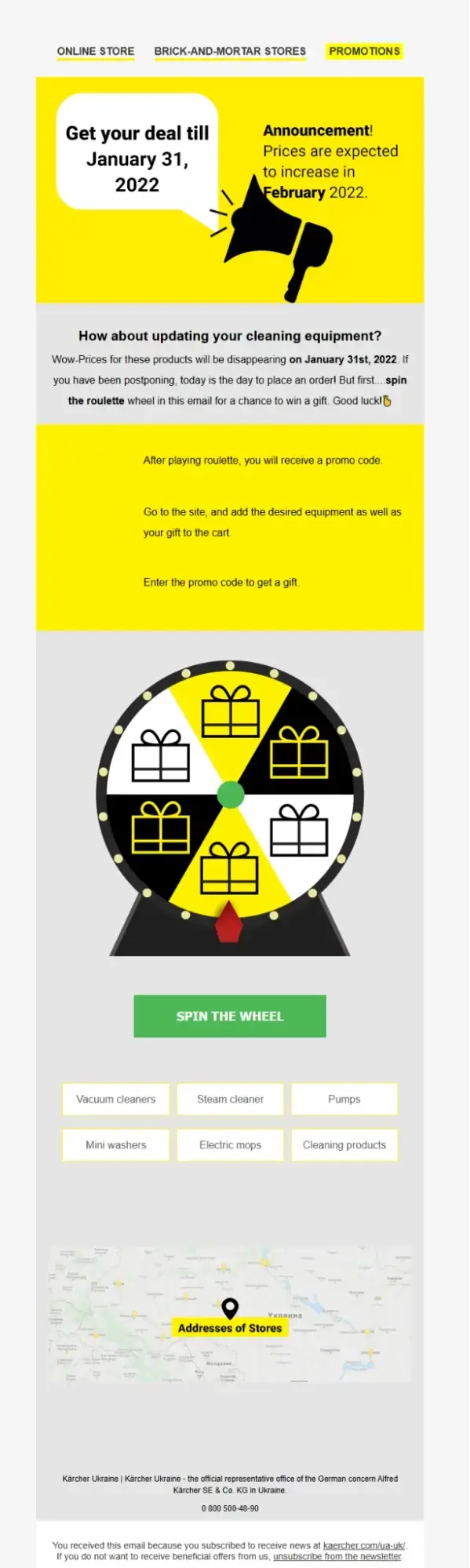
You can test the wheel in the web version of the email via this link.
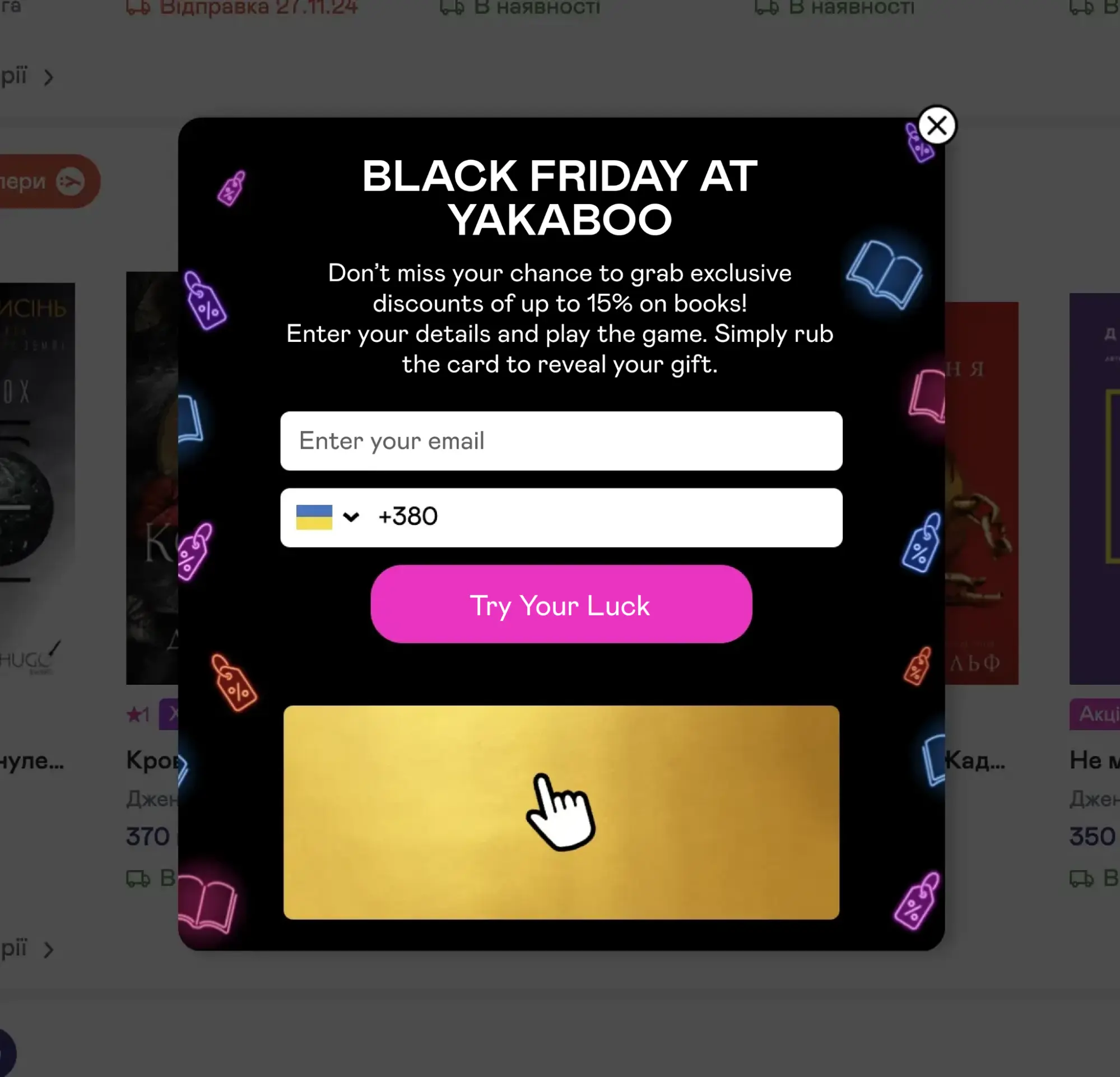
Scratch Card
Modeled after lottery tickets. The user "scratches off" the protective layer using their cursor to reveal a hidden discount code.
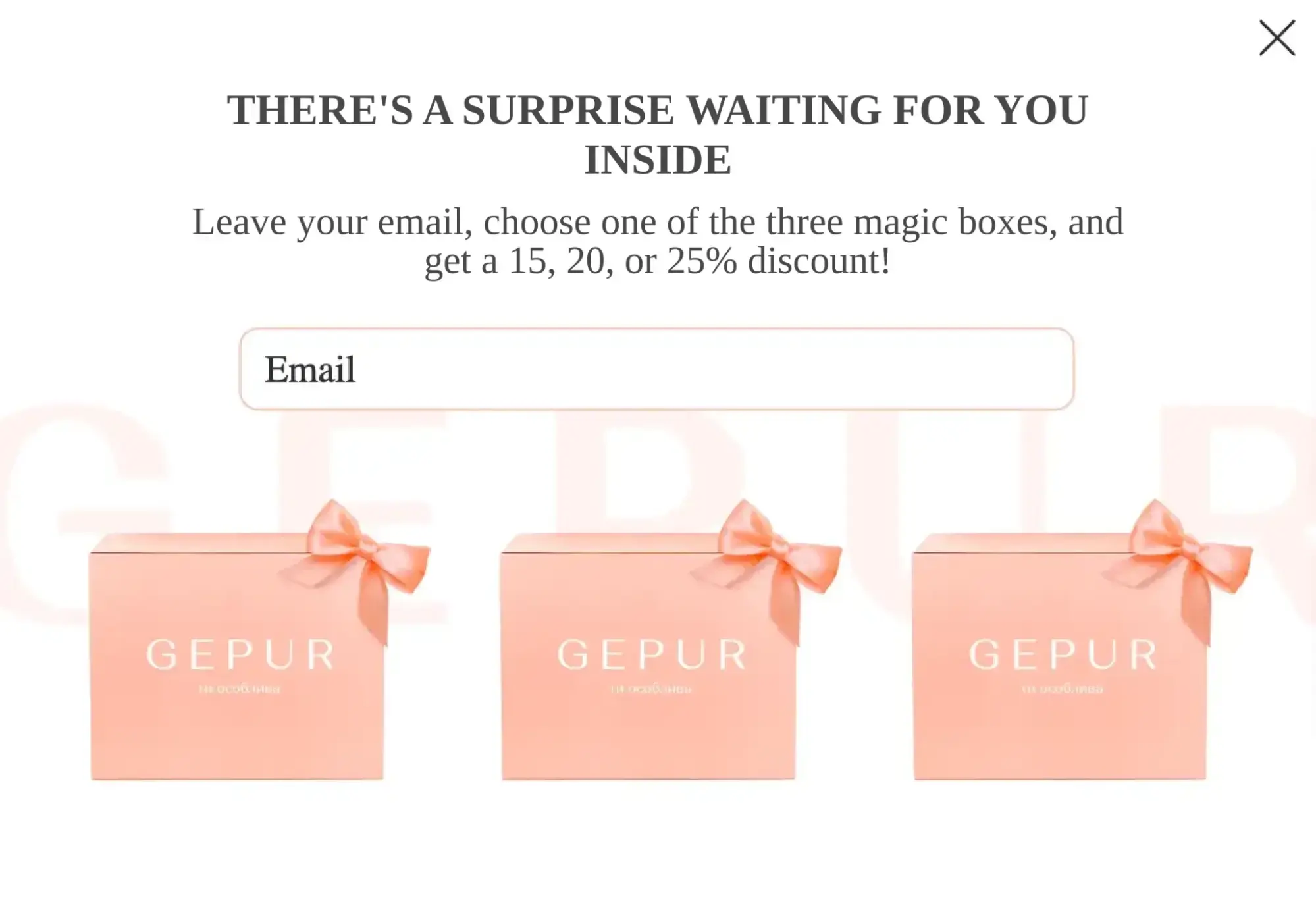
Gift Box
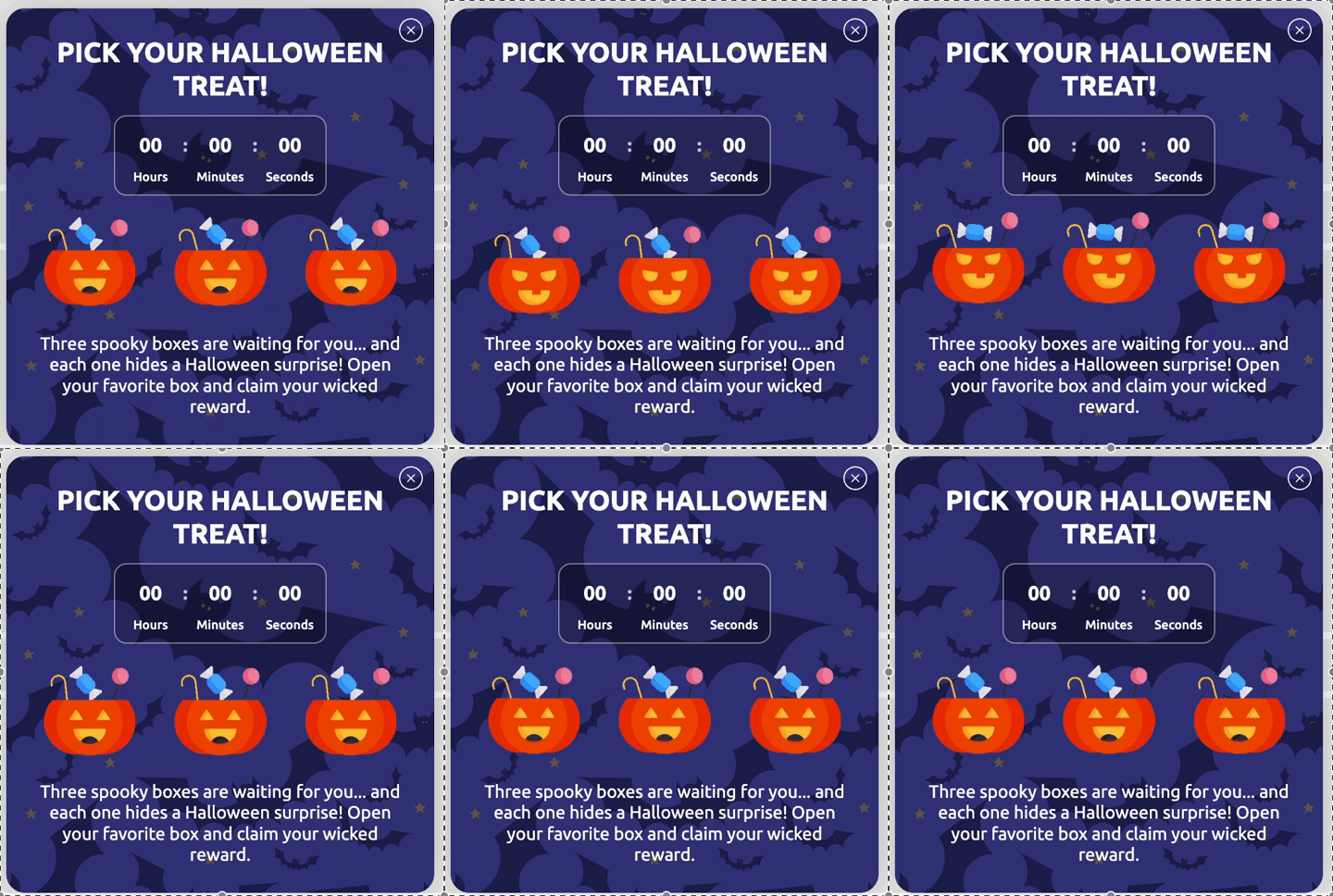
The user chooses one of the boxes without knowing what is inside. It is possible to configure settings to allow another attempt in case of failure.
Case Study Example
GEPUR, a womenswear brand, displayed a Gift Box widget with three mystery boxes to new visitors.
Result: 9x more subscribers compared to a static signup form, and promo code redemption tripled.
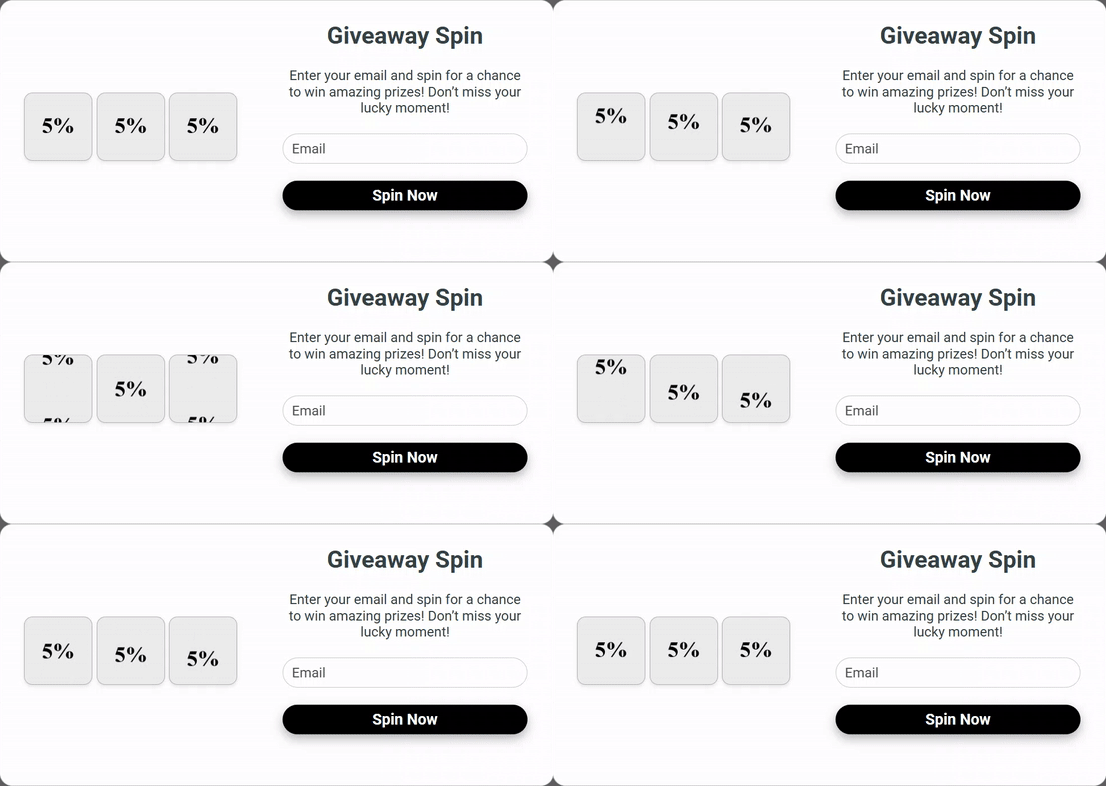
Slot Machine
Hitting the button spins the reels to land on a winning combination.
Your customers are ready to play. Are you?
Puzzle Games
These require time and focus, as the outcome depends on the user's skills. They increase time on site and build an emotional connection with the brand.
Marketing objectives: Increasing loyalty and customer retention.
How it works: The user solves a puzzle, enjoys the process, and earns a reward upon completion – a bonus, a discount, or a non-monetary perk (for example, a thank-you message or a result score).
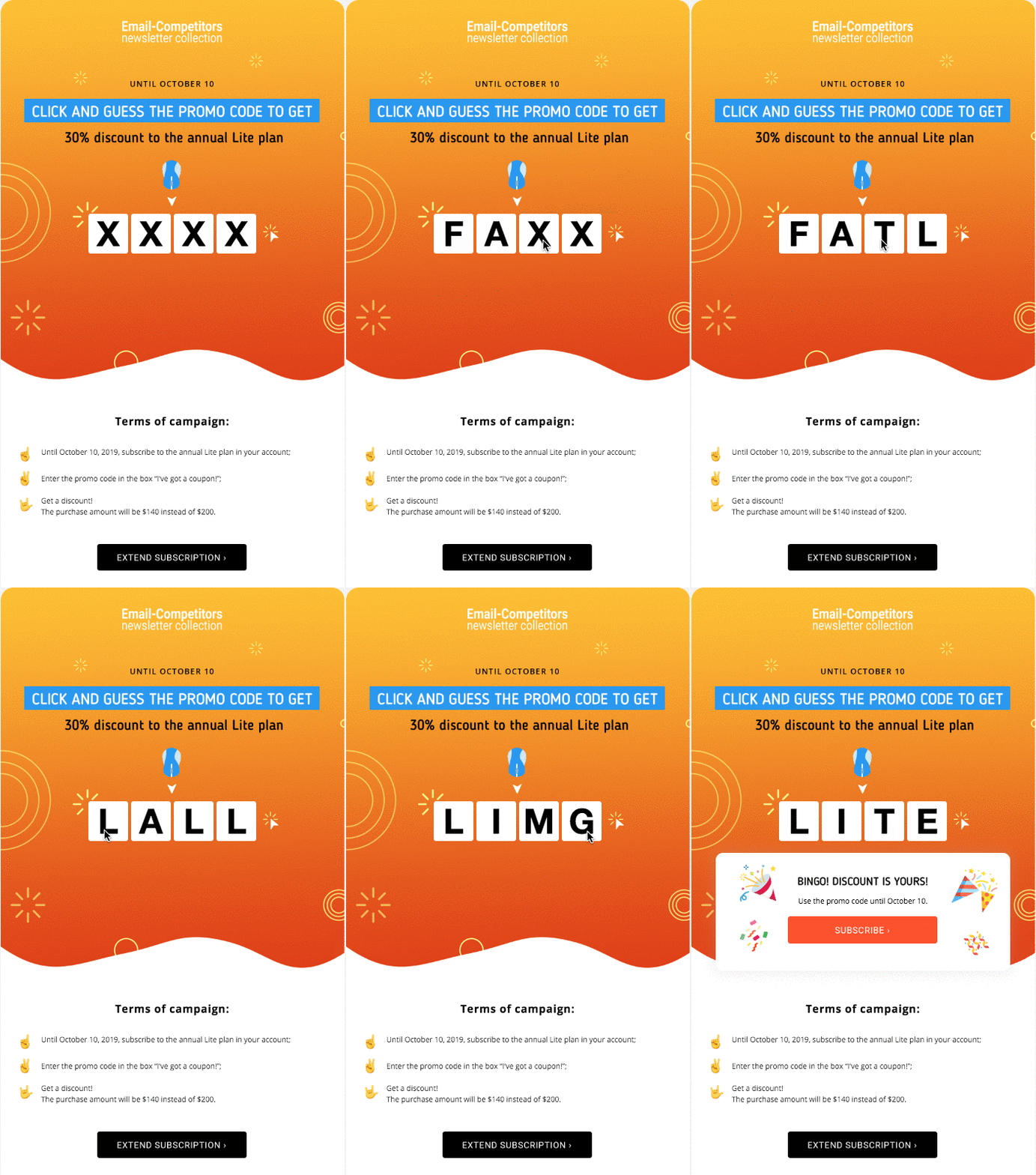
Brain Teasers & Jigsaw Puzzles
Challenges that require the user to assemble an image or guess a word.
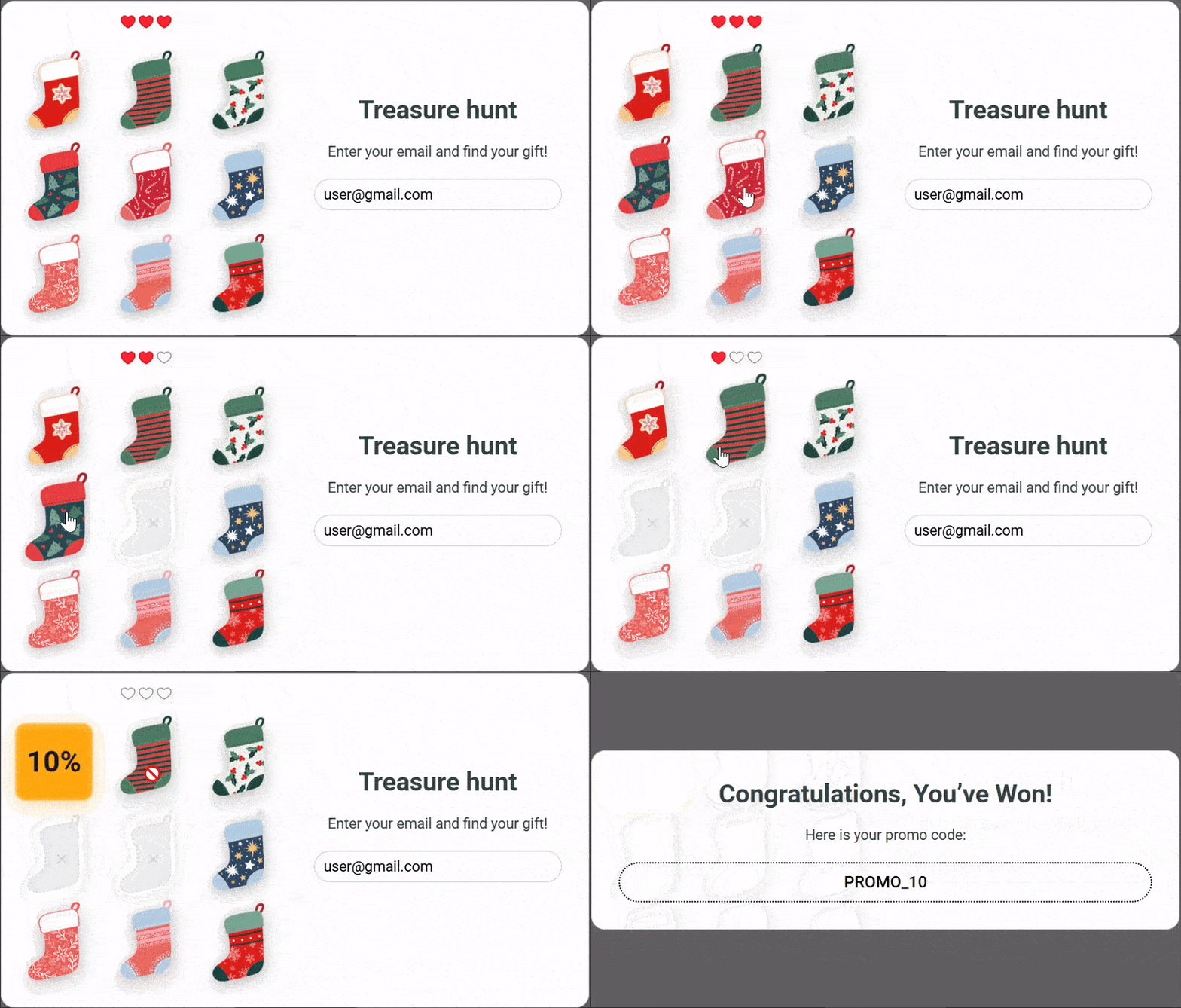
Treasure hunt
The user has a limited number of attempts to find a hidden prize behind one of the images.
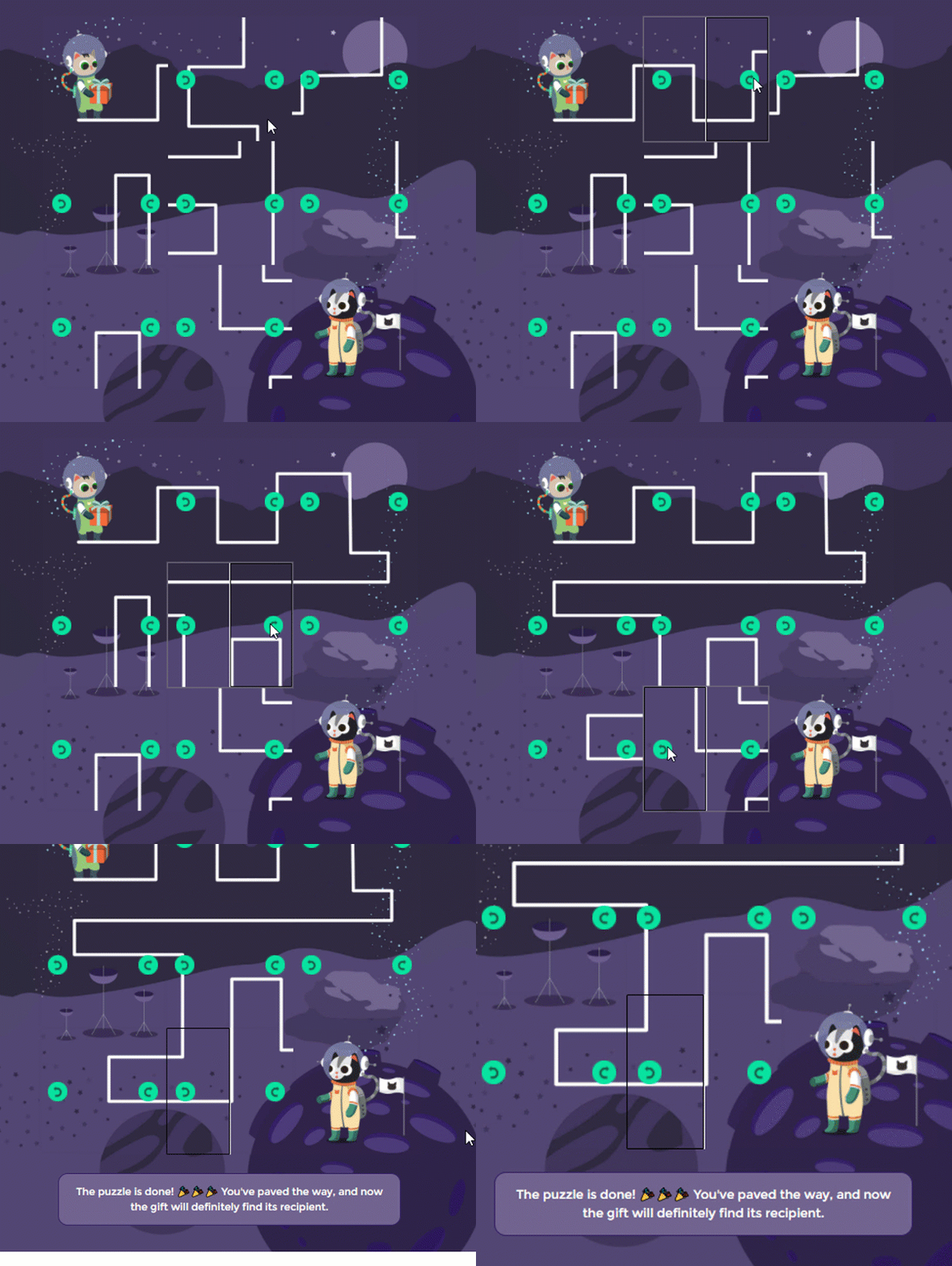
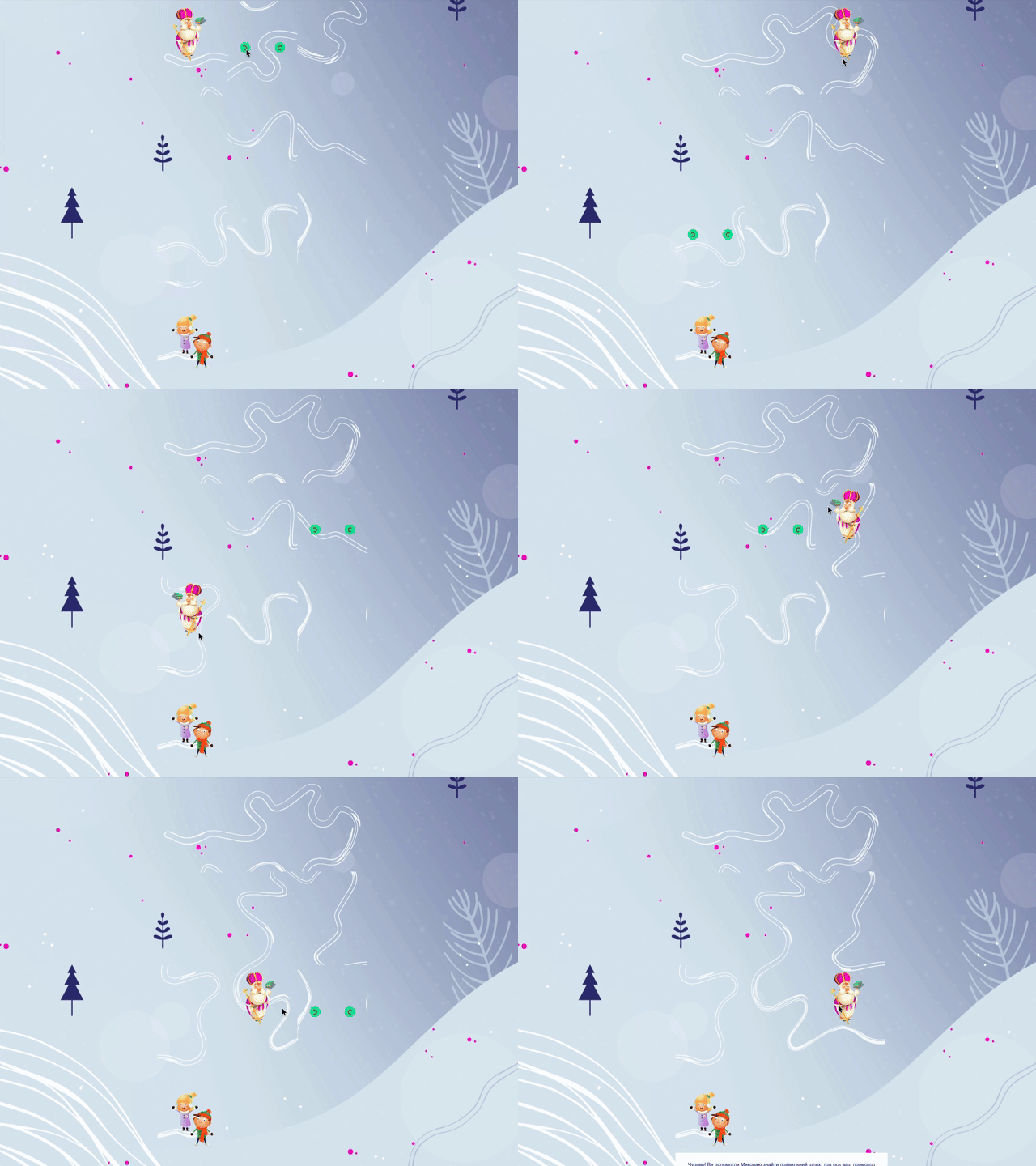
Mazes
Players need to solve or navigate through a maze to reach the finish line.
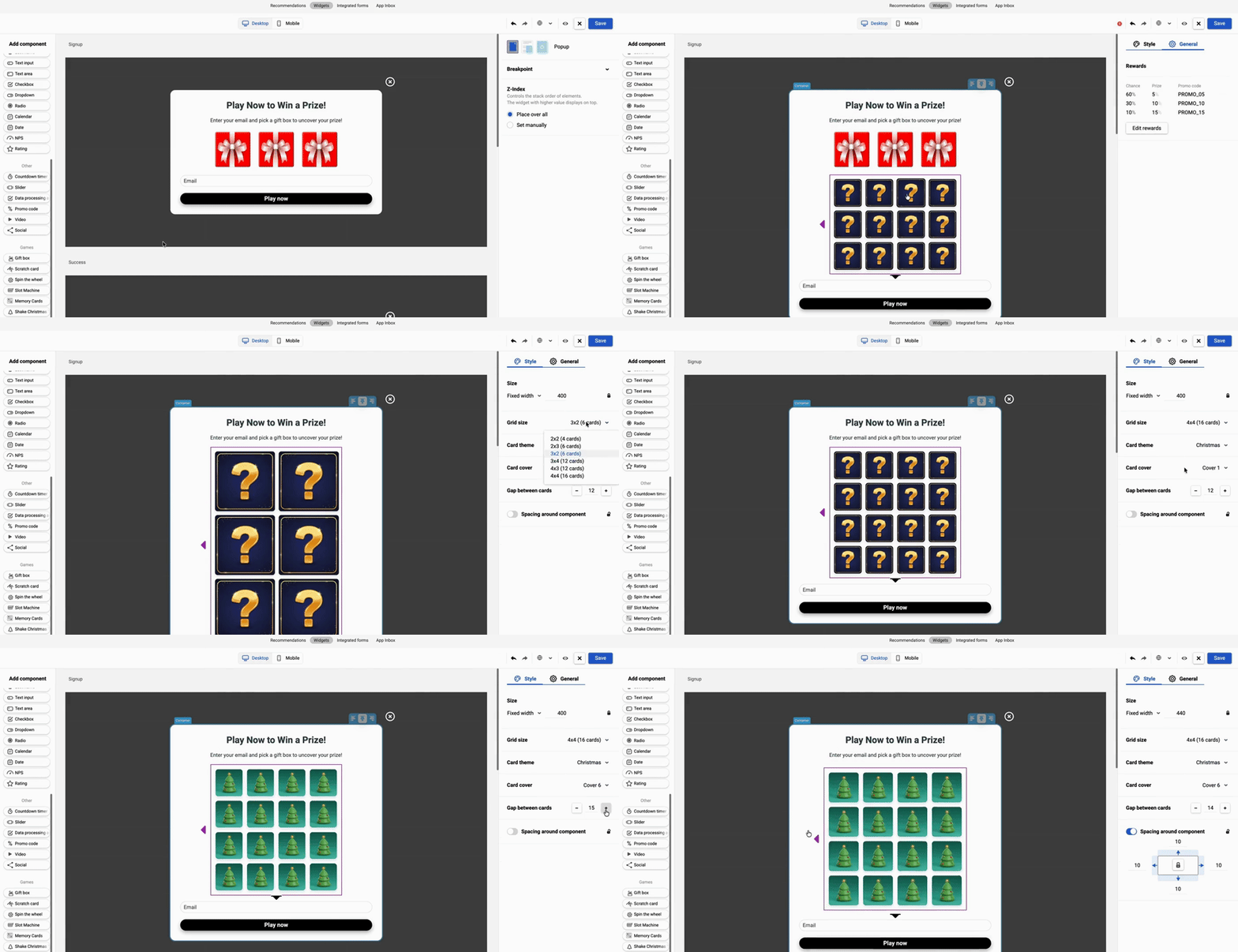
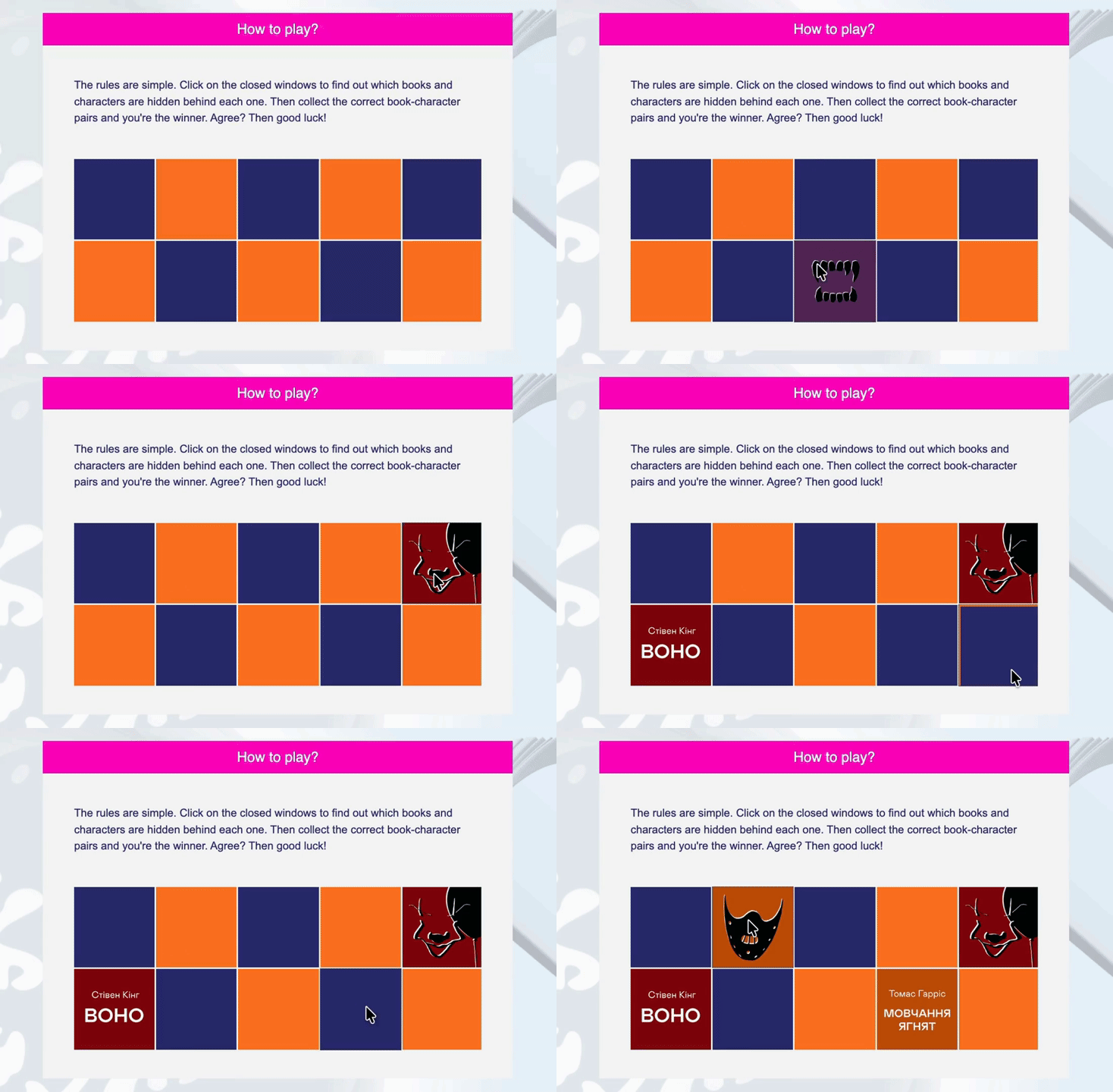
Match the cards
A classic memory game where players flip cards to find matching pairs. The Yespo editor currently offers 3 themes – Winter Holidays, Fruits and Animals – and 7 card back designs.
Discovery and Educational Games
These games plunge users into an immersive environment focused on exploration and learning something new.
Marketing objectives: Boost brand awareness, drive audience engagement, grow the subscriber list, and support product launches.
How it works: Users test their knowledge or uncover new information. Beyond any bonus, the core value comes from the learning experience itself.
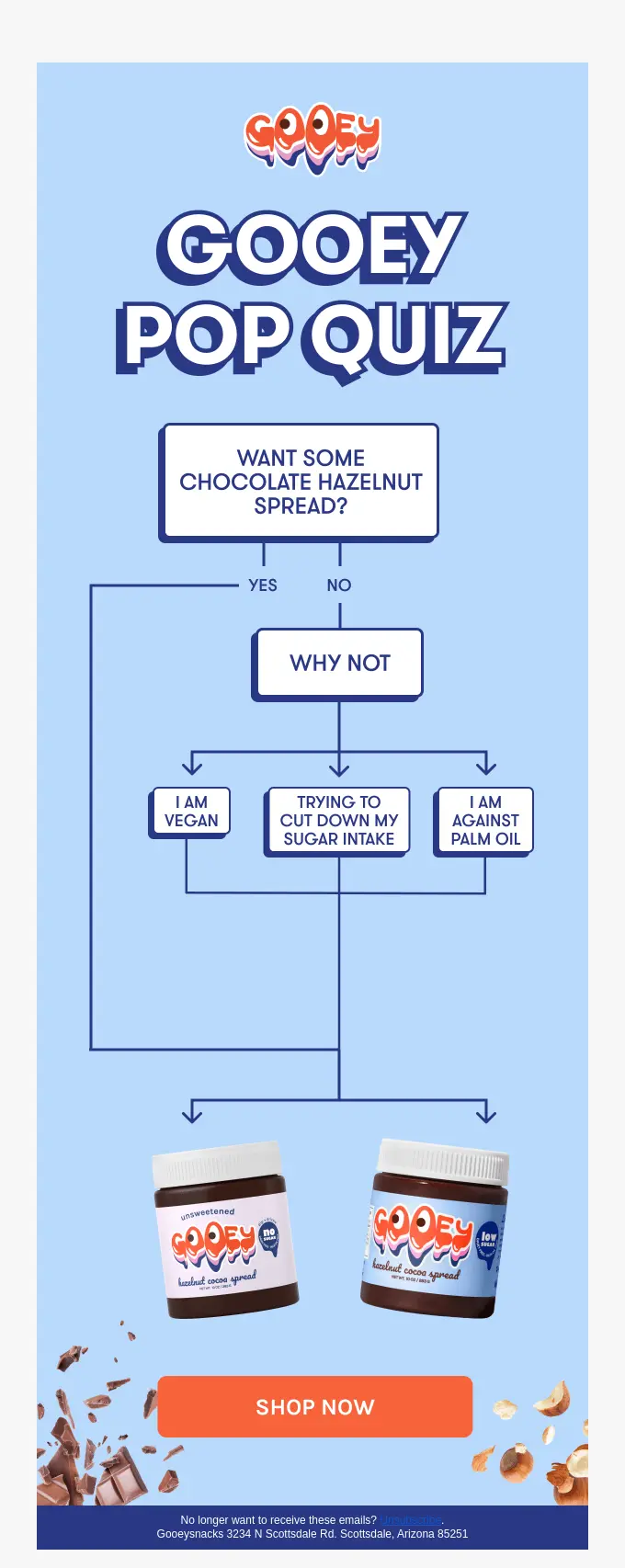
Quizzes
Questions about a product, brand history, or general facts. A game developed once can be used for various occasions by changing the images and text.
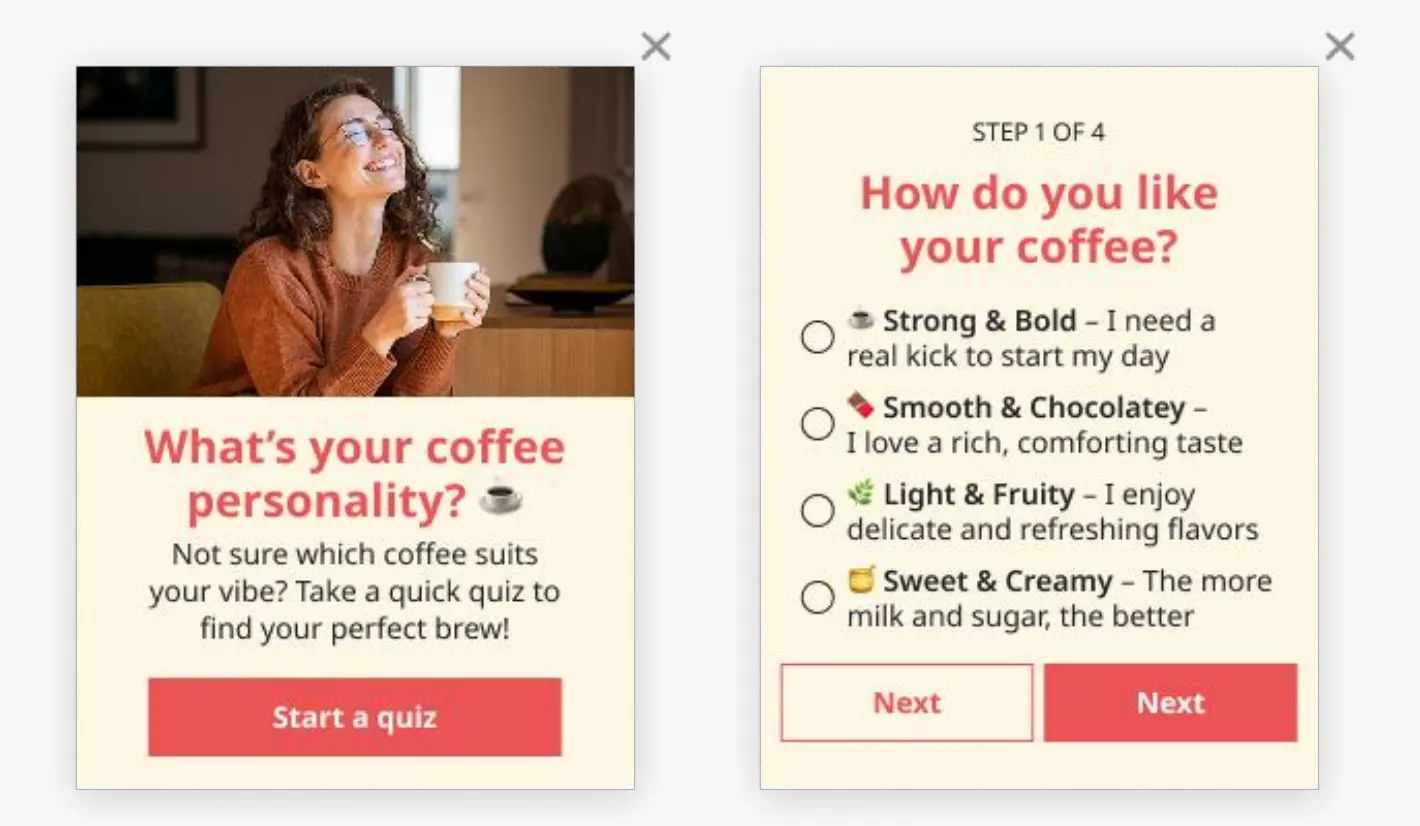
Personality Tests
The user takes a test, answers questions, and in the results, sees a personalized product recommendation based on their answers.
Advent Calendars
The user gets a daily reason to interact with the brand – opening a new window with a surprise. This mechanic is especially relevant during seasonal campaigns, as it involves prolonged interaction with the audience – typically from 7 to 24 days.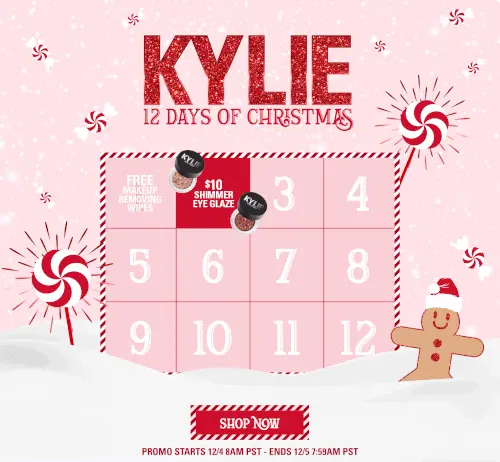
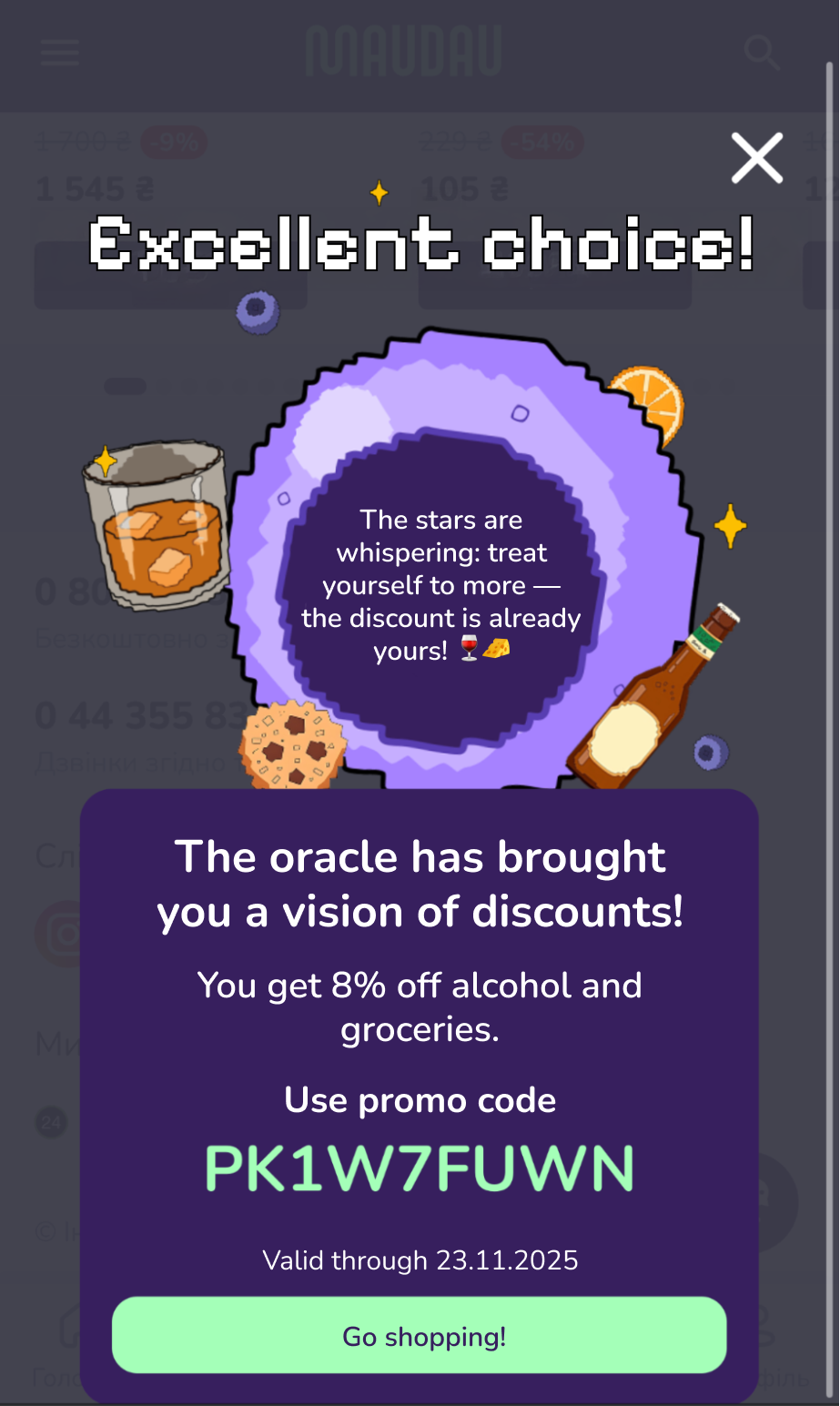
Fortune Telling
The user clicks an element – a magic ball, a cookie, or another chosen object – to receive a prediction or advice linked to a product recommendation.
Skill and Competition Games
More complex mechanics that require specific actions and user effort. They work well for a loyal audience. Players can compare their results with those of other participants and feel satisfaction from the competition.
Marketing objectives: Customer acquisition and retention, boosting brand awareness through user-shared results.
How it works: These games tap into our love for social interaction, competition, and a sense of community.
Match Three
Matching identical elements to score points. A complex mechanic that requires a dedicated landing page.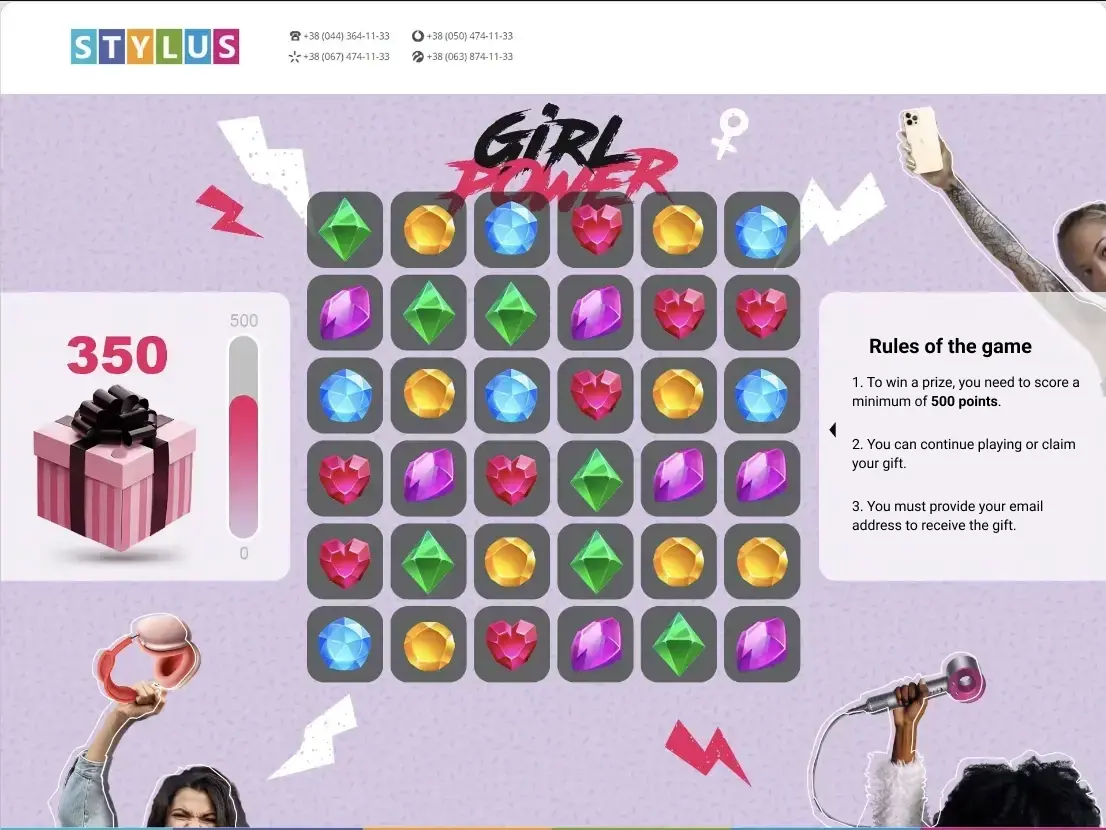
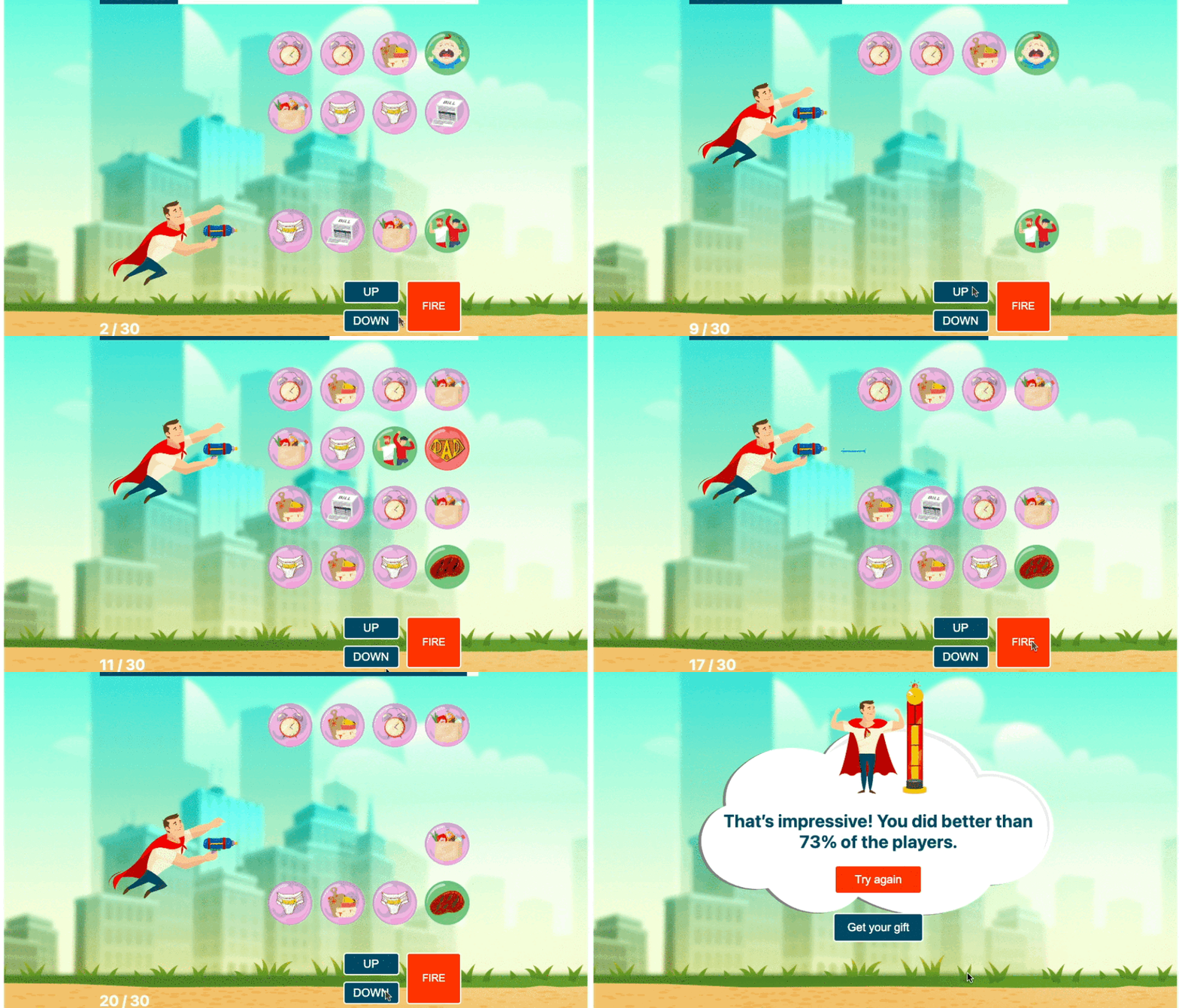
Arcade Games
Simple reaction-based games, for example, "catch a falling discount" or bubble shooters.
Creative Games
These allow users to create something unique. Players enjoy expressing creativity and seeing their ideas come to life, which creates a personal connection with the brand.
Marketing objectives: Boosting brand awareness (especially when users share their creations on social media), driving engagement, and fostering customer retention and loyalty. Creative challenges are also a perfect fit for holiday or company anniversary campaigns.
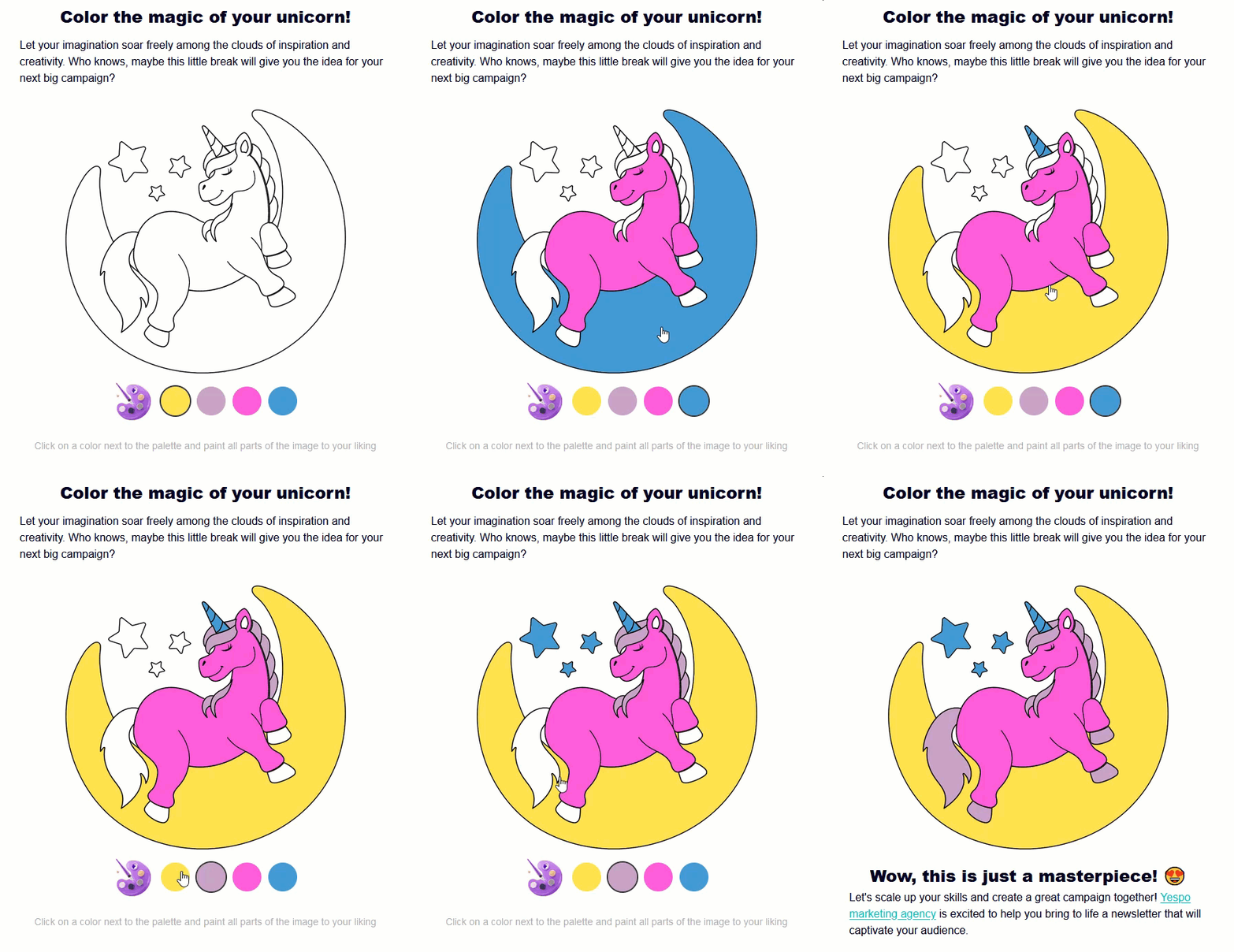
Interactive Coloring Pages
Let users color a picture or a character directly inside an email. Interactive coloring pages are a great way to capture attention without offering a discount. Their engaging format sparks curiosity and encourages users to share their finished artwork on social media or in messengers.
One of Yespo’s case studies is an email for Unicorn Day. It generated a lot of audience reaction and inspired others to try a similar approach.
Dress Up
In this game, users were invited to assemble outfit options for a vacation. The mechanic was dedicated to Marketer's Day, attracted attention, evoked positive emotions, and prompted action.
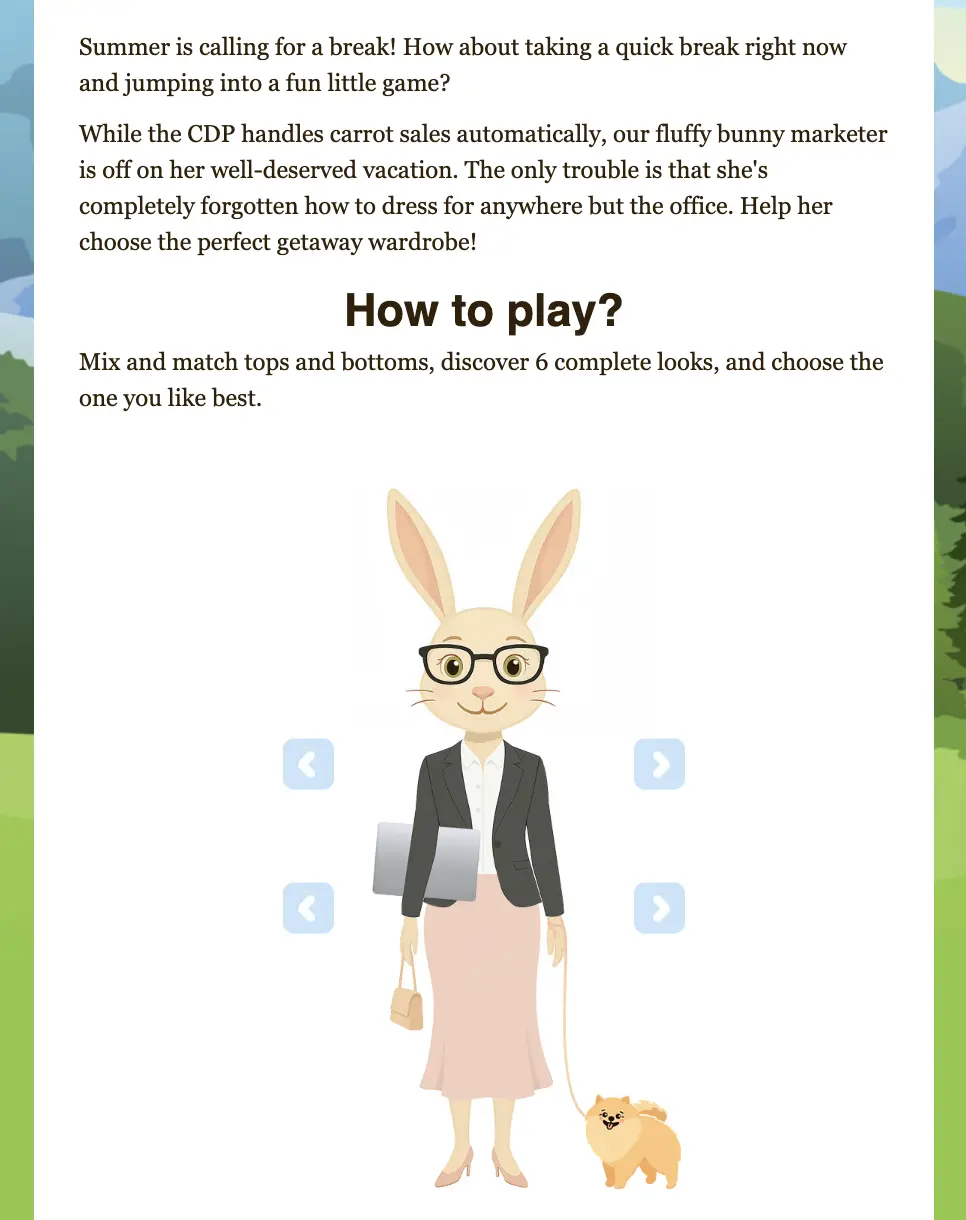
You can see the full version of the email and play via the link.
Gamification and CDP
For gamification to be a strategic tool rather than a random promotion, you need data: who the user is, how they behave, and the context of the interaction.
A Customer Data Platform (CDP) collects this data and unifies it into a single customer profile. This allows you to launch not only the same games for everyone but also to show relevant gamification to specific segments: active buyers, new customers, or those who haven't interacted with the brand for a long time, as well as link workflows to user actions.
Single Customer Profile
The platform receives data from various sources – websites, mobile apps, CRMs, email campaigns, and even offline purchases – and combines them into a 360° user profile.
Gamified mechanics (surveys, quizzes, gift selection, etc.) let you collect not just contact information but also customer preferences. A CDP merges this data with browsing and purchase history to enable further segmentation and personalization.
But a CDP is not just a storage facility; it is a control center for managing customer data, which allows communication across 9 channels, including launching game mechanics, analyzing their effectiveness, and automatically reacting to customer actions.
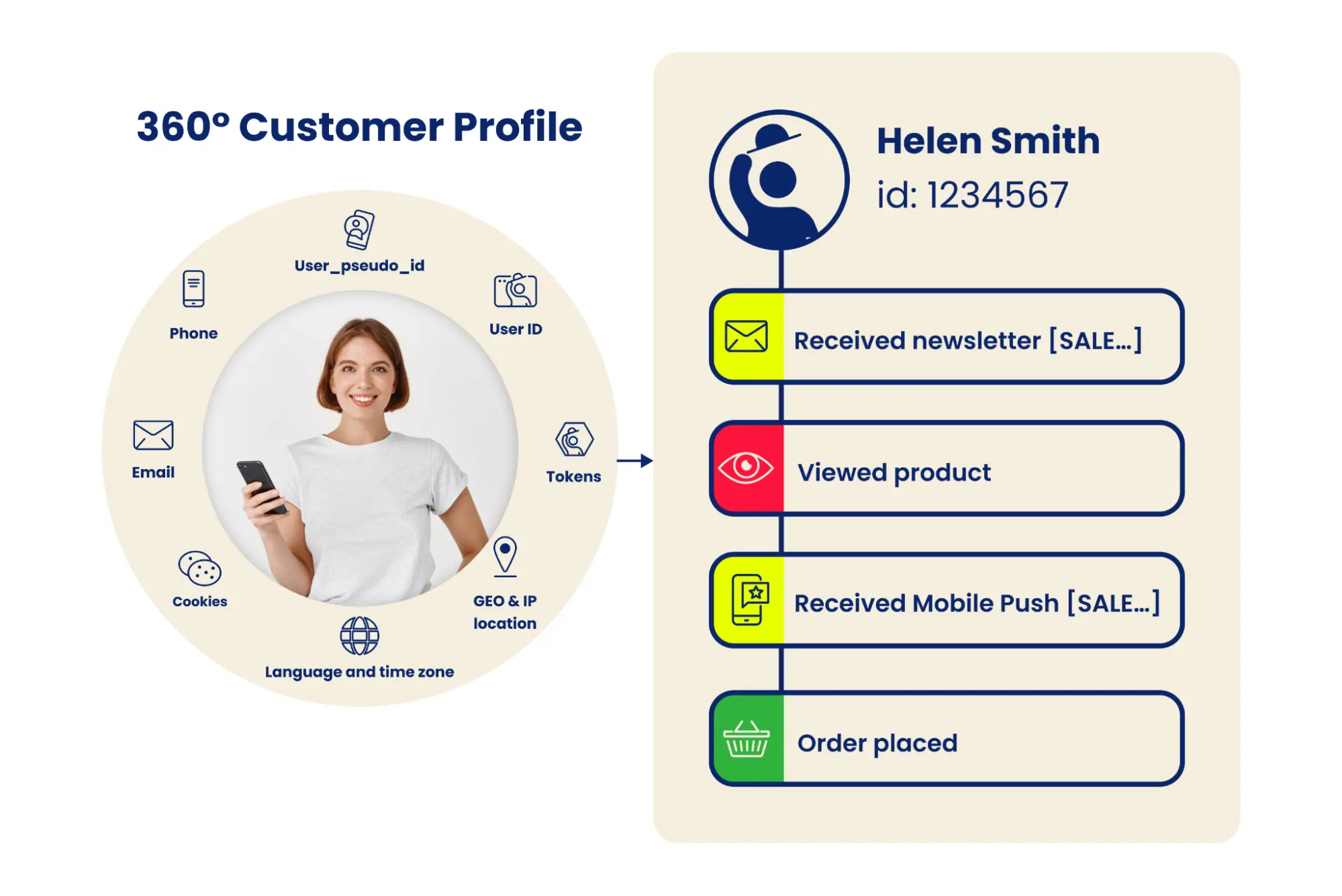
In the Yespo CDP, each profile contains:
- key identifiers: email, phone, cookies, user ID, push tokens;
- behavioral events: views, clicks, purchases, email opens, message reactions.
This data is automatically supplemented with context – device, geolocation, traffic source, and time of activity. Thus, a CDP forms the foundation for personalized gamification.
The customer profile is always up to date because data in the CDP is received and processed in real time.
Choosing the right gamification for your goals is easier than you think
Effortless Game Creation with Templates
Using Yespo templates, you can create different types of game mechanics without involving programmers.
A marketer can independently customize the design, win probability, and prize types (discounts, bonuses) within the platform's interface.
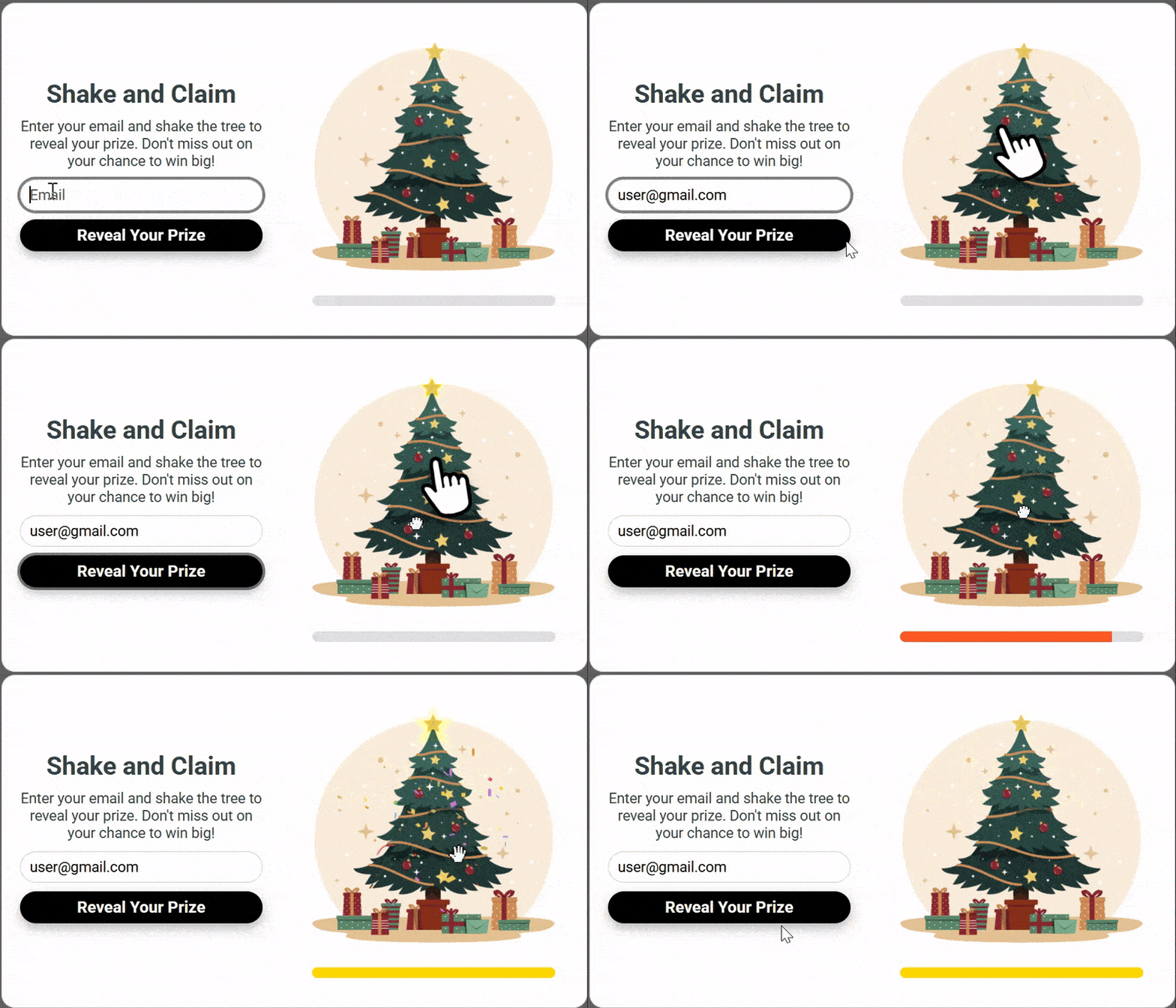
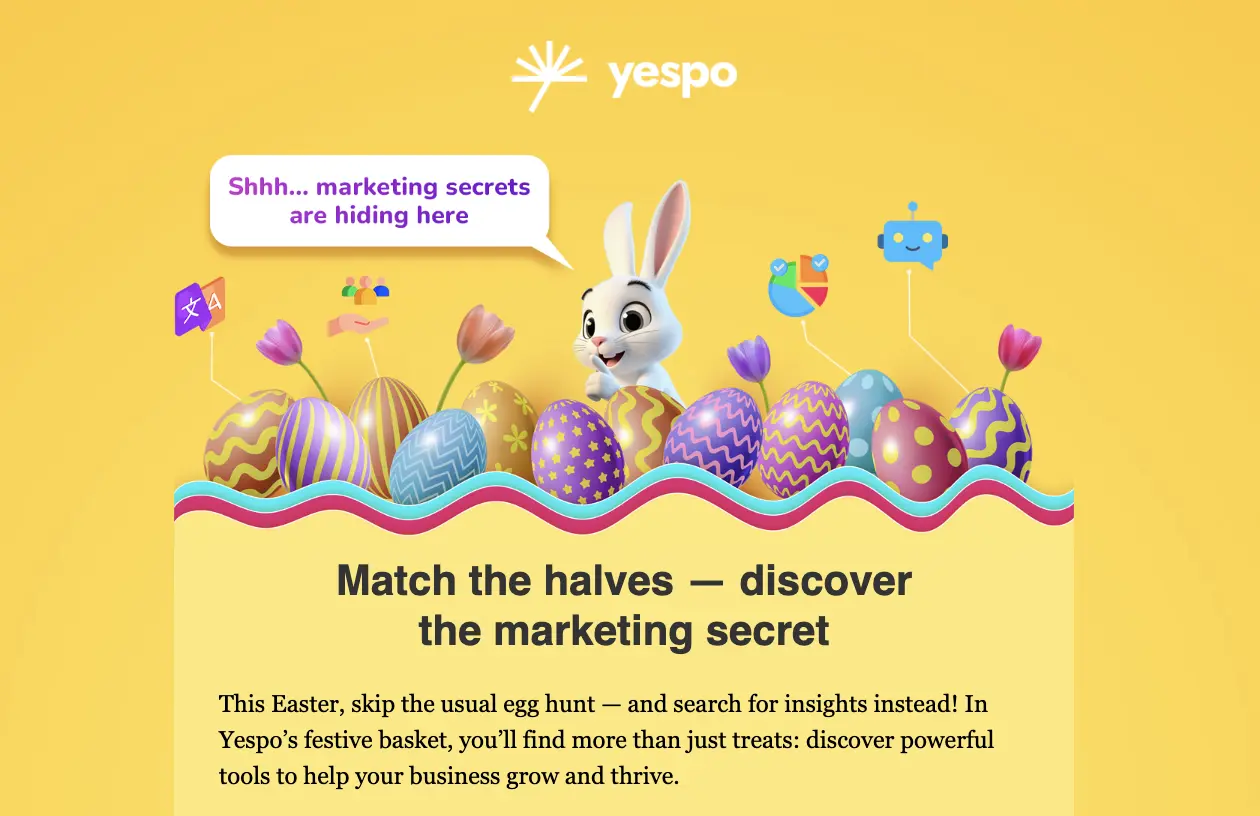
You can view the full version and play via the link.
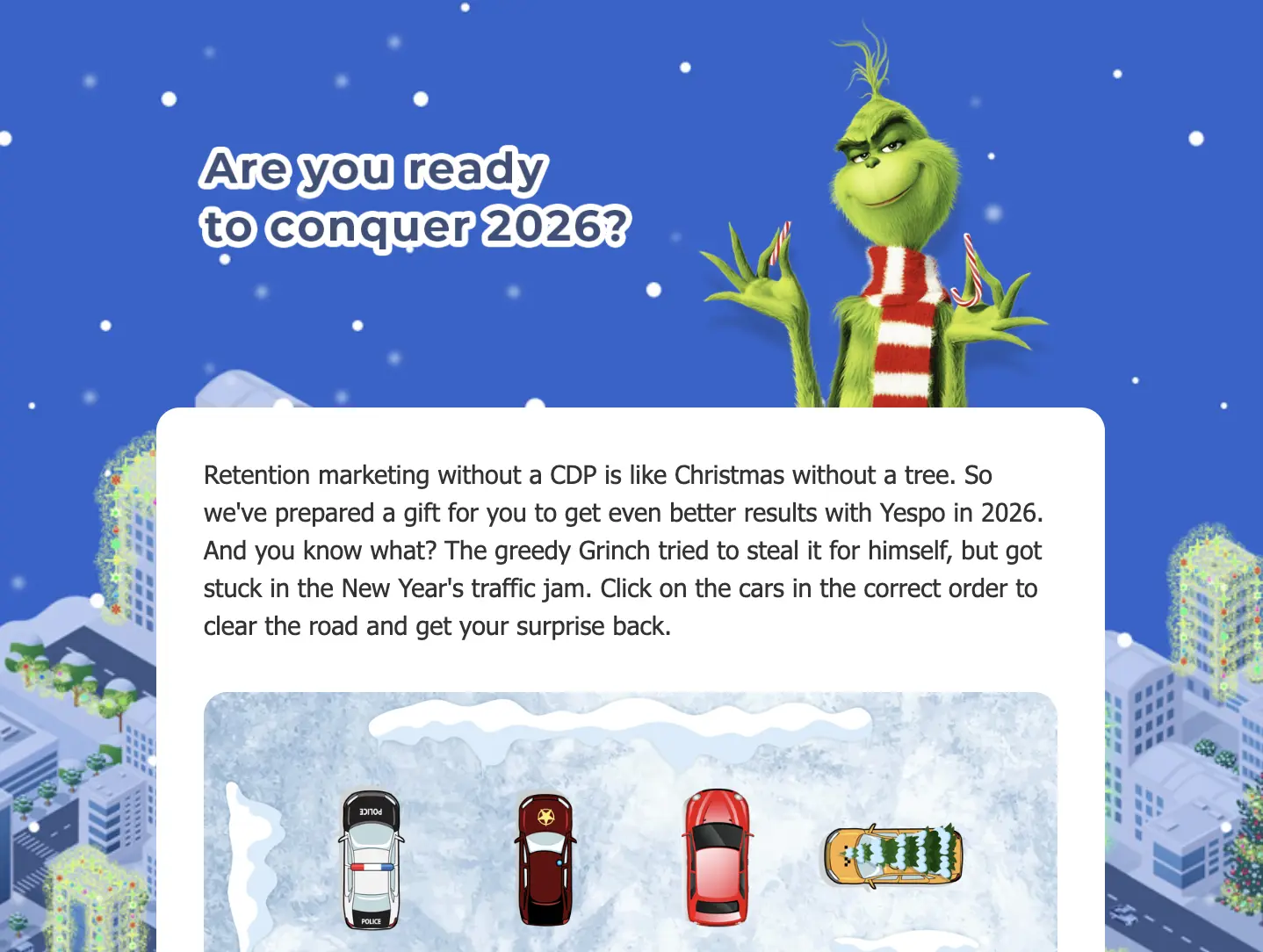
You can view the full version and play via the link.
Add gamification to marketing campaigns without complex development
Omnichannel Workflows
Omnichannel is not just the use of multiple channels, but their coordinated work based on unified customer data. The CDP allows you to build interaction chains where a game is just one of the touchpoints. A few examples of omnichannel workflows:
- Automated prize delivery. A user spins the wheel in a widget on the site. The system records the win and automatically sends a promo code via email, SMS, or messenger, so the user doesn't lose it, and the interaction continues.
- Cross-channel continuation. You can launch a game in an email and use the results to personalize product recommendations on the website or in the mobile app, as all channels are connected to a single system.
- Reactivation. An email with a gamification element is sent to customers who haven't purchased in a while. If the customer doesn't open the email, the system automatically sends a notification via messenger or SMS.
Automation of Gamified Campaigns
Gamification without automation and audience segmentation doesn't deliver the expected results and isn't scalable: workflows have to be manually corrected, data have to be checked separately, and user reactions to actions are lost. As a result, campaigns lose their effectiveness.
At Yespo, a large portion of manual work is replaced by omnichannel workflows: the system tracks a click (e.g., game participation or purchase), links the action, and sends an email/push/message to the right user based on the next workflow.
Campaigns are configured in a drag’n’drop, no-code editor; data from widgets and events automatically updates contact profiles, and progress and rewards are displayed instantly.
For example, thanks to automated, gamified mechanics, the brand Stylus achieved a +150% increase in revenue and a +8% increase in new active contacts during the promotion period.
In Yespo, gamification mechanics, data, and automation are combined into a single ecosystem, turning gamification into a part of a full-fledged omnichannel strategy rather than a one-time campaign.
Campaign Analytics
Any gamification is meaningless if you can't measure exactly how it works. Therefore, the Yespo system tracks user actions – opens, clicks, wins, post-game purchases – and links them to the user's profile.
The data helps evaluate not only the overall CTR or conversion rate but also the impact of gamification on other indicators:
- LTV (Customer Lifetime Value)
- Rate of repeat purchases
- Average order value
- Share of newly acquired users in the total database.
All of this is available on the Yespo platform in dashboards and dynamic reports.
A Home Page Performance Dashboard helps you quickly understand how campaigns are performing overall and within specific channels or message types.
The panel consists of four sections:
- Overall campaign results across all channels for the selected period
- Detailed statistics for each channel
- A report on workflows and identification of the most effective ones
- Top-performing bulk campaigns.
Statistics can be viewed in absolute numbers and percentages, and filters by period and channel allow you to compare trends.
A separate widget interaction report displays detailed analytics for each game: unique views, clicks, subscriptions, conversion rate (views per subscription or click), and new contacts.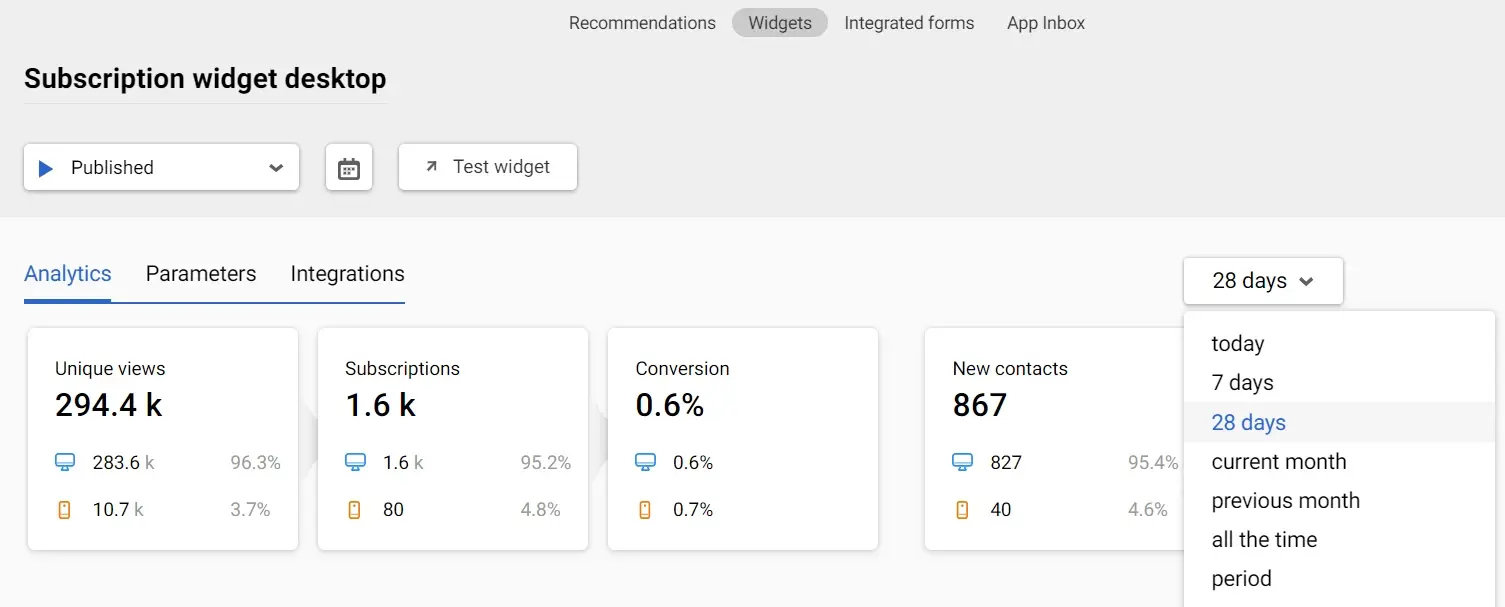
Data is broken down by device (desktop/mobile) and time period, with dynamic activity graphs that update every minute.
If order tracking is configured, the report shows the revenue generated, the number of purchases, and the average order value.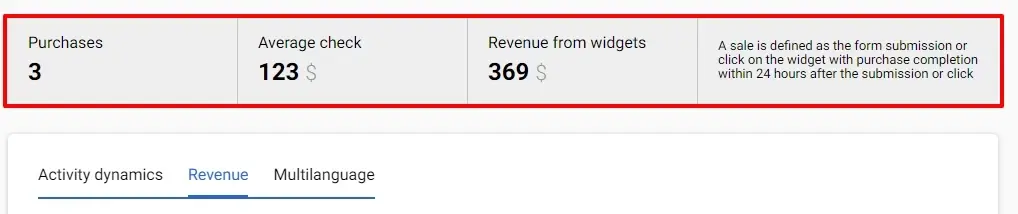
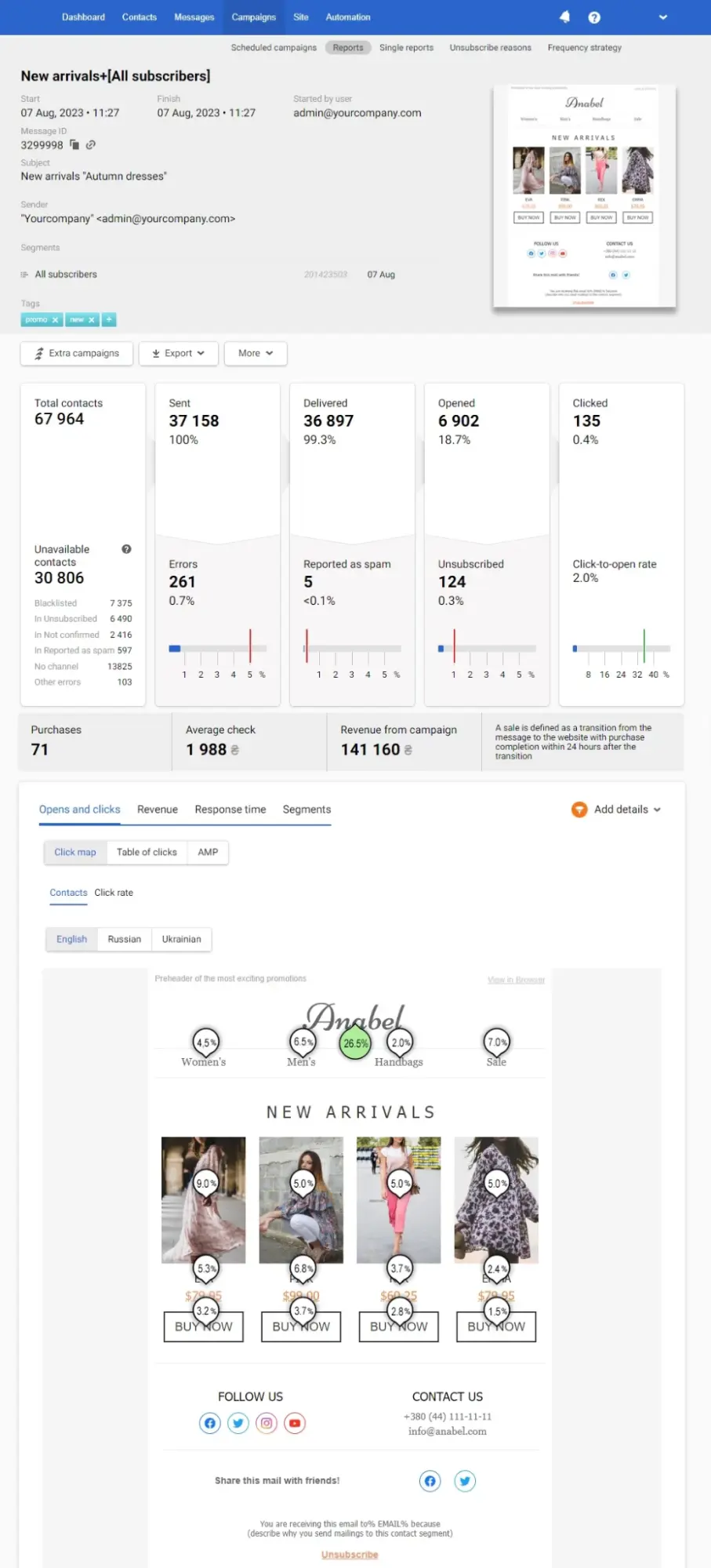
Email campaign reports can be divided into 4 main sections:
- General information
- Performance indicators
- Revenue
- Detailed statistics
In the Yespo CDP, gamified workflows can not only be launched but also continuously improved by testing mechanics, segments, and rewards, and updating campaigns based on data.
Final Thoughts
In this article, we've explored various game mechanics and how leading brands use them to drive results. The key takeaway is this: for gamification to be truly effective, it’s not enough to just pick a fun mechanic. You must strategically weave it into the customer journey, considering the right channel, context, and user behavior. Only then do game workflows become seamless and integral to the customer experience.
Ready to explore which game mechanics are right for your business? Let's discuss how to integrate them into your current marketing strategy. Book a free consultation to start the conversation. Our specialists will showcase the platform's capabilities and help you assess how gamification can drive growth for your ecommerce business.