06 April 2026
874
11 min
0.00
AURUM Case Study: 2x ROI and AOV with Viber Carousel

Kseniia Petrina

Yulia Sadovska
Have you ever looked at a product image and immediately thought, “I want this ?”? Sometimes you don’t even need to read the description or spend time comparing it with something else — you just feel that this item should be yours.
This is exactly how properly selected product recommendations work. And thanks to the Yespo CDP capabilities, you can create not only highly relevant offers for each customer but also confidently experiment with content presentation.
In this article, we’ll explain how the AURUM brand, together with the SMSBAT provider, initiated Viber carousel support on our platform before the official announcement and were the first to test the new functionality. Read the article to the end to discover which product cards are more effective and implement best practices in your communication.
|
Challenge |
Viber carousel support setup. Improving campaign performance through the use of a new format. |
|
Solution |
Development of functionality in the Yespo CDP. Implementation of the Viber carousel in promotional campaigns, active hypothesis testing to identify best practices. |
|
Resources |
AURUM: Head of E-commerce, Retention Marketer SMSBAT: Founder, development team Yespo: Customer Success Manager, product team |
|
Results |
+10% CR 1.75x CTR 2x ROI 2x AOV |
About the Project
AURUM is one of the largest Ukrainian jewelry retail chains with over 15 years of history. The brand’s assortment includes thousands of items, ranging from affordable jewelry priced at 900–1000 UAH to exclusive pieces from contemporary designer collections and religious items. The company operates throughout Ukraine through a network of offline stores and its own website.
A large assortment and different purchase workflows require personalized communication. For this purpose, AURUM uses the Yespo CDP: the system automatically selects relevant offers for different segments and ensures customer interaction across multiple channels — email, SMS, push notifications, Telegram bot, and Viber.
This approach not only maintains communication with customers at every stage of their journey, but also enables testing new formats, quickly evaluating their effectiveness, and scaling successful solutions.
Challenge
In May 2025, Viber introduced a new feature for businesses — an interactive carousel that allows displaying multiple products in a single message and adding a separate button with a link for each.
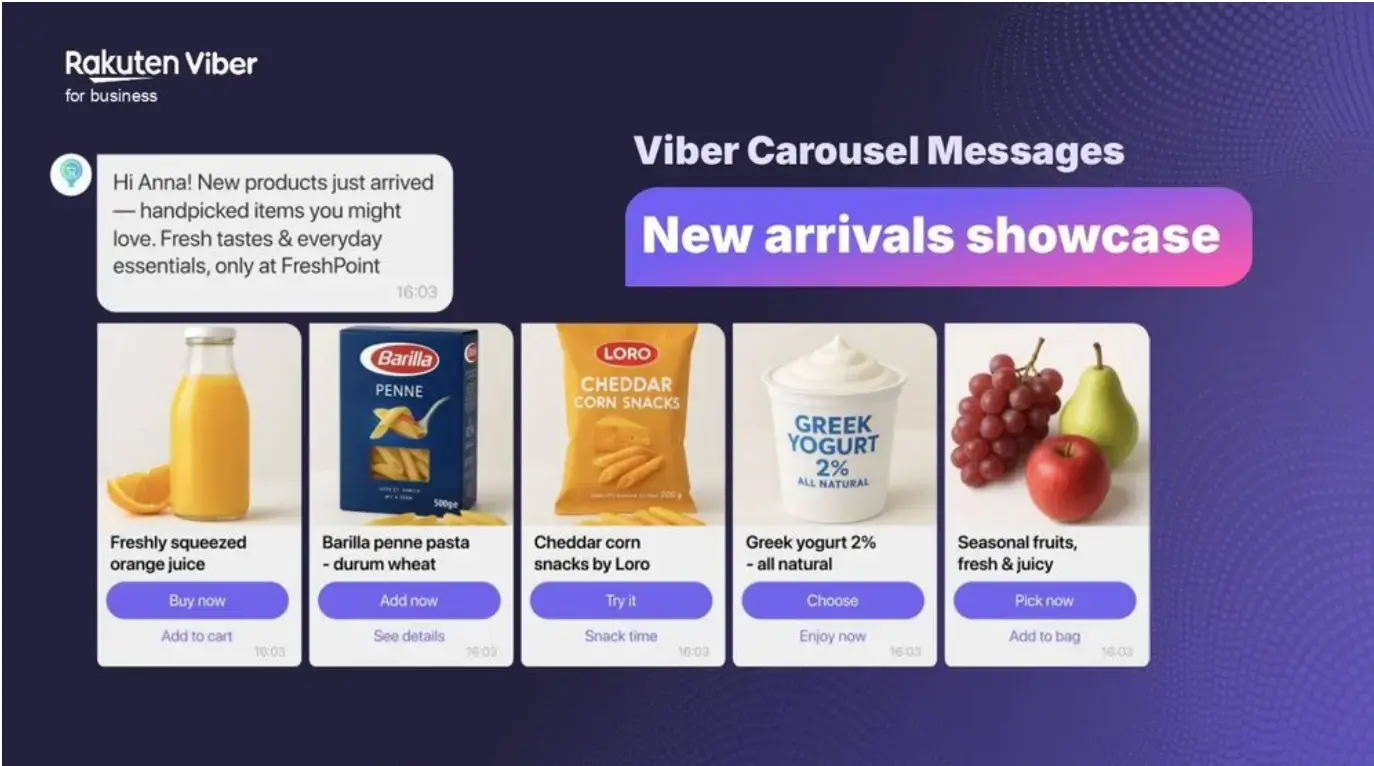
Even before the official release, the SMSBAT provider, which AURUM uses for message processing through the Yespo CDP, approached the jewelry brand and our platform with a proposal to be among the first to test this functionality.
AURUM immediately saw the potential for their business. The format enabled diversifying communication in the messenger and increasing conversions, as in the jewelry niche, visuals often determine whether a customer will be interested in an offer.
It was necessary to set up carousel support for SMSBAT in Yespo and then test the format in real promotional campaigns to understand how the carousel would perform in the jewelry niche and how to use this tool most effectively.
Solution
The integration process took place in several stages:
- May 2025: discussion of the idea between SMSBAT developers and the Yespo product team.
- June–July 2025: development of the functionality and testing.
- Mid-July 2025: launch of the first Viber campaigns from AURUM using the carousel.
|
“It was comfortable for us to work together. We studied in advance how the Yespo platform operates, how data is structured and delivered, and prepared a Postman collection that could be quickly implemented and tested. The entire implementation took a couple of weeks.”
Oleksii Verbytskyi, SMSBAT founder |
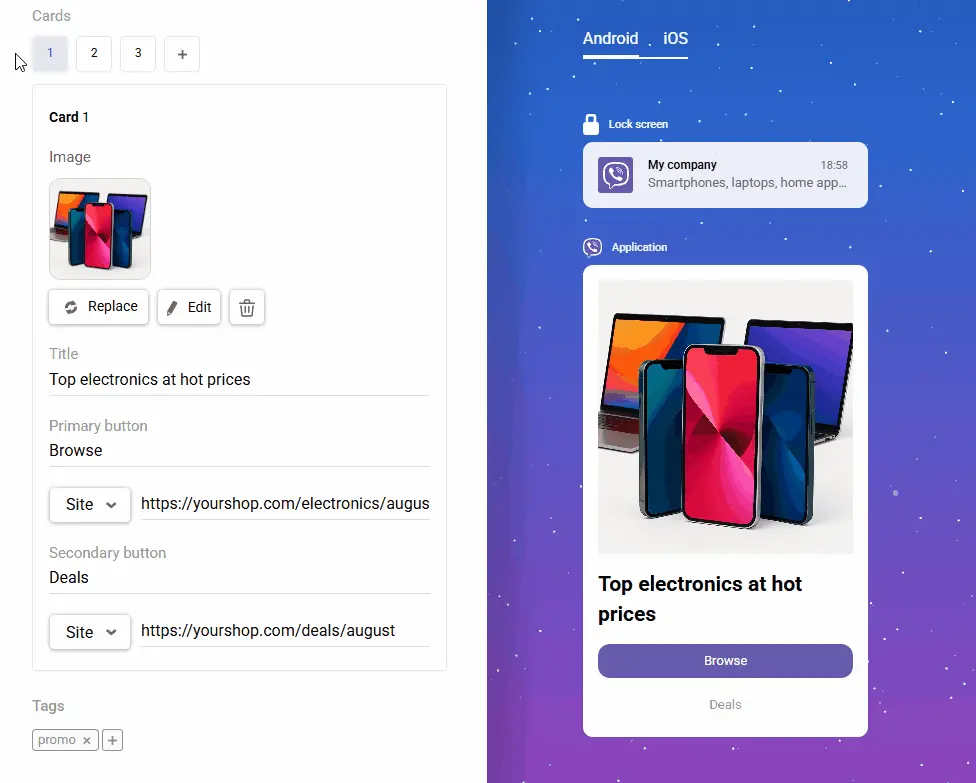
Creating a Viber message with a slider in the Yespo editor is very simple: just select the “Interactive Carousel” format and add the corresponding content for each card.
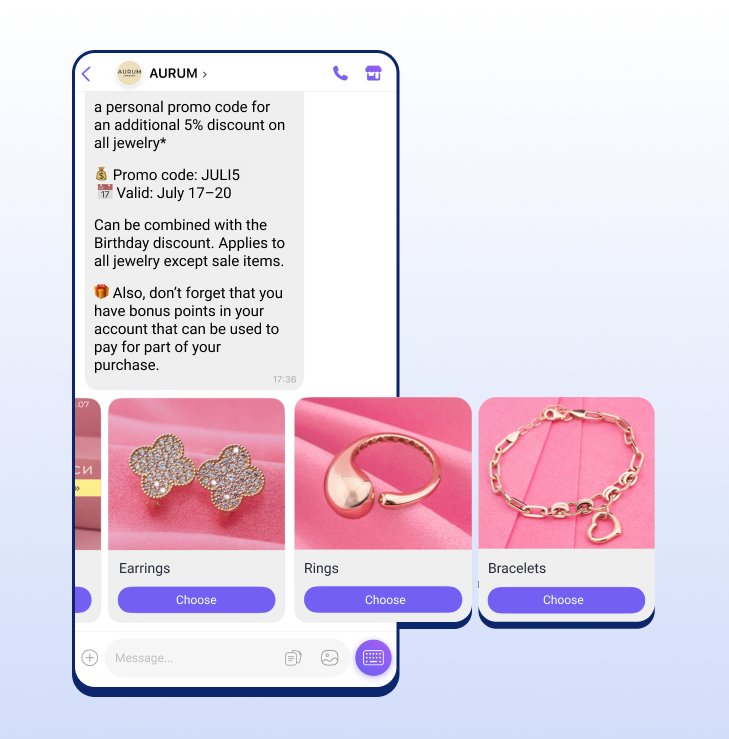
For the first send, the AURUM team prepared two segmented campaigns. Both included a promo code and a slider with five cards: a general banner and four images featuring key categories — necklaces, earrings, bracelets, and rings. In the version for customers with bonuses, the message also included the number of available bonus points.
The results of these campaigns were close to average performance. There was no noticeable spike. The team deliberately avoided making premature conclusions, as AURUM message content and audiences can differ significantly from campaign to campaign. The brand actively segments its database by demographics, purchase history, bonus account balance, and other parameters. Under such conditions, two mass campaigns could not provide a complete picture of the effectiveness of the new format.
That is why after the first launches, the company’s marketers decided to continue experimenting: changing the number of slides, the content of the cards, and testing sends across different segments. This approach allowed them to gradually collect enough data and move from general observations to specific conclusions.
Key Insights From Testing:
1. The number of slides matters
A minimum of 3 slides is the optimal number for a carousel. Two slides look incomplete on some devices, so the team settled on a format with 3–5 products.
2. Buttons increase clicks by 27%
The most important finding: images with CTA buttons received 27% more clicks than those without. This became a mandatory element of subsequent carousels.
3. Content specifics for small images
To help users better perceive small images in the messenger, the team focused on the visual elements: clear close-up photos of jewelry, emphasis on the discount size, minimal text, etc.
4. CTA selection depends on the context
AURUM tested different button text options: “Buy,” “Choose,” “View.” Ultimately, it turned out that there is no universal solution — performance differed from campaign to campaign depending on the type of promotion and the audience. Therefore, the company’s marketers continued to use different CTAs to make communications more diverse
Results
After several campaigns, the AURUM team compared the performance of standard Viber messages with campaigns that included an interactive carousel. For the analysis, they selected campaigns with similar promotional mechanics and comparable audiences — this enabled them to evaluate not a one-time effect but consistent performance indicators resulting from systematic work with the format.
The use of carousels showed the following results:
- conversion rate (CR) increased by 10%;
- CTR increased by 1.75 times;
- ROI doubled;
- average order value (AOV) also doubled.
These results confirmed that among several images in one message, a customer is more likely to see something that feels relevant to them. In addition, thanks to buttons with relevant links, users immediately land on website pages that match their interests. As a result, the carousel format became for AURUM not just a visual update of the Viber channel, but a tool that helped increase the effectiveness of mass campaigns and improve key business metrics.
Learn what workflows you can implement in your business
Additional Insights on Product Offers and Personalization
The experience gained by AURUM was later scaled to triggered campaigns, and the team has already started testing the carousel in Viber messages for abandoned cart and abandoned view workflows.

Anton Kondratyuk, AURUM marketer
I have a hypothesis that carousels will perform best in personalized campaigns. When a customer sees several products they actually viewed and want to buy, this format may show even higher performance than in mass campaigns.
In AURUM communications, an individual approach is systematically used: about 95% of campaigns include personalization elements. This includes not only addressing customers by name, but also taking into account bonus balance, purchase history, interaction channel (online or offline), and customer behavior on the website. This strategy has already shown noticeable results; in particular, adding blocks with personalized product recommendations to mass email campaigns helped increase the average order value by 30%.
While working with recommendations in promotional emails, AURUM marketers gathered several practical insights that they apply depending on the audience type and workflows:
- For campaigns sent to the entire database, the team uses a proven formula: 3 products per row × 3 rows = 9 products with photos, discount percentage, old and new price, and a “Buy” button. To ensure product images display well in email clients with dark mode, white-background images are used.
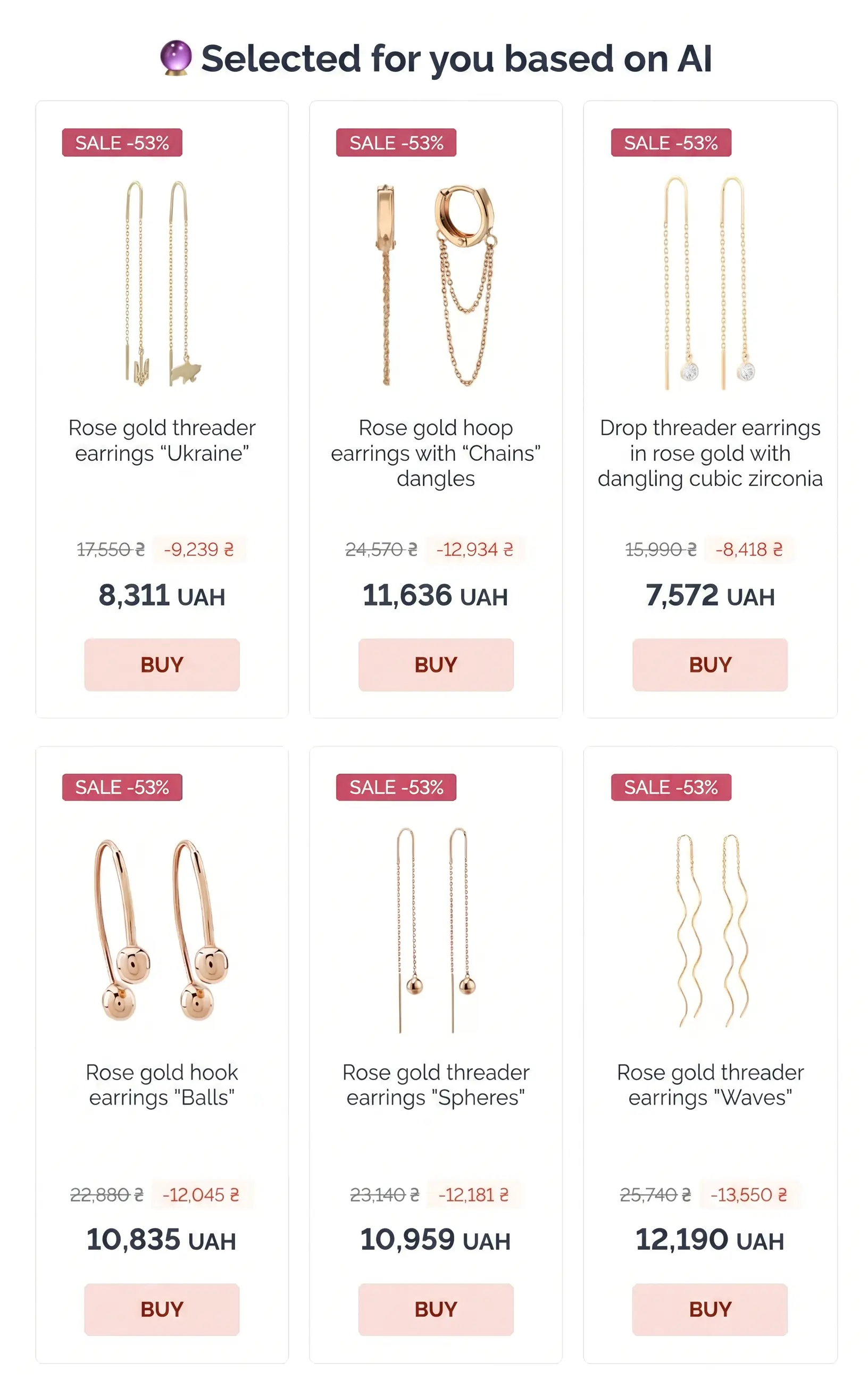
For active customers who recently interacted with the website or campaigns, a simplified recommendation block can be used — only the product image and the discount size, without the name and prices. This allows reducing email size and showing 12–15 recommended products instead of 9.
- However, the number of products per row is less important than selecting the first three products, since about 75% of the audience views emails on mobile devices, and the first screen determines further interaction.
The team also actively tests recommendation logic for different segments:
- Customer gender: it was noticed that men rarely click on purely men’s products, since they more often buy jewelry for women rather than for themselves.
- Previous purchases: if a customer has already chosen silver jewelry, there is a high probability that the next purchase will also be silver. The same logic applies to those who buy gold.
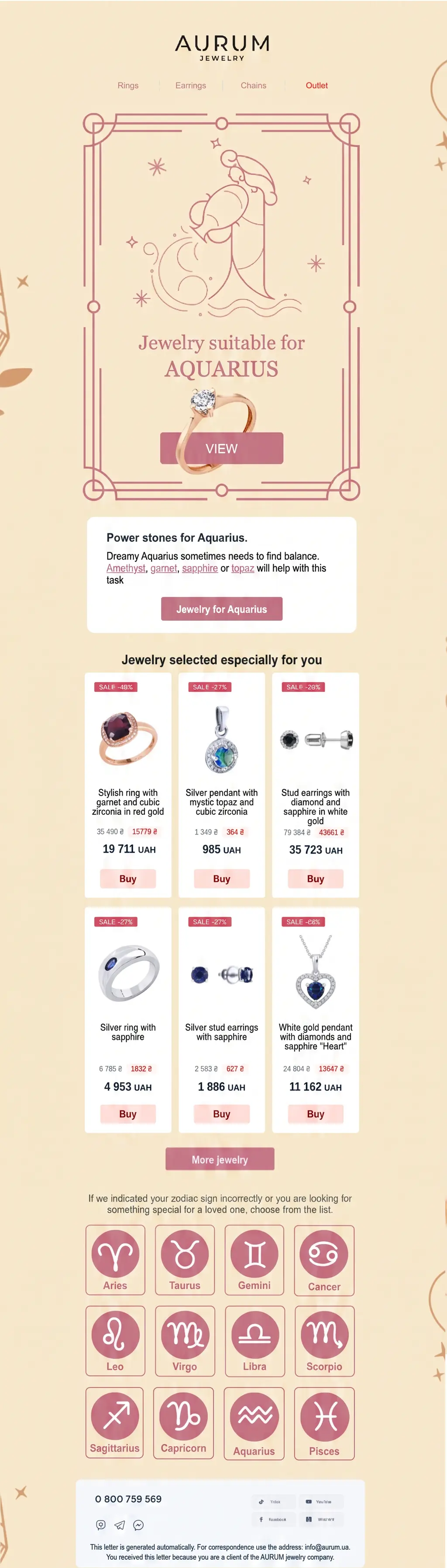
- Zodiac sign: the welcome series includes an email with a selection of jewelry with stones that “suit you.” This helps emphasize an individual approach from the very first communications.
Anton Kondratyuk, AURUM marketer
Thanks to convenient functionality, we can configure recommendation blocks for any type of campaign and for different audiences.
Explore the platform’s features
Conclusion
The implementation and testing of the Viber carousel helped AURUM not only refresh communication in the messenger but also significantly improve business metrics — from CTR to ROI and average order value.
This case shows that new tools deliver results when they become part of a well-thought-out marketing strategy. Today, carousel functionality is available to all Yespo users, and AURUM’s experience can serve as a reference point for teams planning to scale effective communication workflows.
If you are also planning to test new approaches or want to improve campaign performance, sign up for a consultation with the Yespo team. Together, we will define the workflows and tools that will deliver the best results for your business.