Content
09 September 2026
594
15 min
5.00
Promo Codes in Abandoned Cart Workflows: 4 Ecommerce Case Studies

Anna Zabudskaya

Mariia Natarova
Content
According to Baymard Institute, the average documented ecommerce cart abandonment rate is 70.22%. The figure is based on data from 50 different studies on online shopping cart abandonment.
For ecommerce businesses, this is one of the biggest points of lost potential revenue — and, at the same time, a real opportunity to win some of those users back through triggered workflows. Companies are testing all kinds of approaches: message timing, communication channels, personalization, and extra incentives to push the purchase through.
Promo codes are one of those tools. In this article, we'll look at how companies use promo codes in their Abandoned Cart workflows, and which mechanics work best across different niches.
How Yespo Clients Use Promo Codes in Abandoned Cart Workflows
A promo code in the Abandoned Cart workflow isn't a one-size-fits-all solution for every business or audience segment. For companies, it's always a balancing act between extra conversions and margin: a discount that's too generous or poorly timed can eat into profitability, or train customers to simply wait for the next deal.
That's why businesses take different approaches: some add a promo code after the first reminder, others save it for the final step, offer it only to specific audience segments, or use it throughout the entire workflow.
Below, we'll break down how these approaches play out in practice across different niches and workflows.
Aviatsiya Halychyny: A Promo Code After the First Reminder
Aviatsiya Halychyny is a clothing brand inspired by the modern military, selling through both an online store and a network of offline shops.
In its Abandoned Cart workflow, the company doesn't lead with a promo code — it only introduces one after the first reminder. This approach lets it win back some users without offering an additional discount and use the promo code only for those still hesitant to purchase.
How the workflow runs
Communication channel: email. After an Abandoned Cart event, the user gets a first reminder email with no discount. If the order still isn't placed, the system sends a second email with a promo code. A static promo code is used here.
In that email, the company puts the extra benefit front and center: the promo code sits right in the main message, visually set apart in its own block.
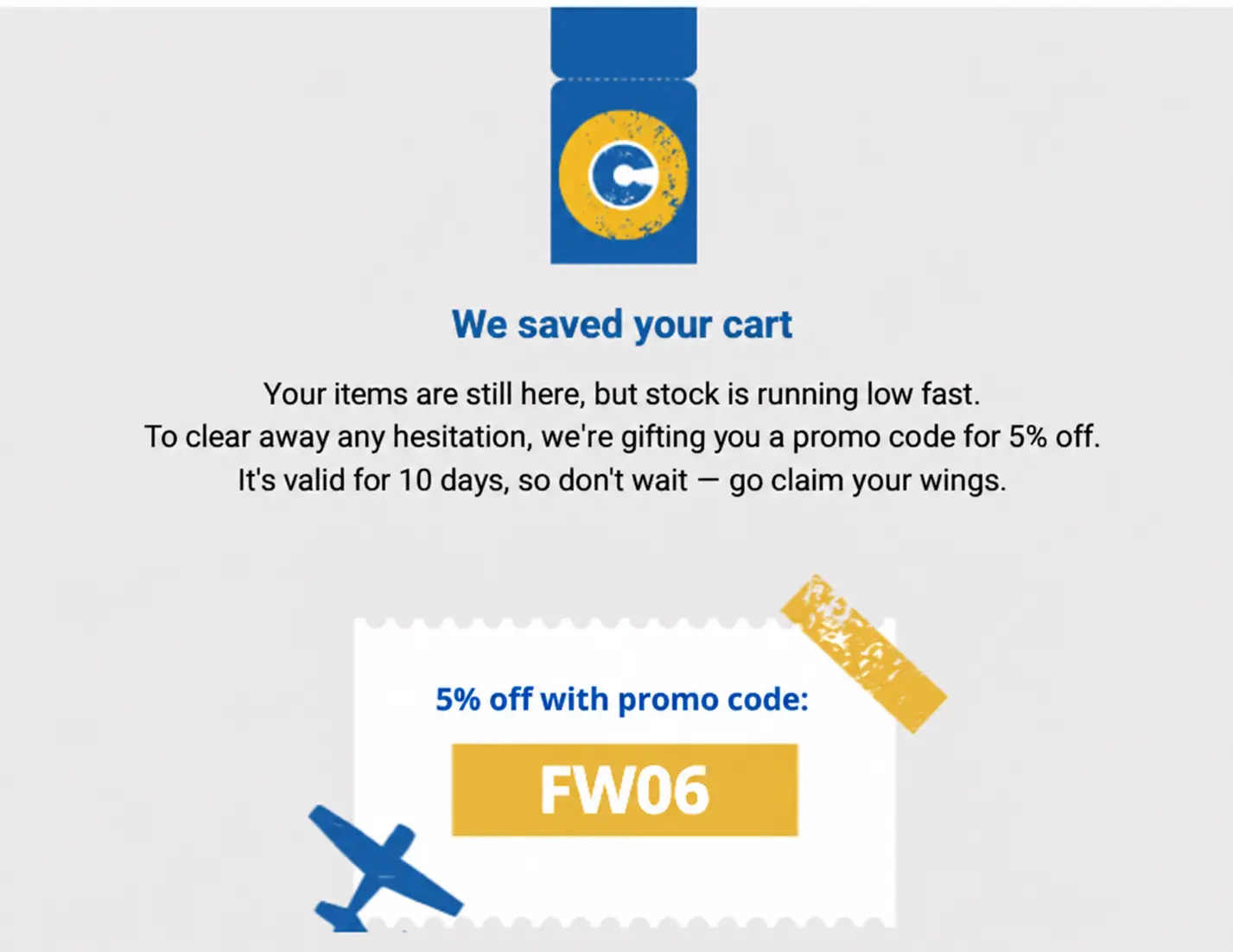
Aviatsiya Halychyny also highlights the promo code in the email's hidden preheader. That said, they don't use Gmail annotations for this.
Results
From March 2 to May 31, 2026, the workflow's overall conversion into purchases ranged from 0.79% to 1.17%.
The workflow opens with a reminder email offering no added benefit, and users who still hadn't completed their purchase later received a 5% discount promo code. Conversion after the promo code message came in about 10% higher than after the first reminder.
At the same time, the promo code email accounted for nearly half of all sales generated within the workflow.
Apteka 9-1-1: Different Promo Code Timing for Different Segments
Apteka 9-1-1 is a pharmacy chain, combining online sales with an extensive network of physical pharmacies.
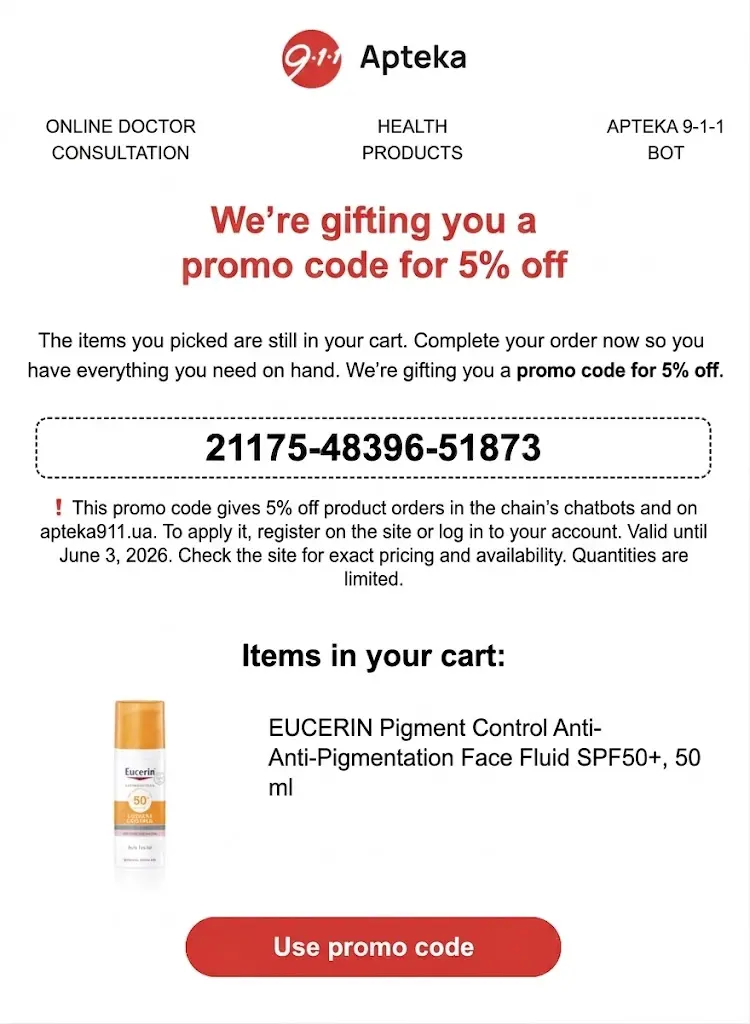
In its Abandoned Cart workflow, the company uses promo codes selectively, targeting first-time buyers above all. At the first stage, only those contacts receive a discount. This helps nudge them toward that first purchase and boosts the effectiveness of acquiring new subscribers through contact-capture forms.
How the workflow runs
The workflow combines email and web push. After a user abandons their cart without completing an order, they receive a first reminder email with no promo code. A day later, the system checks whether the contact belongs to the buyers segment.
If the user has never placed an order before, they get an email with a 5%-off promo code. For everyone else, the promo code kicks in later — on the third day after the first reminder, if the purchase still hasn't gone through.
Web push messages don't carry promo codes — they serve as a supporting channel. They go out an hour after each email if that email remains unopened.
A static promo code is used here as well.
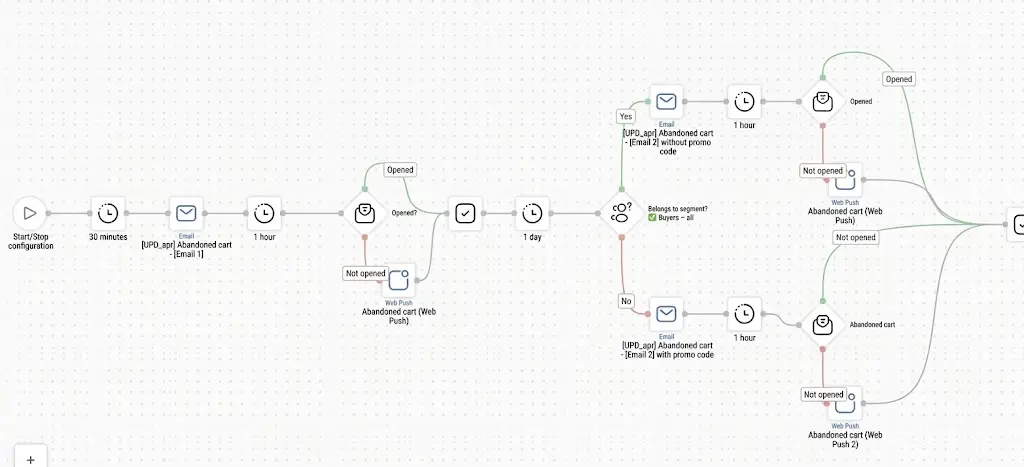
Unlike many workflows where a discount is offered to all users with an abandoned cart, Apteka 9-1-1 first uses the promo code as a tool to encourage the first purchase. Only then does the mechanic scale to the rest of the audience who still haven't completed their order.
Results
Based on the workflow's results from January through June 2026, promo code messages accounted for 31.8% of purchases and 38.7% of the workflow's revenue — despite making up only 30% of deliveries.
Promo code emails delivered almost double the purchase conversion rate and more than double the revenue per delivery compared to emails without a promo code.
In web push, though, it's the no-discount messages that drive most of the results. They work as a quick nudge to bring users back to their cart.

Anna Zabudska, Retention Marketer at Yespo
“To assess the specific incremental effect of the promo code, the Apteka 9-1-1 team should test identical emails with and without the promo code at the same stage of the scenario. This is especially relevant for the final message offering an additional benefit, which already delivers the biggest contribution to revenue.
Such A/B testing would help clarify how much of the result comes from the promo code itself, and how much from the final reminder.”
Zootovary: An Omnichannel Workflow with a Promo Code in the Final Messages
Zootovary is an online store for pet supplies.
In its Abandoned Cart workflow, the company doesn't lead with the promo code as an initial incentive — it treats it as a closing argument for users who didn't respond to earlier reminders.
How the workflow runs
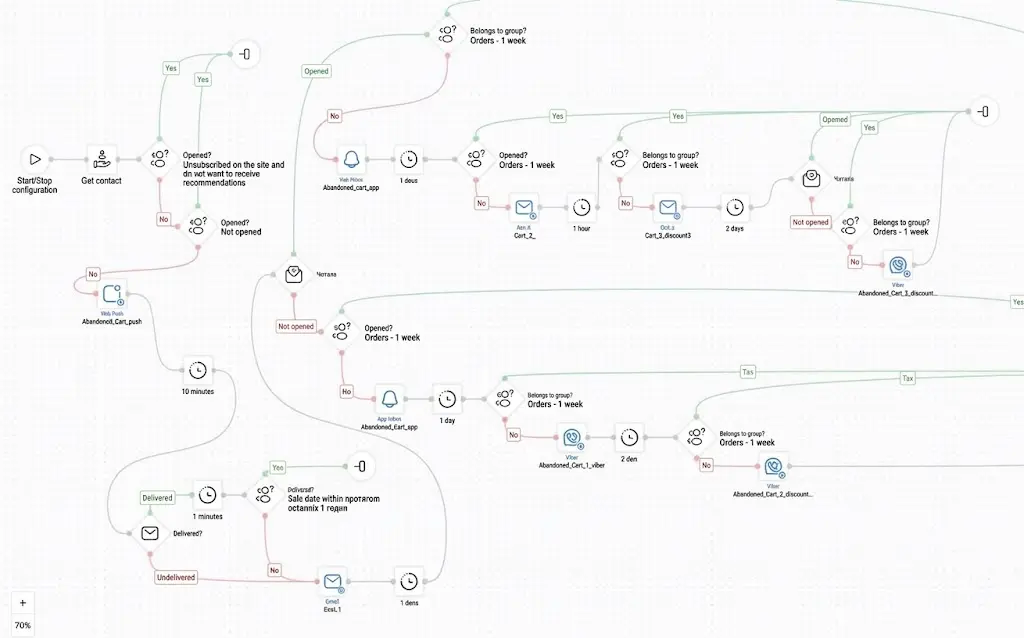
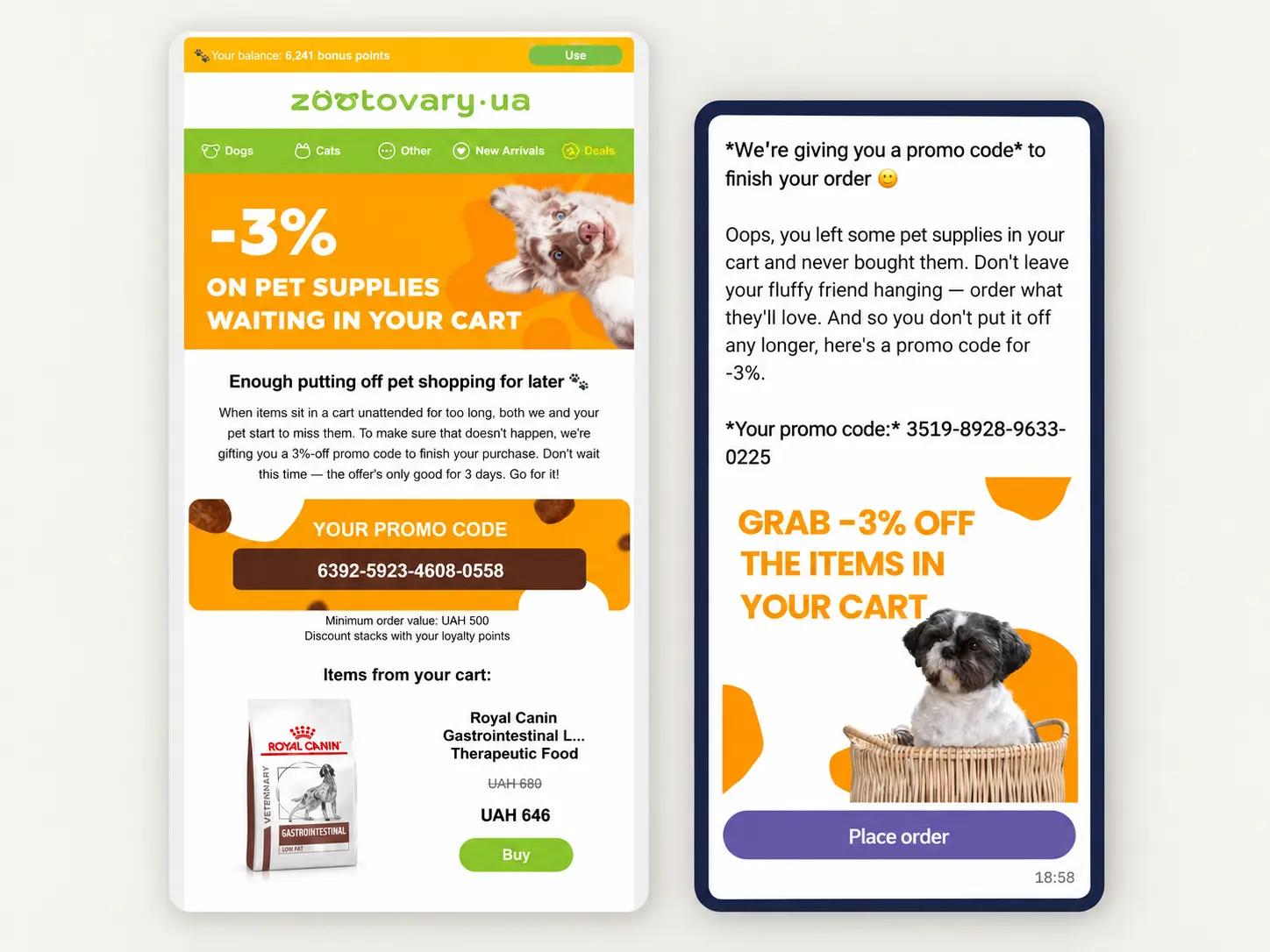
The workflow ties together several channels at once: email, web push, App Inbox, and Viber. After a cart is abandoned, the user gets a first reminder with no promo code. If the order still isn't placed, the company gradually adds more channels and sends follow-up messages. Only at the final stage of the workflow does the user receive an email and Viber message with a discount.
This approach lets them first win back some customers without any extra incentive, and reserve the promo code for those who still haven't completed their purchase after several reminders.
The workflow uses individual promo codes, pre-generated and uploaded into Yespo via a CSV file. This approach keeps discount usage under control and prevents a single code from being shared among multiple buyers.
Results
From December 12, 2025, to June 12, 2026, the promo code branch reached just 20.3% of workflow participants, yet it delivered more than half the overall result: 50.6% of all purchases and 51.2% of the revenue generated by the Abandoned Cart workflow.
Overall, messages with an added incentive significantly outperform plain reminders. While email and Viber messages without a promo code convert 1.26% of users into buyers, discount messages convert 3.75% — nearly three times as many. On top of that, they generate 3.07 times more revenue per message sent.
That said, the impact of the promo code depends on the channel. In email, its main effect is pulling users back into engaging with the message: CTR and CTOR both more than double. The click-to-purchase conversion gap is less dramatic — 38.66% versus 30.36%. In other words, the biggest difference between promo and non-promo emails shows up at the click-through stage, not after.
Viber tells a slightly different story. There, promo code messages don't just get more clicks — they also convert better after the click: 35.88% versus 23.24%. On top of that, average order value was higher for messages with an added benefit than for those without.
Zootovary's experience shows that in an omnichannel workflow, a promo code isn't just one more nudge to close the order — it also helps recapture user attention at the final stage of the funnel.
MIRSON: A Promo Code in Every Message of the Workflow
MIRSON is a Ukrainian home textiles manufacturer specializing in bedding, blankets, pillows, loungewear, and other sleep and rest products.
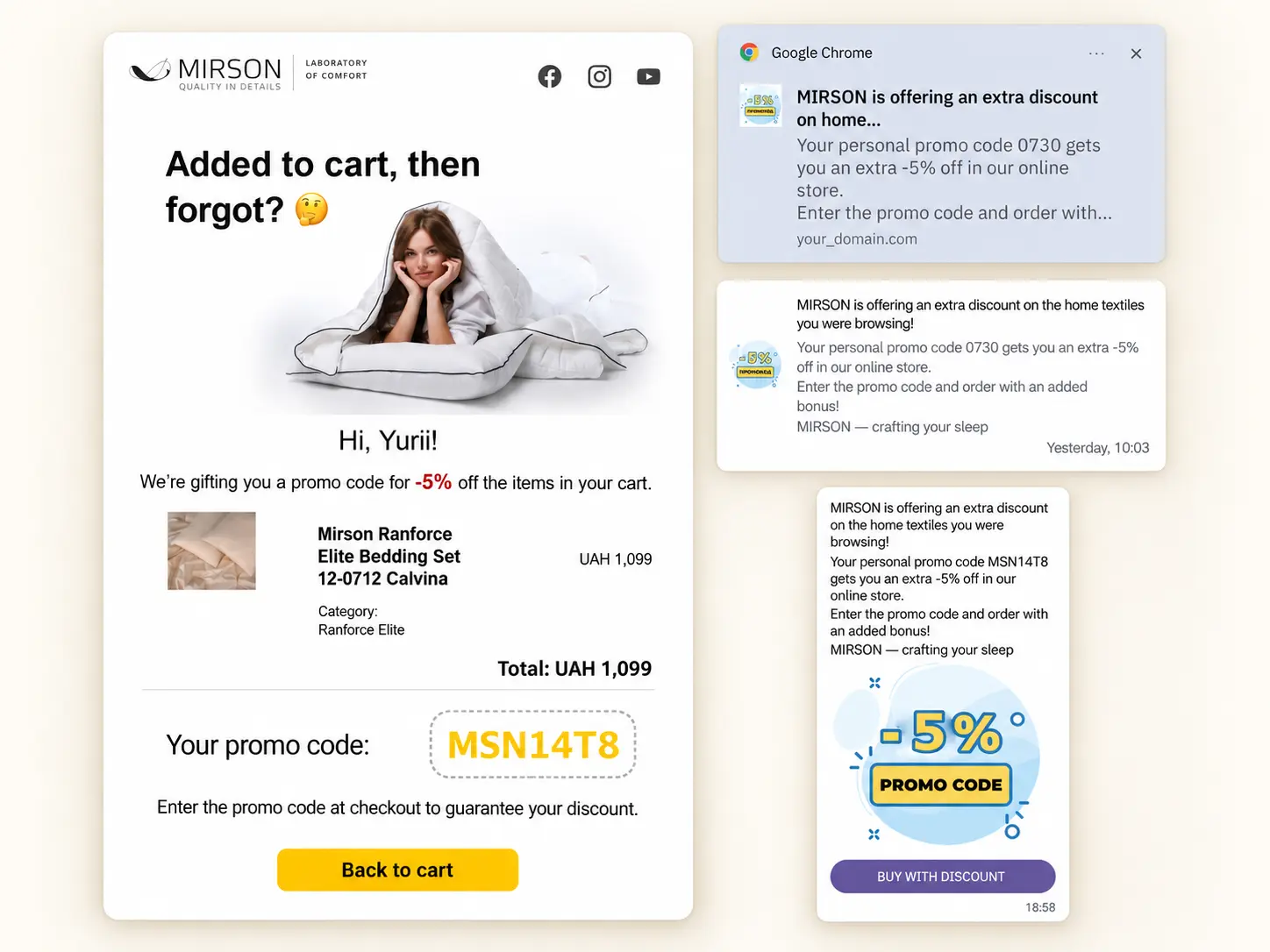
Unlike most cases in this roundup, the company adds a promo code to every message in its Abandoned Cart chain.
How the workflow runs
The workflow relies on four channels at once: Viber, web push, email, and App Inbox. After a cart is abandoned, the user first gets a Viber message with a promo code. If they don't click through, a web push follows 45 minutes later, then an email 15 minutes after that. The next day, users who haven't engaged with the email also get a message in App Inbox.
Every message across the chain uses the same static 5%-off promo code.
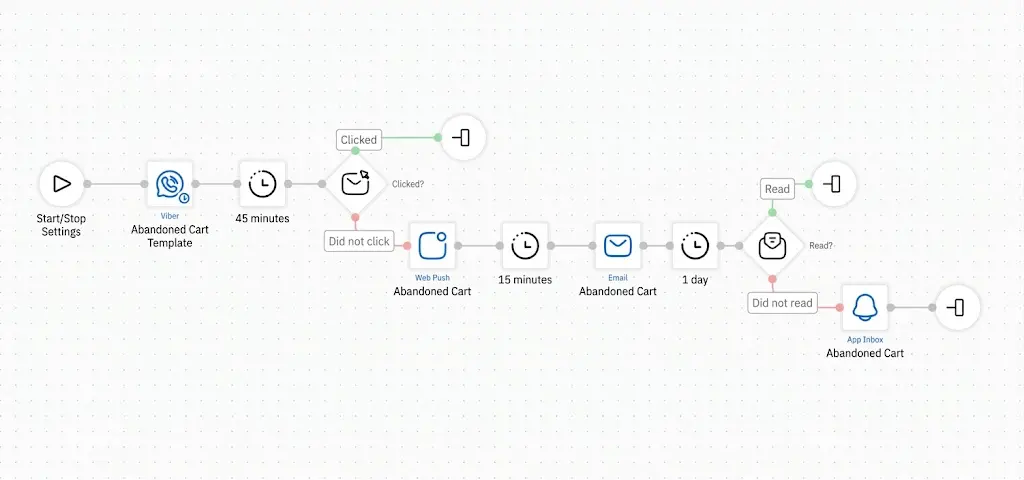
Unlike the other companies in this roundup, MIRSON doesn't treat the added incentive as a tool for winning back specific users — the promo code appears in every message of the workflow, regardless of channel.
Results
From January 1 to May 28, 2026, the workflow delivered a 0.57% conversion into purchases. Viber drove most of that result, accounting for over 82% of all orders from the workflow. Email contributed nearly another 18% of purchases.
The company also notes a high promo code redemption rate among buyers who completed their order after receiving these messages.
Since the mechanic was built around the promo code from the outset, there's no way to compare it against a no-discount version. Still, MIRSON considers the approach economically justified:

Ihor Navrotskyi, Marketer at MIRSON
“It's better to give the customer a discount and get the order than to lose them after you've already spent the ad budget acquiring them.”
By the company's own assessment, the mechanic remains effective and scales well as the customer base grows.
Anna Zabudska, Retention Marketer at Yespo
“To get a more precise read on the mechanic's effectiveness, it's worth periodically testing select segments with no discount, or with a different promo code size. That would clarify where the promo code genuinely drives extra orders — and where it's simply cutting into margin on purchases that would have happened anyway.”
Key Takeaways
These Yespo client cases show there's no universal formula for using promo codes in Abandoned Cart workflows.
Some companies only add a discount after an initial no-incentive reminder; others lead with the promo code right away, or reserve it for specific stages of the workflow.
For some businesses, though, the promo code can be woven into the entire re-engagement logic — especially when customer acquisition costs are already high.
That's why the added incentive in an Abandoned Cart workflow deserves to be treated as its own distinct tool — one whose effectiveness depends on context: product margins, average order value, customer acquisition cost, the communication channel, audience behavior, and the stage at which the discount appears in the workflow.
These cases also show that it's not enough to test whether or not a promo code exists. What matters just as much is when it appears, how big the reward is, which segments receive it, and which channels carry it. In some cases, the promo code meaningfully lifts results; in others, it's worth checking whether the discount is going to an audience that would have completed the purchase anyway.
The decision to use a promo code should be based on the expected conversion lift and the workflow's underlying economics. Below are two formulas to help you judge whether the mechanic will actually pay off.
Anna Zabudska, Retention Marketer at Yespo
It makes sense to launch a promo code when the expected conversion lift generates enough extra purchase volume to cover both the cost of the discount and the cost of the communication channel.
To figure out the maximum discount your business can afford, use this formula:
Maximum discount = N × AOV × (CRpromo − CRbase) × Margin − Communication cost N × AOV × CRpromo
where
N — projected number of promo code recipients;
AOV — average order value, in currency;
CRbase — conversion rate without the promo code, %;
CRpromo — expected conversion rate with the promo code, %;
Margin — gross margin, %;
Communication cost — spend on Viber, SMS, and other paid channels, in currency.
To calculate the conversion rate a promo code needs to hit in order to pay for itself, use this formula:
Minimum conversion rate with promo code = CRbase × Margin + Communication cost N × AOV Margin − Discount
Promo Codes in Abandoned Cart Workflows: A Checklist
- Don't rush to put a discount in the first message — some users will come back to complete their purchase without any extra incentive.
- Run the numbers on the discount before you launch — a promo code should offset the margin loss through extra purchases, not just boost conversion for its own sake.
- Segment your promo code recipients — for instance, treat first-time non-buyers, inactive customers, and repeat cart-abandoners as separate groups.
- Test when the promo code appears — after the first reminder, only in the final messages, or only for specific audience segments.
- Evaluate channels separately — a promo code might do more for click-through in email, while in Viber or push it might drive a faster return to the cart.
- Don't copy-paste the same message across every channel — give each channel its own role in the workflow: detail, reminder, urgency, or final incentive.
- Use individual promo codes when you need tighter control over discounts — it's easier to limit usage, prevent code-sharing, and get cleaner analytics.
- Don't judge success by purchase conversion alone — factor in promo code redemption rate, average order value, revenue lift, and the impact on margin and profitability.
A promo code in the Abandoned Cart workflow works best when its role is planned across the entire journey — who gets the discount, when, and through which channel. Book a consultation, and we'll show you how to set all of this up in Yespo and test it, so the discount drives orders instead of just eating into your margin.