Content
01 April 2026
2951
14 min
0.00
RCS vs SMS: Key Differences Between Channels & Use Cases

Yaroslava Kurta
Content
Marketing trends come and go, yet SMS remains an incredibly reliable mobile channel for businesses. When you have a time-sensitive message, sheer speed and high open rates easily beat a flashy design. In fact, SMS volumes continue to grow. Ecommerce brands rely heavily on this channel year after year to push urgent alerts and quick reminders that customers need to see right away.
However, modern buyers expect more. A simple plain-text message doesn't always cut it, depending on the campaign, prompting many brands to explore RCS (Rich Communication Services).
Relying strictly on SMS is becoming a thing of the past as the messaging landscape expands. Industry experts clearly see that message traffic across SMS, RCS, and OTT apps will continue to rise throughout this decade. Revenue-wise, RCS is gearing up to claim a massive piece of the pie in the near future.
Below, we compare RCS and SMS, examine where each channel works best, and show how they can support retention and repeat purchase rate.
What is SMS and RCS?
SMS (Short Message Service) is the standard text messaging format supported by mobile carriers worldwide. It is limited in format — usually plain text, short length, and basic links — but that simplicity is also its strength. SMS works through the cellular network and does not require an internet connection. Unlike RCS, SMS can reach almost any mobile phone.
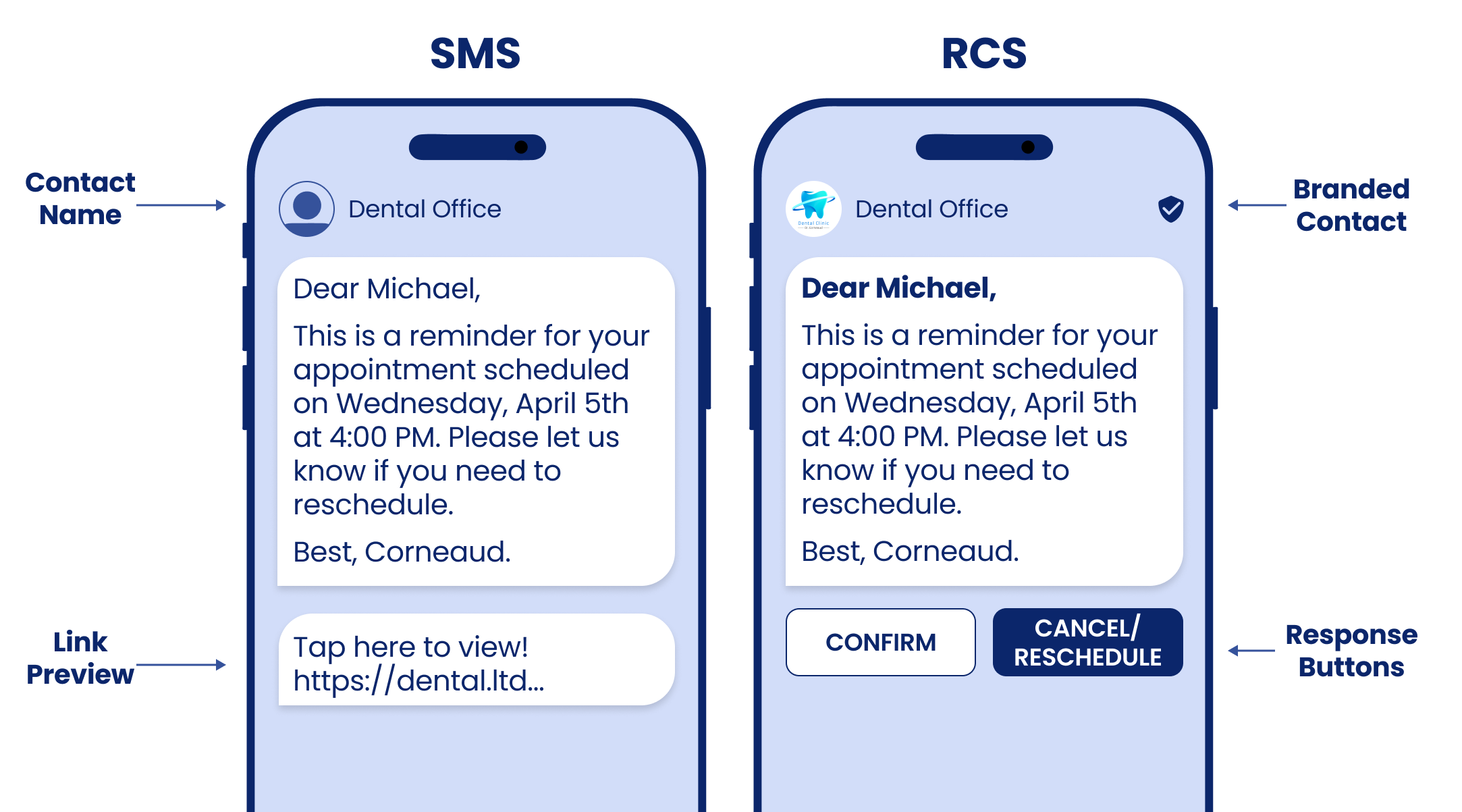
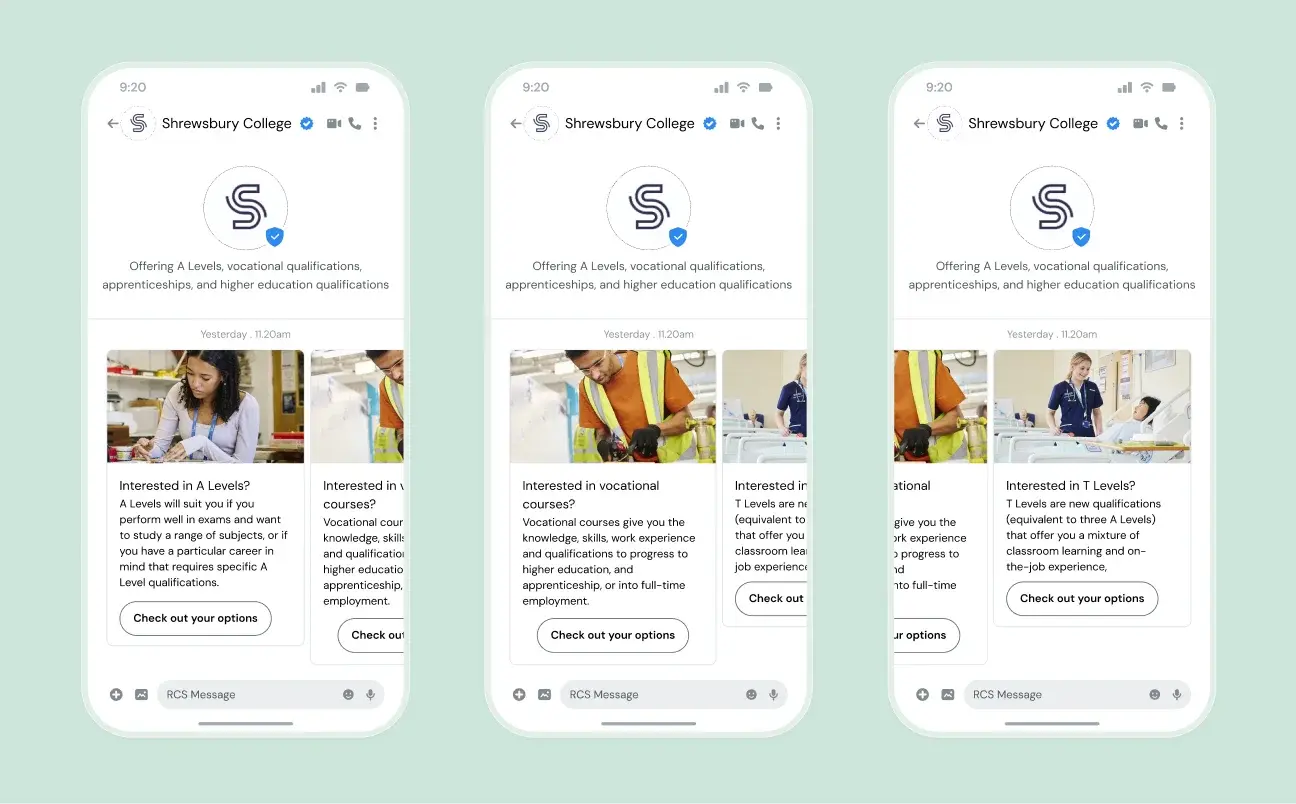
Then what is RCS message? In short, it’s a more interactive version of SMS. It expands the native messaging experience with branded content, visual elements, and built-in actions that feel closer to an app than to a traditional text message. Instead of plain text alone, RCS can include:
- high-resolution images
- GIFs
- videos
- file sharing
- product carousels
- quick-reply action buttons
- read receipts and more.
The user experience closely mirrors OTT applications like WhatsApp or Telegram. The primary advantage, however, is friction-free access. Customers interact with this rich media directly within their phone's native inbox, completely eliminating the need to download third-party software. Organizations using emergency notification software can send urgent alerts directly to recipients' mobile devices without requiring additional apps. This ensures critical messages are delivered quickly through familiar communication channels when timely updates matter most.
While RCS has been a standard on Android devices for years, Apple’s support for RCS in iOS 18 significantly increased its viability for cross-platform campaigns. For marketing teams, this update removes a major technical hurdle. It enables brands to deploy rich formats to a unified global audience, rather than constantly segmenting campaigns by operating system.
RCS vs SMS: What Are the Key Differences
To establish a clear framework for these use cases, we first need to outline the structural differences among them. Here is a breakdown of how the SMS vs RCS setups compare:
|
|
RCS |
SMS |
|
Internet Connection Requirement |
YES |
NO |
|
Tracking & Analytics |
Advanced (Read receipts, click-through rates, engagement) |
Basic (Delivery rates, basic link clicks) |
|
Content Formats |
Rich media (images, carousels, videos, interactive buttons) |
Text-only (max 160 characters) |
|
Device compatibility |
Requires RCS-supported devices and carrier networks |
Works on virtually all mobile devices globally |
|
Branding |
High (Verified sender IDs, brand logos, colors) |
Low (Plain text sender ID or shortcode) |
|
Cost |
Typically higher (priced per message or session) |
Lower (standard carrier pricing) |
To really grasp the RCS vs SMS dynamic, you have to dig into the technical and practical differences. Let’s break down exactly what sets them apart:
Internet Dependency and Reach
Network dependency forms the core technical divide between these channels. Transmitting rich media via RCS strictly requires an active Wi-Fi or mobile data connection. If the recipient drops offline, the transmission may be delayed unless you configure an automated fallback protocol. SMS bypasses internet requirements entirely. Operating exclusively over basic cellular networks, it ensures guaranteed delivery even in areas with zero data coverage.
Engagement and Content Capabilities
Think of standard SMS as purely informational. You get plain text and maybe a link. It gets the job done, but it’s completely static. Every RCS message transforms into an interactive space with swipeable carousels and buttons. This directly impacts engagement rates: while standard SMS links typically generate a 4–7% CTR, RCS interactive buttons and cards drive a 15–30% CTR, with some case studies reaching up to 51%.
Trust and Brand Verification
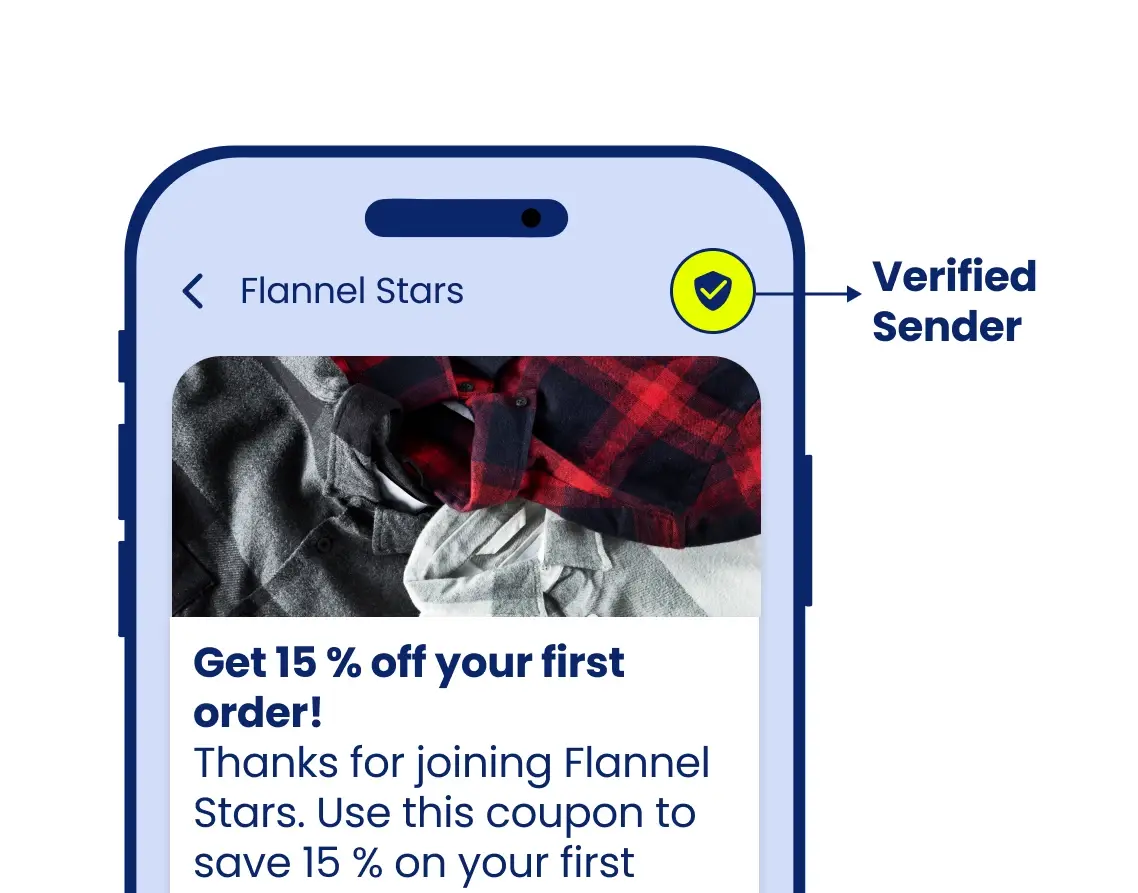
Phishing and spam are significant issues with traditional SMS, as sender IDs can often be spoofed. RCS combats this through mandatory business verification. The moment a message hits the screen, customers see a verified profile complete with your company logo. Plus, the analytics go much deeper. You can track read receipts and exact button clicks, while basic SMS tracking rarely gives you more than delivery confirmations and simple link clicks.
RCS vs SMS: Pros and Cons Comparison
Ultimately, picking a winner in the RCS vs SMS comparison comes down to your campaign goals. Are you prioritizing massive reach, or do you need deep, rich engagement? Let's look at the strengths of each.
Pros of SMS
- High open rates — 98%, one of the highest across all marketing channels. With up to 95% of messages read within the first 3 minutes of delivery.
- Delivers an average CTR of 18–20% and a response rate of 45%+, leaving traditional email (~2–3% CTR and ~6% response rate) far behind.
- Works on any mobile phone globally without installation. Highly valuable in markets with lower smartphone or data adoption.
- Delivered via cellular networks, making it the most reliable channel for critical alerts.
- Fast to launch — does not require a complex layout because of a text-only format.
Cons of SMS
- Expensive at scale, as paid per message (typically 0.5–3 cents per message).
- Limited content (text only and basic links). Not ideal for branding or complex offers.
- Requires strict frequency control due to its inherent intrusiveness.
- Weak personalization and limited dynamic content. Harder to adapt in real time and less effective for advanced lifecycle marketing.
- Limited tracking. Mostly click-based measurement.
I want to improve my mobile marketing
Pros of RCS
- App-like experience. It delivers a richer user experience that feels closer to a mini landing page inside an RCS message, thanks to quick replies, images, buttons, and branding.
- Higher engagement compared to SMS. RCS users don’t need to open a browser for simple actions.
- Rich analytics for every RCS message, including delivery, read status, and engagement.
- No need for a separate app. Works inside the default messaging app on Android and iOS 18.
- Supports automation (eg, chatbots, FAQs).
Cons of RCS
- Requires an internet connection. No delivery if the user is offline without a fallback.
- Limited device coverage. Strong on Android, with limited support on iOS.
- Not fully supported in all countries or by all carriers.
- Requires business verification and message templates.
- Higher cost for RCS than SMS (up to 20–30%).
Tip
RCS fallback to SMS is when a message is first sent via RCS, and if it can’t be delivered, it is automatically resent as SMS.
When to Use RCS vs SMS: Common Cases & Best Practices
Although both channels appear in the same messaging inbox, they are suited to different tasks.
When to Use SMS
Sending good SMS messages remains the primary way to communicate when absolute delivery certainty and immediate open rates are required. It is the optimal channel for transactional alerts where delays are unacceptable, ensuring vital information reaches the end user instantly, regardless of their data connectivity.
Use Cases: One-Time Passwords (OTPs), two-factor authentication, order confirmations, fraud alerts, and time-sensitive shipping updates
Best Practice for SMS
- Keep it Ultra-Short. A good SMS text gets straight to the point within the 160-character limit.
- Limit Links. Only include URLs if strictly necessary (and use branded short links to save space and maintain trust).
- Clear Sender ID. Use a clear sender name so recipients can immediately tell who the message is from.
When to Use RCS
RCS is a powerful tool for engaging messaging, marketing, and sales. A well-crafted RCS message, when combined with proper customer segmentation, is perfect for campaigns that showcase a product, drive a specific action, or provide customer support natively. Channel choice here is also a market question. It is worth checking global WhatsApp usage data before you commit budget, because in regions where the app is already the default inbox, those same rich, conversational campaigns tend to land better there
Use Cases: Personalized messaging for abandoned cart reminders, lead generation messaging, interactive holiday lookbooks, and automated customer service routing.
Best Practice for RCS
- Design for Action. Treat your RCS template like a storefront. Use high-quality visuals and clear copy.
- Use 1-2 Clear CTA. Use CTAs like "Shop Now" or "Track Order."
- Set a Fallback. Configure your RCS campaigns to deliver an SMS alternative for non-RCS users.
What Tools to Use for Launching RCS or SMS Campaigns
Picking the right software comes down to what you actually need to do. Are you just blasting single texts, or are you ready to build omnichannel campaigns? If you're trying to understand the RCS vs SMS landscape, here are a few platforms worth exploring.
Yespo
Best for: Full omnichannel lifecycle marketing.
What it does well: Rather than using fragmented tools, Yespo centralizes SMS, web push, mobile push, email, and in-app communications into a single interface. The platform provides a visual workflow builder and maintains live customer profiles that automatically update based on behavioral data.
When to choose it: Yespo is optimal for brands integrating messaging into a comprehensive retention framework. It performs best when driving highly segmented triggers — such as abandoned cart flows and post-purchase sequences — rather than isolated promotional sends.
Note
While Yespo does not currently route native RCS messages, it provides deep integrations with Viber and Telegram to meet rich messaging requirements.
Klaviyo
Best for: Running Email and SMS flows inside Shopify-centric setups.
What it does well: Klaviyo is highly regarded for its pre-built ecommerce templates and deep, native integration with Shopify. It also provides advanced performance tracking to accurately measure message-driven revenue.
When to choose it: This platform is a strong fit if you operate a DTC brand and your technical stack relies heavily on a traditional Email-and-SMS combination.
Note
Klaviyo is currently testing out RCS, meaning the feature is strictly in Beta right now.
Attentive
Best for: Mobile-first growth strategies.
What it does well: Treats SMS and RCS as a core revenue channel. Offers aggressive list-growth tools (popups) and highly personalized mobile-first campaigns.
When to choose it: You want to scale mobile marketing as your primary revenue driver and don’t need deep orchestration with non-mobile channels.
Insider One
Best for: Enterprise ecommerce with cross-channel journeys.
What it does well: Advanced AI-driven personalization and strong customer journey orchestration across web, email, SMS, RCS, and WhatsApp.
When to choose it: You represent an enterprise-level brand that needs to combine deep personalization with multiple touchpoints at a massive scale.
Infobip
Best for: Global communication infrastructure.
What it does well: The infrastructure natively handles multiple protocols, including standard text, WhatsApp, Viber, and RCS. Its primary operational advantage is an extensive network of global carrier partnerships, allowing enterprise teams to deploy rich media campaigns alongside an automated text fallback as a standard platform feature.
When to choose it: You want to launch RCS at scale across multiple countries and carriers. The platform has massive global carrier reach, plus it sets up RCS with an automatic SMS fallback from day one.
Final thoughts
When analyzing RCS vs SMS, it isn’t about which channel will "kill" the other. Operational success comes from integrating both channels into a cohesive workflow rather than viewing them as competitors.
For campaigns demanding absolute delivery certainty, standard text messaging remains the foundational infrastructure. It handles time-sensitive texts — such as OTPs and fast-delivery alerts — perfectly. RCS steps in when you want to impress the customer. It provides the interactive marketing experience that plain text just can't match.
You don't actually have to choose just one side in the RCS vs SMS rivalry. The smartest move in the SMS vs RCS debate is to run a hybrid setup. Start with RCS to grab those high conversion rates and stunning visuals, but keep an SMS fallback active. That way, you secure almost 100% deliverability, regardless of which device your customer uses.
At Yespo, we are currently gearing up to add RCS to our platform. However, you don't have to wait to start boosting your retention rates. If you want to optimize your current SMS flows or map out a full omnichannel journey, fill in the form below to discuss your current marketing challenges with our experts!


