Content
27 April 2026
3154
12 min
5.00

One by One Case Study: How Omnichannel Drove +35% Retention Revenue

Yaroslava Kurta

Nazar Soroka
Content
In the fashion segment, even a well-structured email marketing program doesn't always unlock the full retention potential. Some customers regularly open emails, others ignore their inbox entirely, and a significant share of the audience responds faster to short mobile messages than to email campaigns.
In this article, we'll look at how to engage customers at the moment they're ready to purchase — and how a smart combination of channels helped the brand grow revenue without intrusive spam.
|
Task |
Improve customer engagement and increase sales |
|
Solution |
Integrating SMS into existing workflows |
|
Resources |
|
|
Highlight |
Implementation of an additional communication channel |
|
Results |
|
About the Project
ONE BY ONE is a women's clothing brand with its own production and a well-developed online store. The company already had a structured retention marketing setup: configured triggers, regular campaigns, and stable revenue from repeat purchases. However, even under these conditions, it was missing out on potential profit.
Remrkt agency asked a key question: could adding SMS to a cascading omnichannel model recover lost sales?
The answer came within the first month after launch, the brand saw +35% to overall retention revenue, with each message generating an average of 0,34 EUR in revenue.
To understand how that became possible, let's look at the initial conditions.
Initial Conditions: What Came Before SMS
Before integrating a new channel, the Remrkt team focused on a thorough audit of ONE BY ONE's existing retention system. The goal wasn't just to add SMS — it was to ensure the current email ecosystem was performing at its peak and ready to scale.
What was done at the preparation stage
1. Regular campaigns were restructured. Marketers clearly separated communication by role and content, forming a balanced structure across three directions:
- Promo — to drive sales;
- Social Proof — to build trust;
- Education — to establish brand value.
This eliminated chaotic sends and made communication systematic and predictable for the customer.
2. The trigger map was optimized. More than 15 automated workflows in Yespo CDP were organized to cover the entire customer journey — from first contact to repeat purchase. Timing, transition logic, and segmentation were all reviewed so each workflow could operate with maximum relevance.
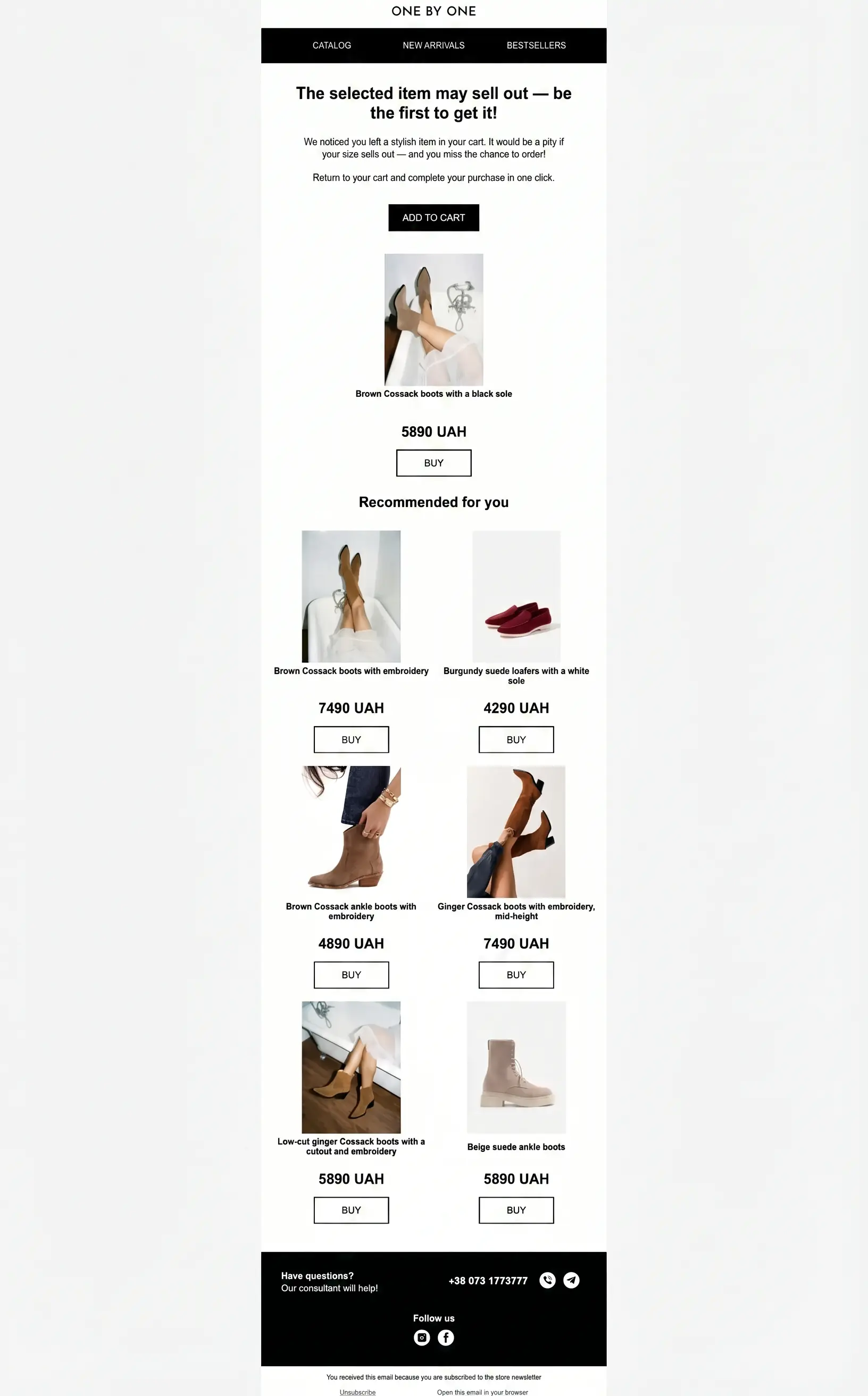
3. Key revenue flows were strengthened. Special attention was given to the highest-monetization triggers — "Abandoned Cart" and "Abandoned Browse." These were analyzed in detail, the email sequences were optimized, and the content was enhanced.
As a result, the brand had a strong retention marketing foundation. Only then did it make sense to integrate an additional channel — SMS — as a tool for targeted reinforcement.
I want to return my customers automatically
Where Revenue Was Being Lost
1. Complete dependency on email opens.
Email was the only touchpoint. If a user didn't open a message, the workflow essentially lost its effectiveness. In the fashion segment, this is critical — the audience doesn't spend much time in the inbox.
2. Missing high-intent moments.
Limited-time offers, final reminders, and sale campaigns require quick responses. If an email went unread in the first few hours, its value dropped sharply.
3. Unrealized revenue potential.
In some campaigns, the brand was losing 30–40% of potential revenue simply because part of the database wasn't engaging with email. It wasn't a lack of interest — it was a communication channel that didn't match the behavior of a certain segment.
Email was performing reliably, but it wasn't covering the full potential of the database. That became the foundation for a new strategy.
Building the Hypothesis: Why SMS
Having identified where users were dropping off, the marketers determined the right tool to strengthen communication. The hypothesis was that:
- SMS can act as an impulse trigger at moments of peak purchase intent
- the mobile format ensures a faster response — especially important in fashion, where decisions are emotionally driven
- the channel would be most effective in high-intent workflows, including sales campaigns, trigger sequences, and final reminders.
The guiding principle was not to duplicate email, but to build a cascading interaction model. SMS would appear only when email hadn't worked — serving as a shortcut to action.
The hypothesis looked logical, but proving it required precise execution: well-considered timing, correct segmentation, and behavior-based trigger logic. It was the systematic approach — not just the addition of a new channel — that would determine the outcome.
Implementation: How SMS Was Integrated
Rather than scaling SMS across all flows immediately, the marketers focused on the points where the audience shows the highest purchase intent. Two workflows were selected for testing:
- "Abandoned Cart"
- "Abandoned Browse"
These are precisely the moments where the purchase decision is either nearly made or at its final stage — meaning a minimal additional action can produce a maximum financial result.
Before the changes, the system looked like this:
- regular campaigns — email only;
- trigger workflows (including "Abandoned Cart" and "Abandoned Browse") — email only.
A portion of the audience was "dropping out" of the process due to behavioral factors: an overloaded inbox, an inconvenient time to check emails, or simply ignoring their mailbox. The team rebuilt the system into a cascading model. Using Yespo CDP's omnichannel capabilities, they implemented behavior-based workflow logic: tracked email engagement, automatically excluded users who had already responded, and activated SMS only for the relevant segment.
Yespo experts will analyze your communication channels for free and identify hidden growth opportunities
Interaction Logic
Email — the first touch. It creates demand, communicates value, and works for the brand.
SMS — the second level of contact. Messages were sent only to users who hadn't opened the email. SMS didn't repeat the email — it briefly focused attention on a single action: return to the cart, view the product, take advantage of the offer. It shortens the distance to purchase, captures a high-intent moment, and brings the "silent" segment back into the workflow.
The core principle was precision over volume. SMS was sent only when the user's behavior justified it.
In Yespo CDP, this enabled managing workflows at the condition level — not just sending messages on a timer, but also accounting for whether the user opened the email, whether they remained in the segment, and whether high purchase intent persisted. That precision was the foundation of the channel's effectiveness.
Where SMS Delivered the Greatest Impact
"Abandoned Cart" Workflow
The logic worked as follows:
- The user receives the first email.
- If the email hasn't been opened within 3–5 hours, SMS #1 is sent.
- The second and third emails are sent the following day.
- After the third email, engagement is checked again. If there were no opens, SMS #2 is sent.
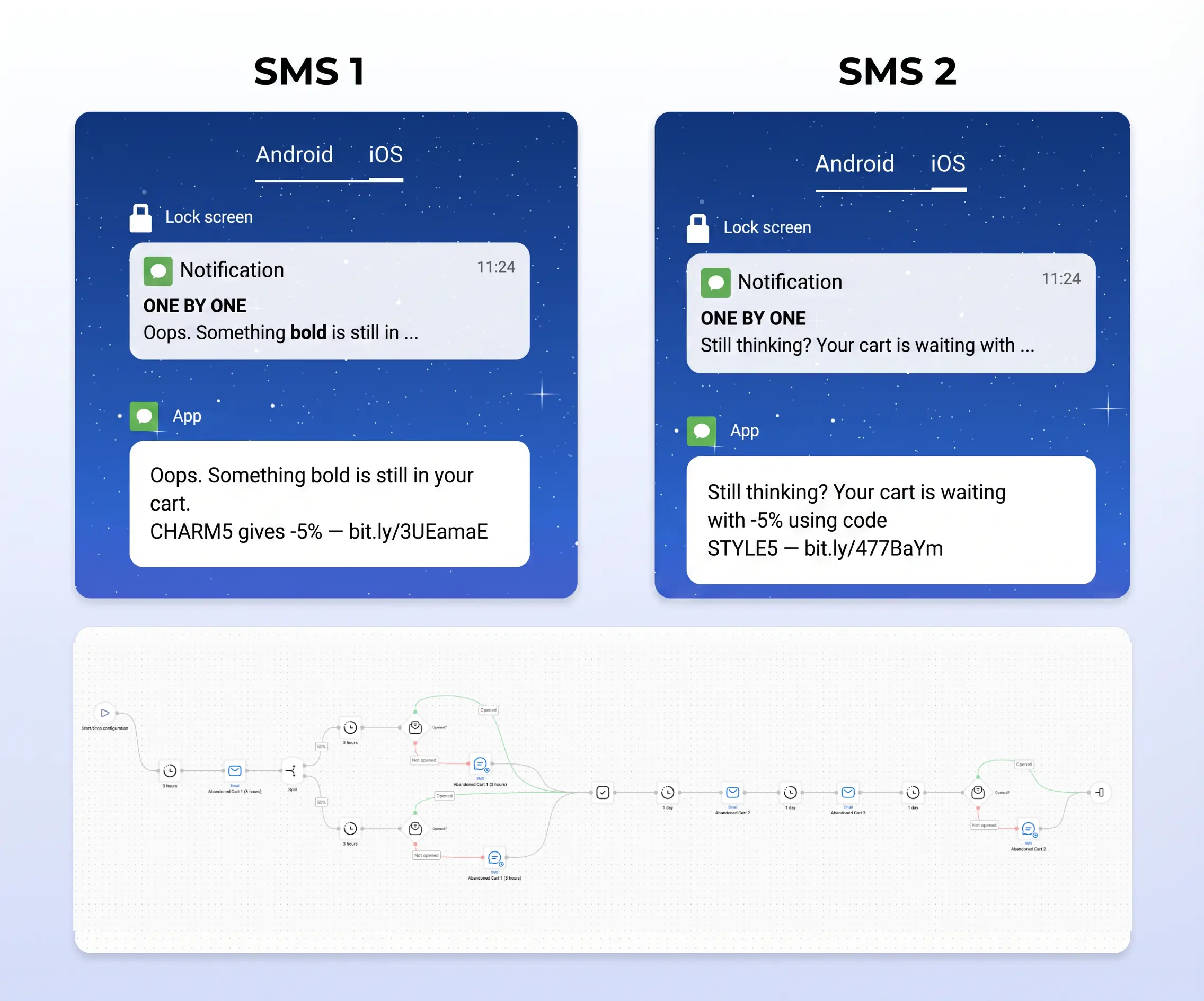
Thus, SMS became the final trigger. Not aggressive, but timely — at the moment when interest in the product is still there.
"Abandoned Browse" Workflow
The model was similar: SMS appeared only after the email and only for users who hadn't engaged with it.
The message didn't pressure — it reminded the user about the browsed product or category, bringing them back to the catalog.
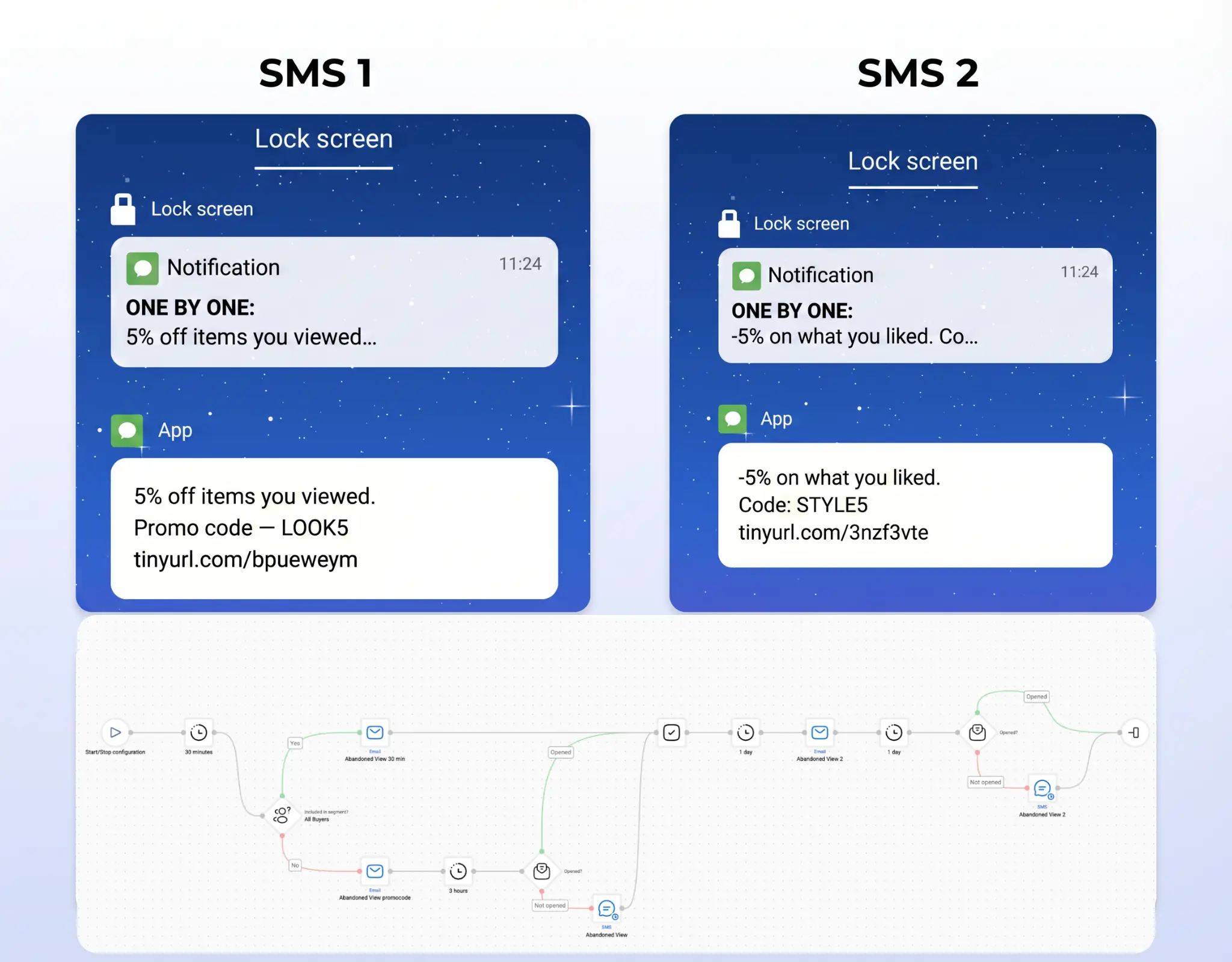
As a result, SMS didn't replace email — it became its continuation. The brand stopped depending on a single channel and gained the ability to reach customers where and when it was most relevant.
Results
After launching SMS across trigger workflows and regular campaigns, the team recorded the following results in the first month:
1. +35% to overall retention revenue with ROMI of 1,774%
Adding the mobile channel brought back users who hadn't been engaging with email. On average, each SMS sent generated around 0,34 EUR in revenue — delivering an almost 19x return on channel investment and an overall ROMI of 1,774%. SMS became a "second chance" tool that monetized an audience that had already shown interest but hadn't converted.
2. +57% revenue from the "Abandoned Cart" workflow
The highest impact was seen in the incomplete purchase flow. SMS sent as a final impulse shortened the distance between interest and action. Users received a brief reminder at the exact moment when purchase intent was still active — significantly increasing cart recovery and transaction completion rates.
3. +33% revenue from the "Abandoned Browse" workflow
Even an unobtrusive reminder about a browsed product or category acted as a catalyst for return visits. Many users are in a comparison stage — SMS helped bring them back to the catalog and continue their selection process, which ultimately led to purchases.
4. +77% growth in purchase conversion
The combination of rich email content and a short mobile trigger created a synergy effect. Email built interest and communicated value; SMS drove action. Together, the two channels performed significantly better than either did independently — reflected in a sharp rise in conversions.
5. +42% of the audience started engaging via SMS
The data confirmed that a significant portion of customers prefer quick mobile messages. They're not ignoring the brand — they simply respond to a different communication format. SMS became a touchpoint for the segment that had previously been beyond the reach of email.
It's worth emphasizing that these results were achieved without aggressive discounts or higher send frequency. The key was the configuration of omnichannel logic within Yespo CDP. Thanks to a unified customer profile, SMS didn't exist separately from email — it was part of the same workflow based on user behavior. This allowed the brand not to increase pressure on its database, but to make more precise use of every contact.
The fashion segment is particularly sensitive to the speed of decision-making: a customer may be ready to buy but easily distracted. A mobile message at the right moment acts as a final nudge that turns interest into a completed transaction.
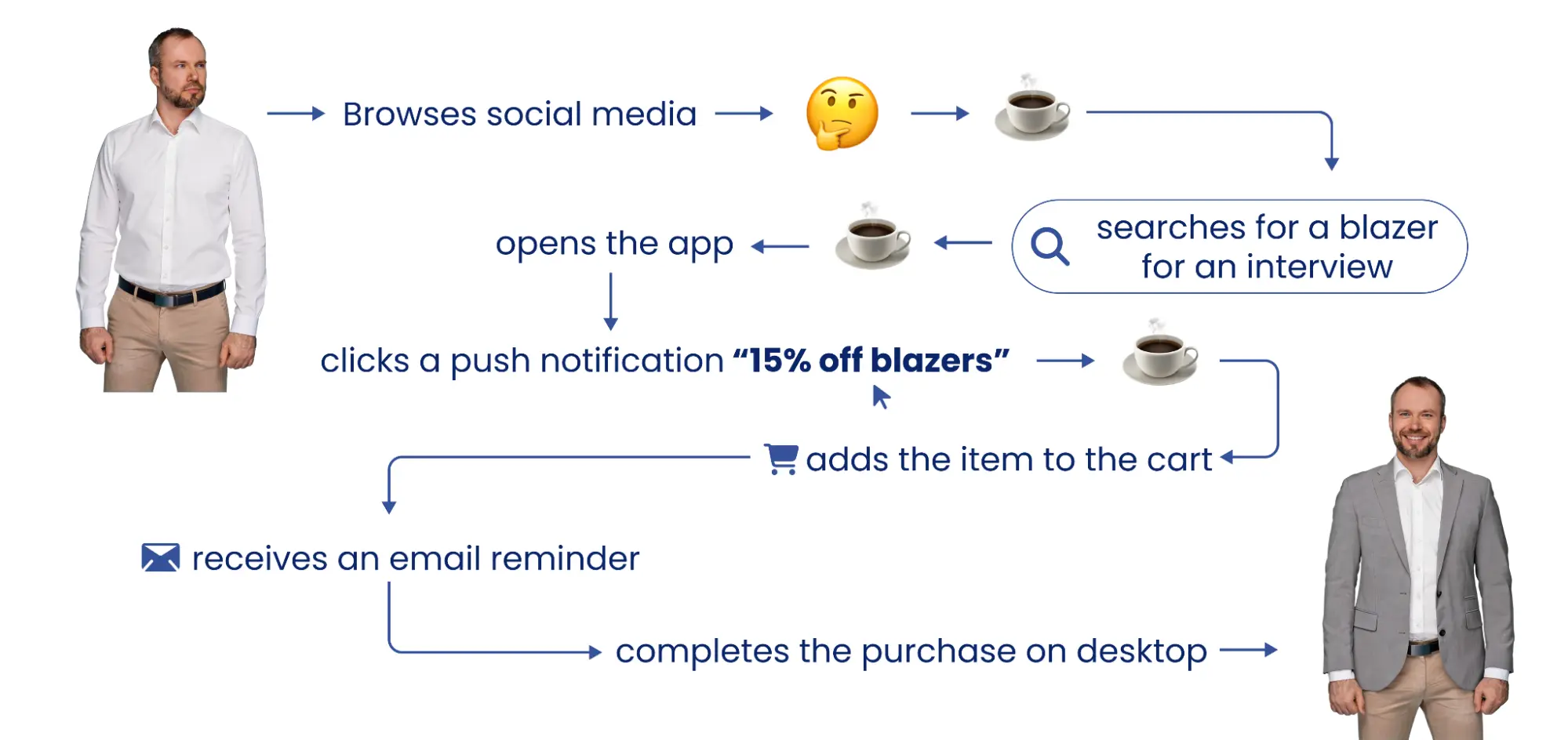
In the end, SMS didn't become just another "nice-to-have" channel — it became the tool that unlocked the hidden potential of the database and strengthened the overall effectiveness of the retention ecosystem.
Conclusion
Integrating SMS into One By One's holistic retention strategy allowed the brand to scale revenue without increasing pressure on its audience.
The core insight of this case is that true omnichannel isn't chaotic message duplication — it's a structured cascading logic. It allows you to reach the portion of customers who need fast, convenient communication but tend to ignore their inbox. In this approach, email remains the foundation that builds value, while SMS serves as the push toward a final action.
Want to find out what potential is hidden in your customer base? Book a free consultation — our experts will show you how to build a similar cascading model using Yespo CDP's omnichannel functionality and recover lost sales.